

162
CHAPTER 14. SOFT-MAGNETIC MATERIALS
thin films are currently indicated as materials giving rise to giant magnetoresistance (GMR)
effects.
In most applications of vertical magnetoresistive heads, one has
in the quiescent
the anisotropy field
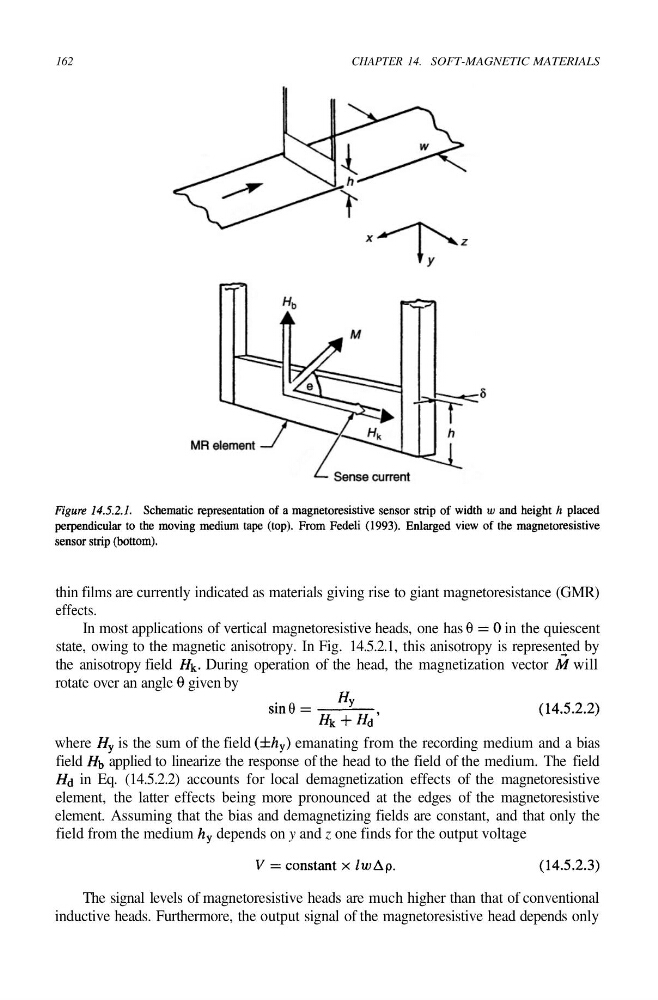
state, owing to the magnetic anisotropy. In Fig. 14.5.2.1, this anisotropy is represented by
During operation of the head, the magnetization vector
will
rotate over an angle given by
where
is the sum of the field
emanating from the recording medium and a bias
field
applied to linearize the response of the head to the field of the medium. The field
in Eq. (14.5.2.2) accounts for local demagnetization effects of the magnetoresistive
element, the latter effects being more pronounced at the edges of the magnetoresistive
element. Assuming that the bias and demagnetizing fields are constant, and that only the
field from the medium depends on y and z one finds for the output voltage
The signal levels of magnetoresistive heads are much higher than that of conventional
inductive heads. Furthermore, the output signal of the magnetoresistive head depends only
CHAPTER 14. SOFT-MAGNETIC MATERIALS
thin films are currently indicated as materials giving rise to giant magnetoresistance (GMR)
effects.
In most applications of vertical magnetoresistive heads, one has
in the quiescent
the anisotropy field
state, owing to the magnetic anisotropy. In Fig. 14.5.2.1, this anisotropy is represented by
During operation of the head, the magnetization vector
will
rotate over an angle given by
where
is the sum of the field
emanating from the recording medium and a bias
field
applied to linearize the response of the head to the field of the medium. The field
in Eq. (14.5.2.2) accounts for local demagnetization effects of the magnetoresistive
element, the latter effects being more pronounced at the edges of the magnetoresistive
element. Assuming that the bias and demagnetizing fields are constant, and that only the
field from the medium depends on y and z one finds for the output voltage
The signal levels of magnetoresistive heads are much higher than that of conventional
inductive heads. Furthermore, the output signal of the magnetoresistive head depends only