

158
CHAPTER 14. SOFT-MAGNETIC MATERIALS
magnetization direction can be optically distinguished from each other by using planepolarized light and a polarization microscope. High-resolution Kerr-effect studies made on
nanocrystalline
have confirmed the presence of very wide domain
walls of about
in thickness.
If there are no other forms of anisotropies present, both the coercivity and the initial
permeability depend on the randomized effective anisotropy constant
and are closely
related via Eqs. (14.1.1) and (14.1.2). It is important to realize that these relations normally
apply to magnetization processes governed by coherent magnetization rotation. According
to an argument given by Herzer (1996), these relations are also applicable to magnetization
processes proceeding by domain-wall displacements for cases in which
fact, on the scale of the nanocrystalline grains (10 nm), the magnetization vector appears
to rotate coherently if a domain wall with a width of
In
passes by.
14.4. DEPENDENCE OF SOFT-MAGNETIC PROPERTIES ON
GRAIN SIZE
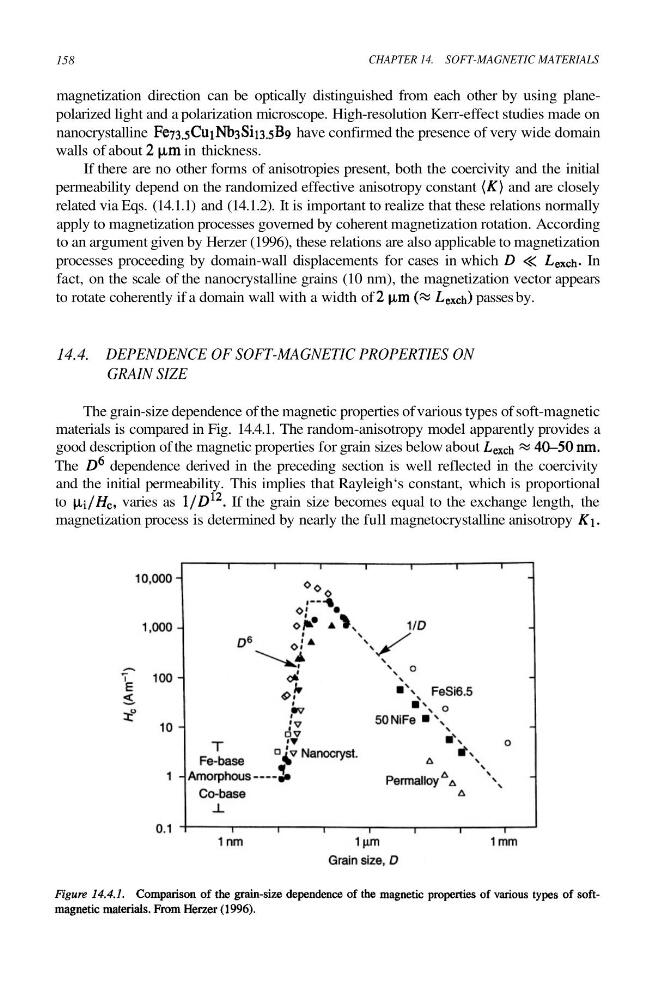
The grain-size dependence of the magnetic properties of various types of soft-magnetic
materials is compared in Fig. 14.4.1. The random-anisotropy model apparently provides a
good description of the magnetic properties for grain sizes below about
The
dependence derived in the preceding section is well reflected in the coercivity
and the initial permeability. This implies that Rayleigh‘s constant, which is proportional
to
varies as
If the grain size becomes equal to the exchange length, the
magnetization process is determined by nearly the full magnetocrystalline anisotropy
CHAPTER 14. SOFT-MAGNETIC MATERIALS
magnetization direction can be optically distinguished from each other by using planepolarized light and a polarization microscope. High-resolution Kerr-effect studies made on
nanocrystalline
have confirmed the presence of very wide domain
walls of about
in thickness.
If there are no other forms of anisotropies present, both the coercivity and the initial
permeability depend on the randomized effective anisotropy constant
and are closely
related via Eqs. (14.1.1) and (14.1.2). It is important to realize that these relations normally
apply to magnetization processes governed by coherent magnetization rotation. According
to an argument given by Herzer (1996), these relations are also applicable to magnetization
processes proceeding by domain-wall displacements for cases in which
fact, on the scale of the nanocrystalline grains (10 nm), the magnetization vector appears
to rotate coherently if a domain wall with a width of
In
passes by.
14.4. DEPENDENCE OF SOFT-MAGNETIC PROPERTIES ON
GRAIN SIZE
The grain-size dependence of the magnetic properties of various types of soft-magnetic
materials is compared in Fig. 14.4.1. The random-anisotropy model apparently provides a
good description of the magnetic properties for grain sizes below about
The
dependence derived in the preceding section is well reflected in the coercivity
and the initial permeability. This implies that Rayleigh‘s constant, which is proportional
to
varies as
If the grain size becomes equal to the exchange length, the
magnetization process is determined by nearly the full magnetocrystalline anisotropy