

141
SECTION 13.3. MATERIALS FOR HIGH-DENSITY MAGNETIC RECORDING
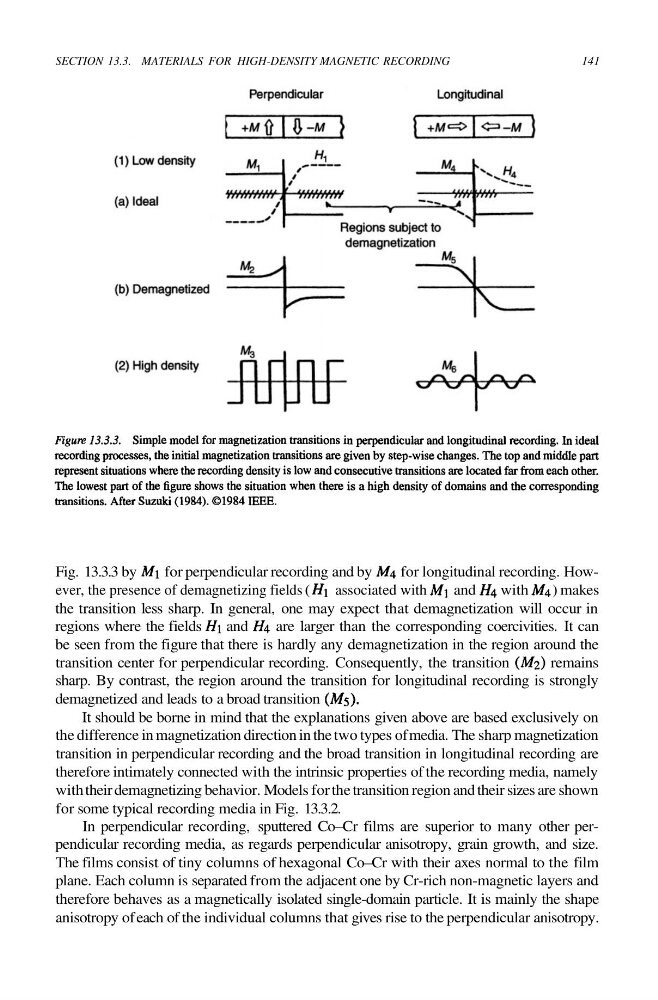
Fig. 13.3.3 by
for perpendicular recording and by
for longitudinal recording. However, the presence of demagnetizing fields (
associated with
and
with
) makes
the transition less sharp. In general, one may expect that demagnetization will occur in
regions where the fields
and
are larger than the corresponding coercivities. It can
be seen from the figure that there is hardly any demagnetization in the region around the
transition center for perpendicular recording. Consequently, the transition
remains
demagnetized and leads to a broad transition
sharp. By contrast, the region around the transition for longitudinal recording is strongly
It should be borne in mind that the explanations given above are based exclusively on
the difference in magnetization direction in the two types of media. The sharp magnetization
transition in perpendicular recording and the broad transition in longitudinal recording are
therefore intimately connected with the intrinsic properties of the recording media, namely
with their demagnetizing behavior. Models for the transition region and their sizes are shown
for some typical recording media in Fig. 13.3.2.
In perpendicular recording, sputtered Co–Cr films are superior to many other perpendicular recording media, as regards perpendicular anisotropy, grain growth, and size.
The films consist of tiny columns of hexagonal Co–Cr with their axes normal to the film
plane. Each column is separated from the adjacent one by Cr-rich non-magnetic layers and
therefore behaves as a magnetically isolated single-domain particle. It is mainly the shape
anisotropy of each of the individual columns that gives rise to the perpendicular anisotropy.
SECTION 13.3. MATERIALS FOR HIGH-DENSITY MAGNETIC RECORDING
Fig. 13.3.3 by
for perpendicular recording and by
for longitudinal recording. However, the presence of demagnetizing fields (
associated with
and
with
) makes
the transition less sharp. In general, one may expect that demagnetization will occur in
regions where the fields
and
are larger than the corresponding coercivities. It can
be seen from the figure that there is hardly any demagnetization in the region around the
transition center for perpendicular recording. Consequently, the transition
remains
demagnetized and leads to a broad transition
sharp. By contrast, the region around the transition for longitudinal recording is strongly
It should be borne in mind that the explanations given above are based exclusively on
the difference in magnetization direction in the two types of media. The sharp magnetization
transition in perpendicular recording and the broad transition in longitudinal recording are
therefore intimately connected with the intrinsic properties of the recording media, namely
with their demagnetizing behavior. Models for the transition region and their sizes are shown
for some typical recording media in Fig. 13.3.2.
In perpendicular recording, sputtered Co–Cr films are superior to many other perpendicular recording media, as regards perpendicular anisotropy, grain growth, and size.
The films consist of tiny columns of hexagonal Co–Cr with their axes normal to the film
plane. Each column is separated from the adjacent one by Cr-rich non-magnetic layers and
therefore behaves as a magnetically isolated single-domain particle. It is mainly the shape
anisotropy of each of the individual columns that gives rise to the perpendicular anisotropy.