

133
SECTION 13.2. MAGNETO-OPTICAL RECORDING MATERIALS
13.2. MAGNETO-OPTICAL RECORDING MATERIALS
An important group of magneto-optical recording media is based on amorphous alloys
of Gd–Fe or Gd–Co with some alloying additives to optimize the magnetic and magnetooptical properties.
The relative concentrations of rare-earth (R) and 3d elements are chosen in such a way
that the R-sublattice magnetization exceeds the 3d-sublattice magnetization at low temperatures. The exchange-coupling constants
responsible for the magnetic coupling
between the R moments and the 3d moments are negative, as in the case of crystalline
materials. The absolute values of these intersublattice-coupling constants are much smaller
than the 3d-intrasublattice-coupling constant
The R-intrasublattice-coupling
constant
is comparatively small and can be neglected in most cases. Using Eqs. (4.4.7)
and (4.4.9) and the fact that
one then finds that the 3d-sublattice moment is
coupled antiparallel to the R-sublattice moment if the R component belongs to the heavy-R
elements
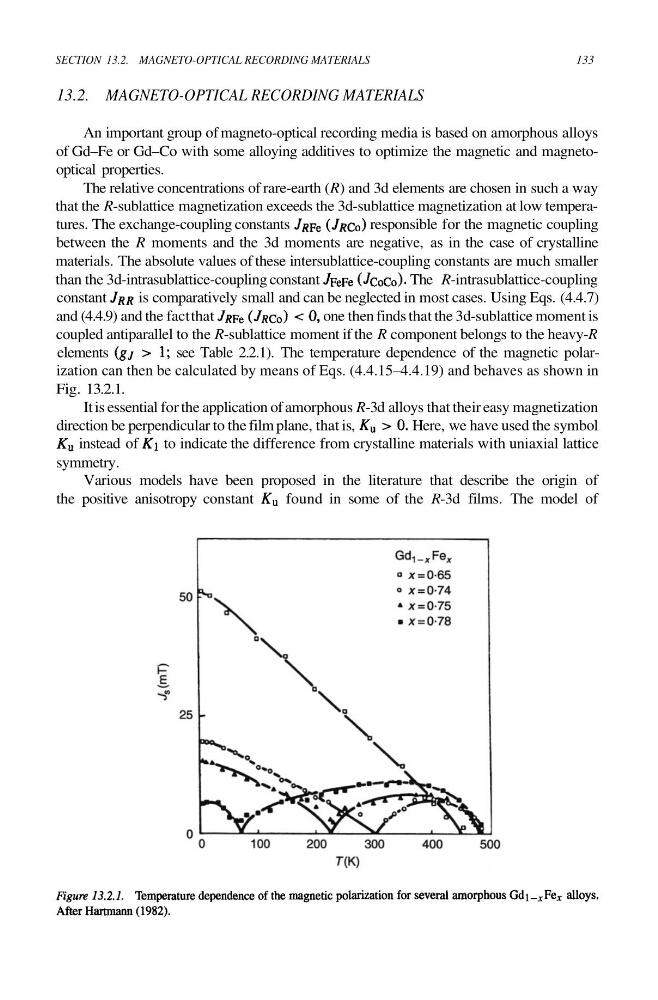
see Table 2.2.1). The temperature dependence of the magnetic polarization can then be calculated by means of Eqs. (4.4.15–4.4.19) and behaves as shown in
Fig. 13.2.1.
It is essential for the application of amorphous R-3d alloys that their easy magnetization
direction be perpendicular to the film plane, that is,
Here, we have used the symbol
instead of
to indicate the difference from crystalline materials with uniaxial lattice
symmetry.
Various models have been proposed in the literature that describe the origin of
the positive anisotropy constant
found in some of the R-3d films. The model of
SECTION 13.2. MAGNETO-OPTICAL RECORDING MATERIALS
13.2. MAGNETO-OPTICAL RECORDING MATERIALS
An important group of magneto-optical recording media is based on amorphous alloys
of Gd–Fe or Gd–Co with some alloying additives to optimize the magnetic and magnetooptical properties.
The relative concentrations of rare-earth (R) and 3d elements are chosen in such a way
that the R-sublattice magnetization exceeds the 3d-sublattice magnetization at low temperatures. The exchange-coupling constants
responsible for the magnetic coupling
between the R moments and the 3d moments are negative, as in the case of crystalline
materials. The absolute values of these intersublattice-coupling constants are much smaller
than the 3d-intrasublattice-coupling constant
The R-intrasublattice-coupling
constant
is comparatively small and can be neglected in most cases. Using Eqs. (4.4.7)
and (4.4.9) and the fact that
one then finds that the 3d-sublattice moment is
coupled antiparallel to the R-sublattice moment if the R component belongs to the heavy-R
elements
see Table 2.2.1). The temperature dependence of the magnetic polarization can then be calculated by means of Eqs. (4.4.15–4.4.19) and behaves as shown in
Fig. 13.2.1.
It is essential for the application of amorphous R-3d alloys that their easy magnetization
direction be perpendicular to the film plane, that is,
Here, we have used the symbol
instead of
to indicate the difference from crystalline materials with uniaxial lattice
symmetry.
Various models have been proposed in the literature that describe the origin of
the positive anisotropy constant
found in some of the R-3d films. The model of