

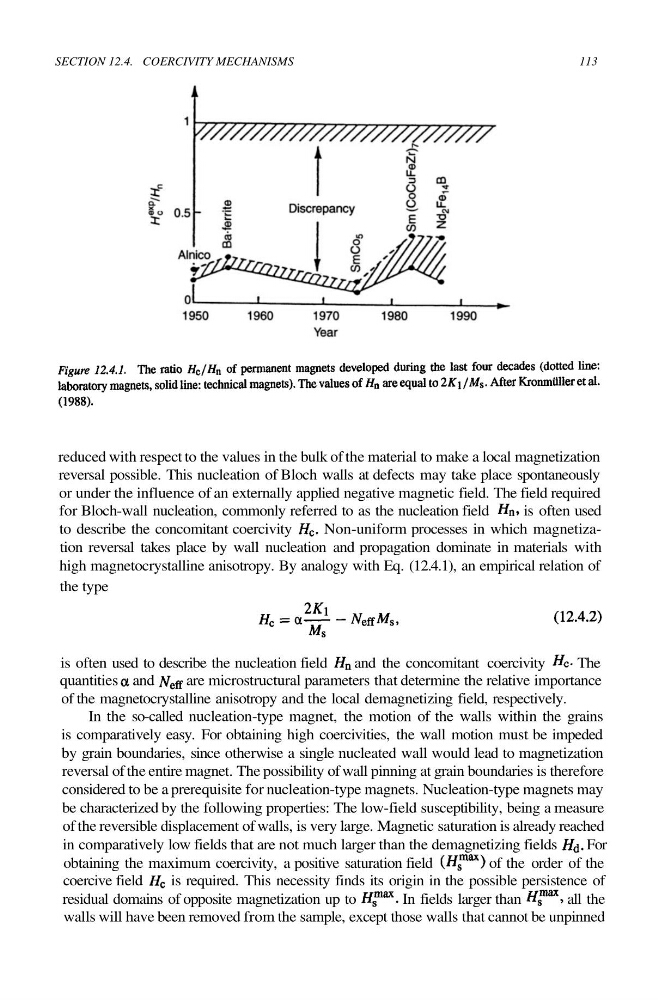
113
SECTION 12.4. COERCIVITY MECHANISMS
reduced with respect to the values in the bulk of the material to make a local magnetization
reversal possible. This nucleation of Bloch walls at defects may take place spontaneously
or under the influence of an externally applied negative magnetic field. The field required
for Bloch-wall nucleation, commonly referred to as the nucleation field
is often used
to describe the concomitant coercivity
Non-uniform processes in which magnetization reversal takes place by wall nucleation and propagation dominate in materials with
high magnetocrystalline anisotropy. By analogy with Eq. (12.4.1), an empirical relation of
the type
is often used to describe the nucleation field
and the concomitant coercivity
The
quantities and
are microstructural parameters that determine the relative importance
of the magnetocrystalline anisotropy and the local demagnetizing field, respectively.
In the so-called nucleation-type magnet, the motion of the walls within the grains
is comparatively easy. For obtaining high coercivities, the wall motion must be impeded
by grain boundaries, since otherwise a single nucleated wall would lead to magnetization
reversal of the entire magnet. The possibility of wall pinning at grain boundaries is therefore
considered to be a prerequisite for nucleation-type magnets. Nucleation-type magnets may
be characterized by the following properties: The low-field susceptibility, being a measure
of the reversible displacement of walls, is very large. Magnetic saturation is already reached
in comparatively low fields that are not much larger than the demagnetizing fields
For
obtaining the maximum coercivity, a positive saturation field
of the order of the
coercive field
is required. This necessity finds its origin in the possible persistence of
residual domains of opposite magnetization up to
In fields larger than
all the
walls will have been removed from the sample, except those walls that cannot be unpinned
SECTION 12.4. COERCIVITY MECHANISMS
reduced with respect to the values in the bulk of the material to make a local magnetization
reversal possible. This nucleation of Bloch walls at defects may take place spontaneously
or under the influence of an externally applied negative magnetic field. The field required
for Bloch-wall nucleation, commonly referred to as the nucleation field
is often used
to describe the concomitant coercivity
Non-uniform processes in which magnetization reversal takes place by wall nucleation and propagation dominate in materials with
high magnetocrystalline anisotropy. By analogy with Eq. (12.4.1), an empirical relation of
the type
is often used to describe the nucleation field
and the concomitant coercivity
The
quantities and
are microstructural parameters that determine the relative importance
of the magnetocrystalline anisotropy and the local demagnetizing field, respectively.
In the so-called nucleation-type magnet, the motion of the walls within the grains
is comparatively easy. For obtaining high coercivities, the wall motion must be impeded
by grain boundaries, since otherwise a single nucleated wall would lead to magnetization
reversal of the entire magnet. The possibility of wall pinning at grain boundaries is therefore
considered to be a prerequisite for nucleation-type magnets. Nucleation-type magnets may
be characterized by the following properties: The low-field susceptibility, being a measure
of the reversible displacement of walls, is very large. Magnetic saturation is already reached
in comparatively low fields that are not much larger than the demagnetizing fields
For
obtaining the maximum coercivity, a positive saturation field
of the order of the
coercive field
is required. This necessity finds its origin in the possible persistence of
residual domains of opposite magnetization up to
In fields larger than
all the
walls will have been removed from the sample, except those walls that cannot be unpinned