

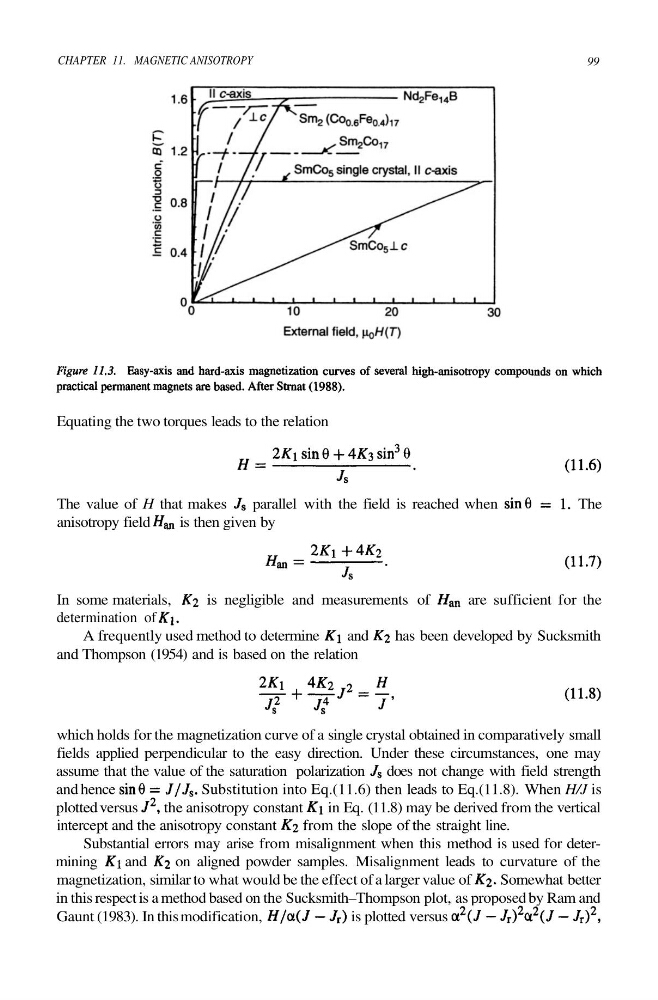
99
CHAPTER 11. MAGNETIC ANISOTROPY
Equating the two torques leads to the relation
The value of H that makes
parallel with the field is reached when
The
anisotropy field
is then given by
In some materials,
is negligible and measurements of
are sufficient for the
determination of
A frequently used method to determine
and
has been developed by Sucksmith
and Thompson (1954) and is based on the relation
which holds for the magnetization curve of a single crystal obtained in comparatively small
fields applied perpendicular to the easy direction. Under these circumstances, one may
assume that the value of the saturation polarization does not change with field strength
and hence
Substitution into Eq.(11.6) then leads to Eq.(11.8). When H/J is
plotted versus
the anisotropy constant
in Eq. (11.8) may be derived from the vertical
intercept and the anisotropy constant
from the slope of the straight line.
Substantial errors may arise from misalignment when this method is used for determining
and
on aligned powder samples. Misalignment leads to curvature of the
magnetization, similar to what would be the effect of a larger value of
Somewhat better
in this respect is a method based on the Sucksmith–Thompson plot, as proposed by Ram and
Gaunt (1983). In this modification,
is plotted versus
CHAPTER 11. MAGNETIC ANISOTROPY
Equating the two torques leads to the relation
The value of H that makes
parallel with the field is reached when
The
anisotropy field
is then given by
In some materials,
is negligible and measurements of
are sufficient for the
determination of
A frequently used method to determine
and
has been developed by Sucksmith
and Thompson (1954) and is based on the relation
which holds for the magnetization curve of a single crystal obtained in comparatively small
fields applied perpendicular to the easy direction. Under these circumstances, one may
assume that the value of the saturation polarization does not change with field strength
and hence
Substitution into Eq.(11.6) then leads to Eq.(11.8). When H/J is
plotted versus
the anisotropy constant
in Eq. (11.8) may be derived from the vertical
intercept and the anisotropy constant
from the slope of the straight line.
Substantial errors may arise from misalignment when this method is used for determining
and
on aligned powder samples. Misalignment leads to curvature of the
magnetization, similar to what would be the effect of a larger value of
Somewhat better
in this respect is a method based on the Sucksmith–Thompson plot, as proposed by Ram and
Gaunt (1983). In this modification,
is plotted versus