

3 Unmanned Aerial Vehicles for Environmental Monitoring …
37
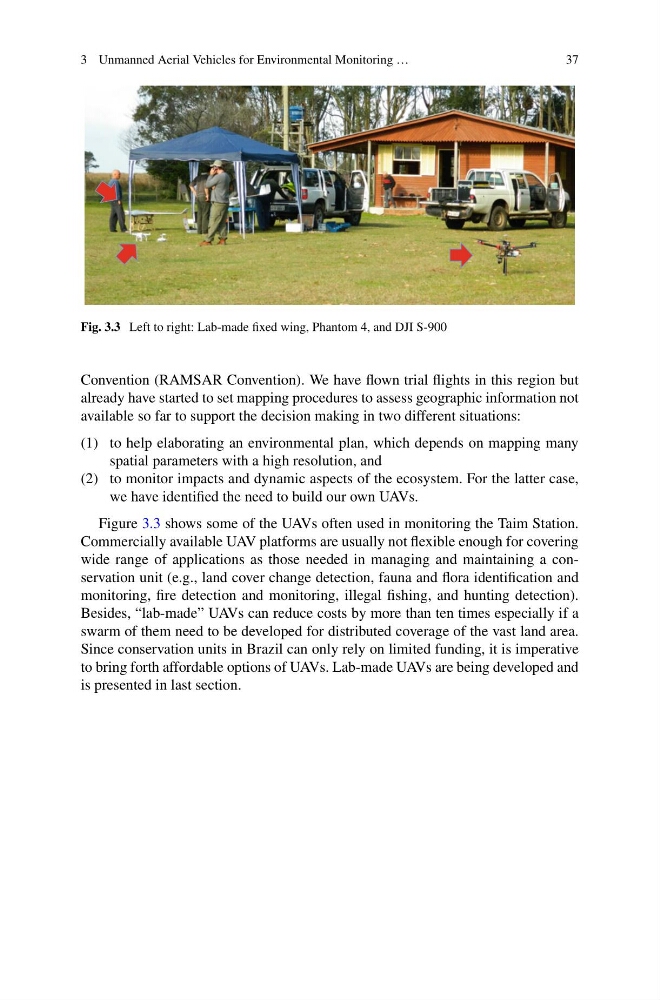
Fig. 3.3 Left to right: Lab-made fixed wing, Phantom 4, and DJI S-900
Convention (RAMSAR Convention). We have flown trial flights in this region but
already have started to set mapping procedures to assess geographic information not
available so far to support the decision making in two different situations:
(1) to help elaborating an environmental plan, which depends on mapping many
spatial parameters with a high resolution, and
(2) to monitor impacts and dynamic aspects of the ecosystem. For the latter case,
we have identified the need to build our own UAVs.
Figure 3.3 shows some of the UAVs often used in monitoring the Taim Station.
Commercially available UAV platforms are usually not flexible enough for covering
wide range of applications as those needed in managing and maintaining a conservation unit (e.g., land cover change detection, fauna and flora identification and
monitoring, fire detection and monitoring, illegal fishing, and hunting detection).
Besides, “lab-made” UAVs can reduce costs by more than ten times especially if a
swarm of them need to be developed for distributed coverage of the vast land area.
Since conservation units in Brazil can only rely on limited funding, it is imperative
to bring forth affordable options of UAVs. Lab-made UAVs are being developed and
is presented in last section.
37
Fig. 3.3 Left to right: Lab-made fixed wing, Phantom 4, and DJI S-900
Convention (RAMSAR Convention). We have flown trial flights in this region but
already have started to set mapping procedures to assess geographic information not
available so far to support the decision making in two different situations:
(1) to help elaborating an environmental plan, which depends on mapping many
spatial parameters with a high resolution, and
(2) to monitor impacts and dynamic aspects of the ecosystem. For the latter case,
we have identified the need to build our own UAVs.
Figure 3.3 shows some of the UAVs often used in monitoring the Taim Station.
Commercially available UAV platforms are usually not flexible enough for covering
wide range of applications as those needed in managing and maintaining a conservation unit (e.g., land cover change detection, fauna and flora identification and
monitoring, fire detection and monitoring, illegal fishing, and hunting detection).
Besides, “lab-made” UAVs can reduce costs by more than ten times especially if a
swarm of them need to be developed for distributed coverage of the vast land area.
Since conservation units in Brazil can only rely on limited funding, it is imperative
to bring forth affordable options of UAVs. Lab-made UAVs are being developed and
is presented in last section.