

160
S. Zekovi´ c et al.
Table 13.2 Preliminary assessment of differences between traditional and “alternative”/improved
approach to planning UMPs
Type of tools/instruments
Alternative approach
Traditional/conventional
approach
Transparency and public
participation in
decision-making
Increased, with bottom-up
approach
Mostly minor, with top-down
approach
Performance specification
Goal-driven approach
Technical
solution-based/driven
approach
Better regulatory framework
Improvement of regulatory
framework
Inversion between feasibility
study and choice of regulatory
regime (e.g., lex specialis
decreases the role of
feasibility study)
Pre-feasibility study
Required, independent
peer-review
Required, independent
peer-review is rarely done
Risk analysis
Inclusion of risks, acceptable
level of public risks
Ignores risks, unacceptable
level of public risks
regulatory framework, less use of private international risk capital, compilation of
pre-feasibility study and appraisals, public bid for possible involvement of the private
sector in financing the capital city infrastructure, and limitation of the state guarantee
to lenders for funding the UMPs, especially in joint projects. The improved approach
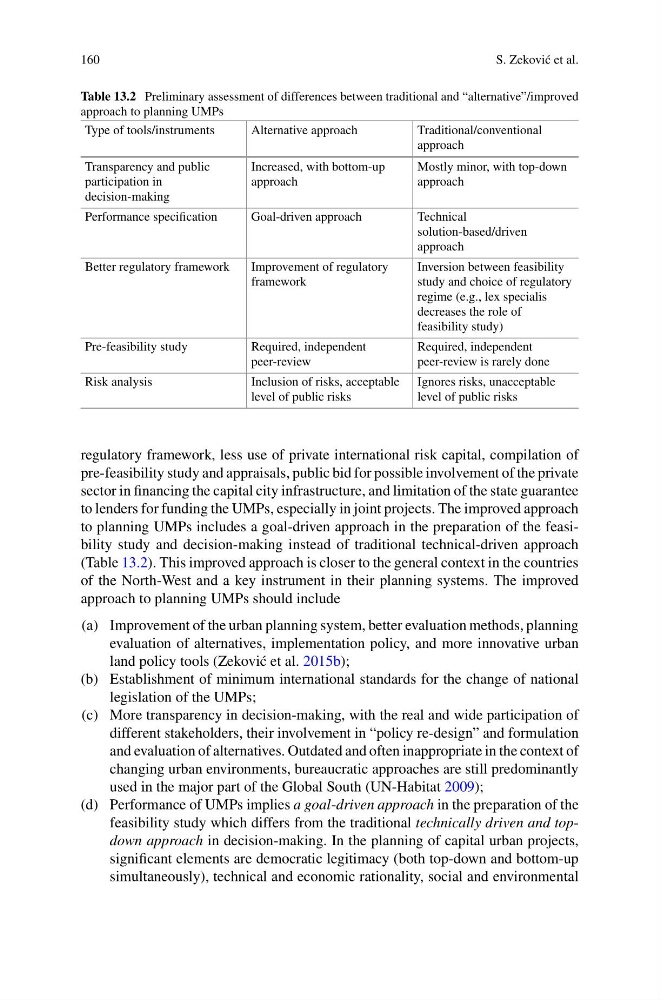
to planning UMPs includes a goal-driven approach in the preparation of the feasibility study and decision-making instead of traditional technical-driven approach
(Table 13.2). This improved approach is closer to the general context in the countries
of the North-West and a key instrument in their planning systems. The improved
approach to planning UMPs should include
(a) Improvement of the urban planning system, better evaluation methods, planning
evaluation of alternatives, implementation policy, and more innovative urban
land policy tools (Zekovi´ c et al. 2015b);
(b) Establishment of minimum international standards for the change of national
legislation of the UMPs;
(c) More transparency in decision-making, with the real and wide participation of
different stakeholders, their involvement in “policy re-design” and formulation
and evaluation of alternatives. Outdated and often inappropriate in the context of
changing urban environments, bureaucratic approaches are still predominantly
used in the major part of the Global South (UN-Habitat 2009);
(d) Performance of UMPs implies a goal-driven approach in the preparation of the
feasibility study which differs from the traditional technically driven and topdown approach in decision-making. In the planning of capital urban projects,
significant elements are democratic legitimacy (both top-down and bottom-up
simultaneously), technical and economic rationality, social and environmental
S. Zekovi´ c et al.
Table 13.2 Preliminary assessment of differences between traditional and “alternative”/improved
approach to planning UMPs
Type of tools/instruments
Alternative approach
Traditional/conventional
approach
Transparency and public
participation in
decision-making
Increased, with bottom-up
approach
Mostly minor, with top-down
approach
Performance specification
Goal-driven approach
Technical
solution-based/driven
approach
Better regulatory framework
Improvement of regulatory
framework
Inversion between feasibility
study and choice of regulatory
regime (e.g., lex specialis
decreases the role of
feasibility study)
Pre-feasibility study
Required, independent
peer-review
Required, independent
peer-review is rarely done
Risk analysis
Inclusion of risks, acceptable
level of public risks
Ignores risks, unacceptable
level of public risks
regulatory framework, less use of private international risk capital, compilation of
pre-feasibility study and appraisals, public bid for possible involvement of the private
sector in financing the capital city infrastructure, and limitation of the state guarantee
to lenders for funding the UMPs, especially in joint projects. The improved approach
to planning UMPs includes a goal-driven approach in the preparation of the feasibility study and decision-making instead of traditional technical-driven approach
(Table 13.2). This improved approach is closer to the general context in the countries
of the North-West and a key instrument in their planning systems. The improved
approach to planning UMPs should include
(a) Improvement of the urban planning system, better evaluation methods, planning
evaluation of alternatives, implementation policy, and more innovative urban
land policy tools (Zekovi´ c et al. 2015b);
(b) Establishment of minimum international standards for the change of national
legislation of the UMPs;
(c) More transparency in decision-making, with the real and wide participation of
different stakeholders, their involvement in “policy re-design” and formulation
and evaluation of alternatives. Outdated and often inappropriate in the context of
changing urban environments, bureaucratic approaches are still predominantly
used in the major part of the Global South (UN-Habitat 2009);
(d) Performance of UMPs implies a goal-driven approach in the preparation of the
feasibility study which differs from the traditional technically driven and topdown approach in decision-making. In the planning of capital urban projects,
significant elements are democratic legitimacy (both top-down and bottom-up
simultaneously), technical and economic rationality, social and environmental