

9 Developing a Low-Cost, Ultraportable, Modular …
101
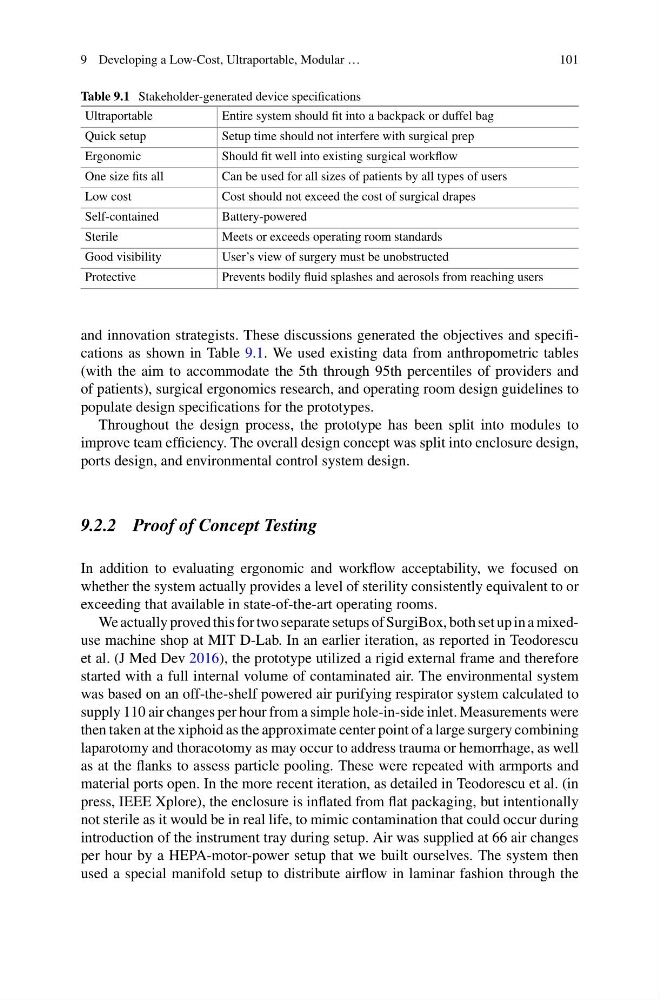
Table 9.1 Stakeholder-generated device specifications
Ultraportable
Entire system should fit into a backpack or duffel bag
Quick setup
Setup time should not interfere with surgical prep
Ergonomic
Should fit well into existing surgical workflow
One size fits all
Can be used for all sizes of patients by all types of users
Low cost
Cost should not exceed the cost of surgical drapes
Self-contained
Battery-powered
Sterile
Meets or exceeds operating room standards
Good visibility
User’s view of surgery must be unobstructed
Protective
Prevents bodily fluid splashes and aerosols from reaching users
and innovation strategists. These discussions generated the objectives and specifications as shown in Table 9.1. We used existing data from anthropometric tables
(with the aim to accommodate the 5th through 95th percentiles of providers and
of patients), surgical ergonomics research, and operating room design guidelines to
populate design specifications for the prototypes.
Throughout the design process, the prototype has been split into modules to
improve team efficiency. The overall design concept was split into enclosure design,
ports design, and environmental control system design.
9.2.2 Proof of Concept Testing
In addition to evaluating ergonomic and workflow acceptability, we focused on
whether the system actually provides a level of sterility consistently equivalent to or
exceeding that available in state-of-the-art operating rooms.
We actually proved this for two separate setups of SurgiBox, both set up in a mixeduse machine shop at MIT D-Lab. In an earlier iteration, as reported in Teodorescu
et al. (J Med Dev 2016), the prototype utilized a rigid external frame and therefore
started with a full internal volume of contaminated air. The environmental system
was based on an off-the-shelf powered air purifying respirator system calculated to
supply 110 air changes per hour from a simple hole-in-side inlet. Measurements were
then taken at the xiphoid as the approximate center point of a large surgery combining
laparotomy and thoracotomy as may occur to address trauma or hemorrhage, as well
as at the flanks to assess particle pooling. These were repeated with armports and
material ports open. In the more recent iteration, as detailed in Teodorescu et al. (in
press, IEEE Xplore), the enclosure is inflated from flat packaging, but intentionally
not sterile as it would be in real life, to mimic contamination that could occur during
introduction of the instrument tray during setup. Air was supplied at 66 air changes
per hour by a HEPA-motor-power setup that we built ourselves. The system then
used a special manifold setup to distribute airflow in laminar fashion through the
101
Table 9.1 Stakeholder-generated device specifications
Ultraportable
Entire system should fit into a backpack or duffel bag
Quick setup
Setup time should not interfere with surgical prep
Ergonomic
Should fit well into existing surgical workflow
One size fits all
Can be used for all sizes of patients by all types of users
Low cost
Cost should not exceed the cost of surgical drapes
Self-contained
Battery-powered
Sterile
Meets or exceeds operating room standards
Good visibility
User’s view of surgery must be unobstructed
Protective
Prevents bodily fluid splashes and aerosols from reaching users
and innovation strategists. These discussions generated the objectives and specifications as shown in Table 9.1. We used existing data from anthropometric tables
(with the aim to accommodate the 5th through 95th percentiles of providers and
of patients), surgical ergonomics research, and operating room design guidelines to
populate design specifications for the prototypes.
Throughout the design process, the prototype has been split into modules to
improve team efficiency. The overall design concept was split into enclosure design,
ports design, and environmental control system design.
9.2.2 Proof of Concept Testing
In addition to evaluating ergonomic and workflow acceptability, we focused on
whether the system actually provides a level of sterility consistently equivalent to or
exceeding that available in state-of-the-art operating rooms.
We actually proved this for two separate setups of SurgiBox, both set up in a mixeduse machine shop at MIT D-Lab. In an earlier iteration, as reported in Teodorescu
et al. (J Med Dev 2016), the prototype utilized a rigid external frame and therefore
started with a full internal volume of contaminated air. The environmental system
was based on an off-the-shelf powered air purifying respirator system calculated to
supply 110 air changes per hour from a simple hole-in-side inlet. Measurements were
then taken at the xiphoid as the approximate center point of a large surgery combining
laparotomy and thoracotomy as may occur to address trauma or hemorrhage, as well
as at the flanks to assess particle pooling. These were repeated with armports and
material ports open. In the more recent iteration, as detailed in Teodorescu et al. (in
press, IEEE Xplore), the enclosure is inflated from flat packaging, but intentionally
not sterile as it would be in real life, to mimic contamination that could occur during
introduction of the instrument tray during setup. Air was supplied at 66 air changes
per hour by a HEPA-motor-power setup that we built ourselves. The system then
used a special manifold setup to distribute airflow in laminar fashion through the