

Elements of Modern Physics
84
φ(x) = a sin (px + α)
(3.96)
p =
1
(2mE)
1/2
(3.97)
The wave function is zero for x < 0 or x > l since the potential is infinite in
this region. Since the potential jumps to infinity at x = 0 and x = l, the boundary
conditions as discussed in Sec. 3.7 are that the wave function should vanish at
x = 0 and x = l. This implies that
sin α = 0,
(3.98)
pl = nπ, n = 1, 2, ...
(3.99)
Therefore, the solutions are
φ n (x) =
1/ 2
2
sin
n x
l
l
π
, n = 1, 2, ...
(3.100)
E n =
2 2 2
2
2
n
ml
π
(3.101)
where a = (2/l)
1/2
has been used as required by the normalization condition in
Eq. (3.19)
2
2
0
| | sin
l
n
a
x d x
l
π
∫
= 1
(3.102)
Some of the significant points to note are as follows:
1. A state with n = 0 is not acceptable since this would correspond to a state
which is zero everywhere. The lowest energy state, called the ground
state, therefore corresponds to n = 1, and has a nonzero energy.
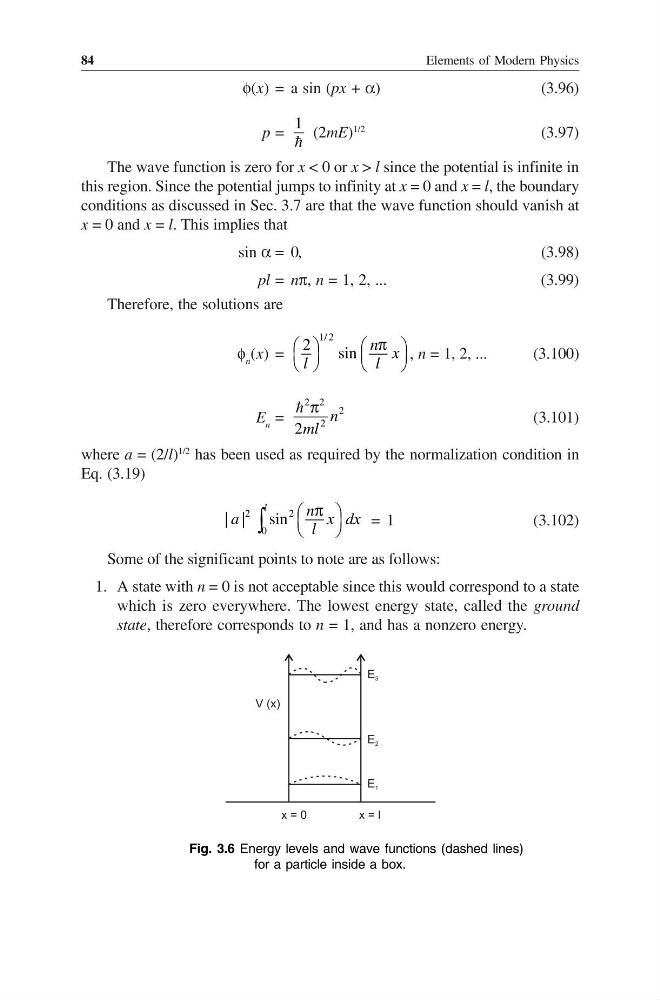
Fig. 3.6 Energy levels and wave functions (dashed lines)
for a particle inside a box.
84
φ(x) = a sin (px + α)
(3.96)
p =
1
(2mE)
1/2
(3.97)
The wave function is zero for x < 0 or x > l since the potential is infinite in
this region. Since the potential jumps to infinity at x = 0 and x = l, the boundary
conditions as discussed in Sec. 3.7 are that the wave function should vanish at
x = 0 and x = l. This implies that
sin α = 0,
(3.98)
pl = nπ, n = 1, 2, ...
(3.99)
Therefore, the solutions are
φ n (x) =
1/ 2
2
sin
n x
l
l
π
, n = 1, 2, ...
(3.100)
E n =
2 2 2
2
2
n
ml
π
(3.101)
where a = (2/l)
1/2
has been used as required by the normalization condition in
Eq. (3.19)
2
2
0
| | sin
l
n
a
x d x
l
π
∫
= 1
(3.102)
Some of the significant points to note are as follows:
1. A state with n = 0 is not acceptable since this would correspond to a state
which is zero everywhere. The lowest energy state, called the ground
state, therefore corresponds to n = 1, and has a nonzero energy.
Fig. 3.6 Energy levels and wave functions (dashed lines)
for a particle inside a box.