

Elements of Quantum Theory
79
2
2
2
( )
2
d
x
m dx
φ
−
= [E – V (x)] φ(x)
(3.72)
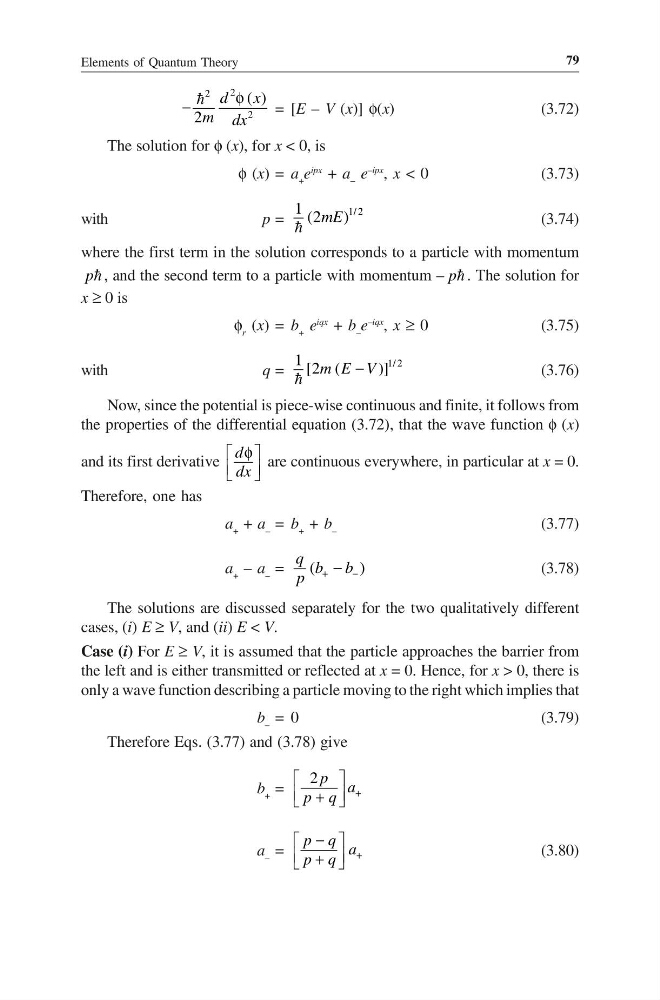
The solution for φ (x), for x < 0, is
φ (x) = a + e
ipx
+ a – e
–ipx
, x < 0
(3.73)
with
p =
1/ 2
1 (2 )
mE
(3.74)
where the first term in the solution corresponds to a particle with momentum
p , and the second term to a particle with momentum – p . The solution for
x ≥ 0 is
φ r (x) = b + e
iqx
+ b – e
–iqx
, x ≥ 0
(3.75)
with
q =
1/ 2
1 [2 (
)]
m E V
−
(3.76)
Now, since the potential is piece-wise continuous and finite, it follows from
the properties of the differential equation (3.72), that the wave function φ (x)
and its first derivative
d
dx
φ
are continuous everywhere, in particular at x = 0.
Therefore, one has
a + + a – = b + + b –
(3.77)
a + – a – =
(
)
q b b
p
+
−
−
(3.78)
The solutions are discussed separately for the two qualitatively different
cases, (i) E ≥ V, and (ii) E < V.
Case (i) For E ≥ V, it is assumed that the particle approaches the barrier from
the left and is either transmitted or reflected at x = 0. Hence, for x > 0, there is
only a wave function describing a particle moving to the right which implies that
b – = 0
(3.79)
Therefore Eqs. (3.77) and (3.78) give
b + =
2 p a
p q
+
+
a – =
p q a
p q
+
−
+
(3.80)
79
2
2
2
( )
2
d
x
m dx
φ
−
= [E – V (x)] φ(x)
(3.72)
The solution for φ (x), for x < 0, is
φ (x) = a + e
ipx
+ a – e
–ipx
, x < 0
(3.73)
with
p =
1/ 2
1 (2 )
mE
(3.74)
where the first term in the solution corresponds to a particle with momentum
p , and the second term to a particle with momentum – p . The solution for
x ≥ 0 is
φ r (x) = b + e
iqx
+ b – e
–iqx
, x ≥ 0
(3.75)
with
q =
1/ 2
1 [2 (
)]
m E V
−
(3.76)
Now, since the potential is piece-wise continuous and finite, it follows from
the properties of the differential equation (3.72), that the wave function φ (x)
and its first derivative
d
dx
φ
are continuous everywhere, in particular at x = 0.
Therefore, one has
a + + a – = b + + b –
(3.77)
a + – a – =
(
)
q b b
p
+
−
−
(3.78)
The solutions are discussed separately for the two qualitatively different
cases, (i) E ≥ V, and (ii) E < V.
Case (i) For E ≥ V, it is assumed that the particle approaches the barrier from
the left and is either transmitted or reflected at x = 0. Hence, for x > 0, there is
only a wave function describing a particle moving to the right which implies that
b – = 0
(3.79)
Therefore Eqs. (3.77) and (3.78) give
b + =
2 p a
p q
+
+
a – =
p q a
p q
+
−
+
(3.80)