

Introduction to Quantum Ideas
63
11. When an electron enters a crystal, it is accelerated towards the interior
because of an inner potential due to the positive charge of the ions in the
crystal. For an electron of speed u, and an inner potential V i volts show
that the bending of the electron beam on entering the crystal is described
by a refractive index µ = (1 + 2eV i /mu
2
)
1/2
. Show also that, in this case, the
Bragg relation is modified to read 2d (µ
2
– cos
2
θ)
1/2
= nλ.
12. Assume that a particle can be confined to a spherical volume only if its
circular orbit can be fitted with an integral multiple of de Broglie wavelengths. Estimate the minimum kinetic energy of a proton confined to a
nucleus of diameter 10
–14
m. What would be the kinetic energy of an
electron similarly confined?
13. Use the arguments of example 9 to obtain a rough estimation of the energy
levels of a 3-dimensional harmonic oscillator.
14. Calculate the distance of closest approach of a 5 MeV a particle in a
head-on collision with a gold nucleus. What is the upper bound of the
α-particle energy for which the Rutherford formula is expected to be
valid? Take the radius of the gold nucleus to be about 7 × 10
–15
m and that
of the α-particle to be about 2 × 10
–15
m.
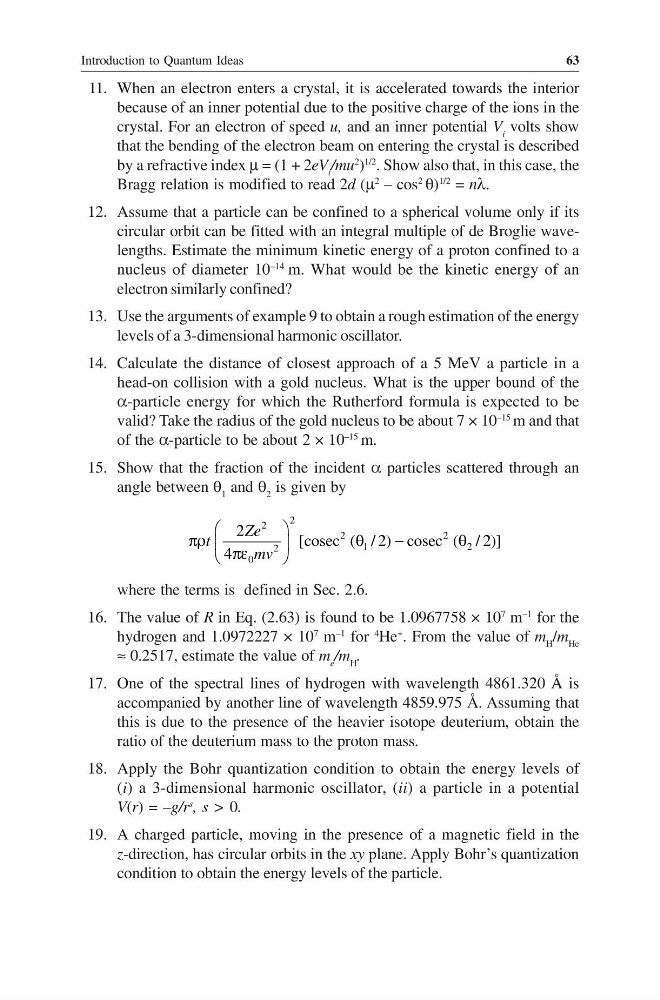
15. Show that the fraction of the incident α particles scattered through an
angle between θ 1 and θ 2 is given by
2
2
2
2
1
2
2
0
2
[cosec ( / 2) cosec ( / 2)]
4
πρ
θ
−
θ
πε
Ze
t
mv
where the terms is defined in Sec. 2.6.
16. The value of R in Eq. (2.63) is found to be 1.0967758 × 10
7
m
–1
for the
hydrogen and 1.0972227 × 10
7
m
–1
for
4
He
+
. From the value of m H /m He
≈ 0.2517, estimate the value of m e /m H .
17. One of the spectral lines of hydrogen with wavelength 4861.320 Å is
accompanied by another line of wavelength 4859.975 Å. Assuming that
this is due to the presence of the heavier isotope deuterium, obtain the
ratio of the deuterium mass to the proton mass.
18. Apply the Bohr quantization condition to obtain the energy levels of
(i) a 3-dimensional harmonic oscillator, (ii) a particle in a potential
V(r) = –g/r
s
, s > 0.
19. A charged particle, moving in the presence of a magnetic field in the
z-direction, has circular orbits in the xy plane. Apply Bohr’s quantization
condition to obtain the energy levels of the particle.
63
11. When an electron enters a crystal, it is accelerated towards the interior
because of an inner potential due to the positive charge of the ions in the
crystal. For an electron of speed u, and an inner potential V i volts show
that the bending of the electron beam on entering the crystal is described
by a refractive index µ = (1 + 2eV i /mu
2
)
1/2
. Show also that, in this case, the
Bragg relation is modified to read 2d (µ
2
– cos
2
θ)
1/2
= nλ.
12. Assume that a particle can be confined to a spherical volume only if its
circular orbit can be fitted with an integral multiple of de Broglie wavelengths. Estimate the minimum kinetic energy of a proton confined to a
nucleus of diameter 10
–14
m. What would be the kinetic energy of an
electron similarly confined?
13. Use the arguments of example 9 to obtain a rough estimation of the energy
levels of a 3-dimensional harmonic oscillator.
14. Calculate the distance of closest approach of a 5 MeV a particle in a
head-on collision with a gold nucleus. What is the upper bound of the
α-particle energy for which the Rutherford formula is expected to be
valid? Take the radius of the gold nucleus to be about 7 × 10
–15
m and that
of the α-particle to be about 2 × 10
–15
m.
15. Show that the fraction of the incident α particles scattered through an
angle between θ 1 and θ 2 is given by
2
2
2
2
1
2
2
0
2
[cosec ( / 2) cosec ( / 2)]
4
πρ
θ
−
θ
πε
Ze
t
mv
where the terms is defined in Sec. 2.6.
16. The value of R in Eq. (2.63) is found to be 1.0967758 × 10
7
m
–1
for the
hydrogen and 1.0972227 × 10
7
m
–1
for
4
He
+
. From the value of m H /m He
≈ 0.2517, estimate the value of m e /m H .
17. One of the spectral lines of hydrogen with wavelength 4861.320 Å is
accompanied by another line of wavelength 4859.975 Å. Assuming that
this is due to the presence of the heavier isotope deuterium, obtain the
ratio of the deuterium mass to the proton mass.
18. Apply the Bohr quantization condition to obtain the energy levels of
(i) a 3-dimensional harmonic oscillator, (ii) a particle in a potential
V(r) = –g/r
s
, s > 0.
19. A charged particle, moving in the presence of a magnetic field in the
z-direction, has circular orbits in the xy plane. Apply Bohr’s quantization
condition to obtain the energy levels of the particle.