

Elements of Modern Physics
54
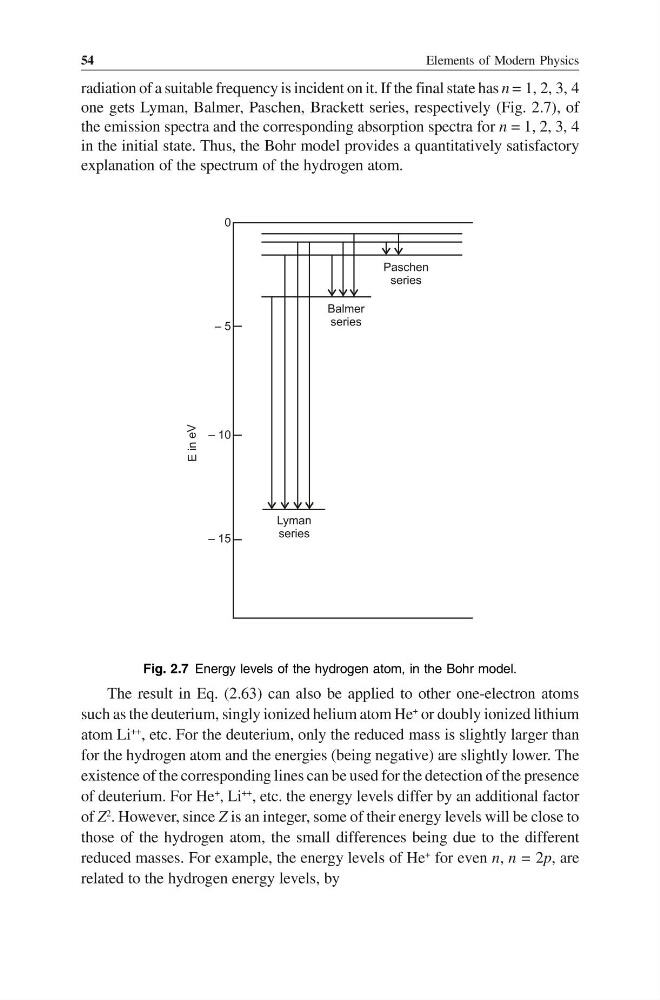
radiation of a suitable frequency is incident on it. If the final state has n = 1, 2, 3, 4
one gets Lyman, Balmer, Paschen, Brackett series, respectively (Fig. 2.7), of
the emission spectra and the corresponding absorption spectra for n = 1, 2, 3, 4
in the initial state. Thus, the Bohr model provides a quantitatively satisfactory
explanation of the spectrum of the hydrogen atom.
Fig. 2.7 Energy levels of the hydrogen atom, in the Bohr model.
The result in Eq. (2.63) can also be applied to other one-electron atoms
such as the deuterium, singly ionized helium atom He
+
or doubly ionized lithium
atom Li
++
, etc. For the deuterium, only the reduced mass is slightly larger than
for the hydrogen atom and the energies (being negative) are slightly lower. The
existence of the corresponding lines can be used for the detection of the presence
of deuterium. For He
+
, Li
++
, etc. the energy levels differ by an additional factor
of Z
2
. However, since Z is an integer, some of their energy levels will be close to
those of the hydrogen atom, the small differences being due to the different
reduced masses. For example, the energy levels of He
+
for even n, n = 2p, are
related to the hydrogen energy levels, by
54
radiation of a suitable frequency is incident on it. If the final state has n = 1, 2, 3, 4
one gets Lyman, Balmer, Paschen, Brackett series, respectively (Fig. 2.7), of
the emission spectra and the corresponding absorption spectra for n = 1, 2, 3, 4
in the initial state. Thus, the Bohr model provides a quantitatively satisfactory
explanation of the spectrum of the hydrogen atom.
Fig. 2.7 Energy levels of the hydrogen atom, in the Bohr model.
The result in Eq. (2.63) can also be applied to other one-electron atoms
such as the deuterium, singly ionized helium atom He
+
or doubly ionized lithium
atom Li
++
, etc. For the deuterium, only the reduced mass is slightly larger than
for the hydrogen atom and the energies (being negative) are slightly lower. The
existence of the corresponding lines can be used for the detection of the presence
of deuterium. For He
+
, Li
++
, etc. the energy levels differ by an additional factor
of Z
2
. However, since Z is an integer, some of their energy levels will be close to
those of the hydrogen atom, the small differences being due to the different
reduced masses. For example, the energy levels of He
+
for even n, n = 2p, are
related to the hydrogen energy levels, by