

Elements of Modern Physics
52
applicable to the motion of an electron around the nucleus. The modifications
are introdued in the form of the following postulates:
1. Electrons that are bound to the nucleus can move around in only certain
discrete orbits. While in these orbits the electrons do not emit
electromagnetic radiation, though the motion is accelerated.
2. For circular motion, the allowed orbits are determined by the quantum
condition that the angular momentum is n where = h/2π, h being
Planck’s constant, and n can take positive integral values, n = 1, 2, ... .
3. Emission or absorption of radiation occurs only when an electron undergoes
transition from one allowed orbit to another. The frequency of the radiation
emitted or absorbed is given by the relations hν = E i –E f for emission and
hν = E f – E i for absorption E f and E t being the energies associated with the
final and initial orbits.
These postulates are quite ad hoc but are justified by the impressive
agreement of the predictions with the experimental observations.
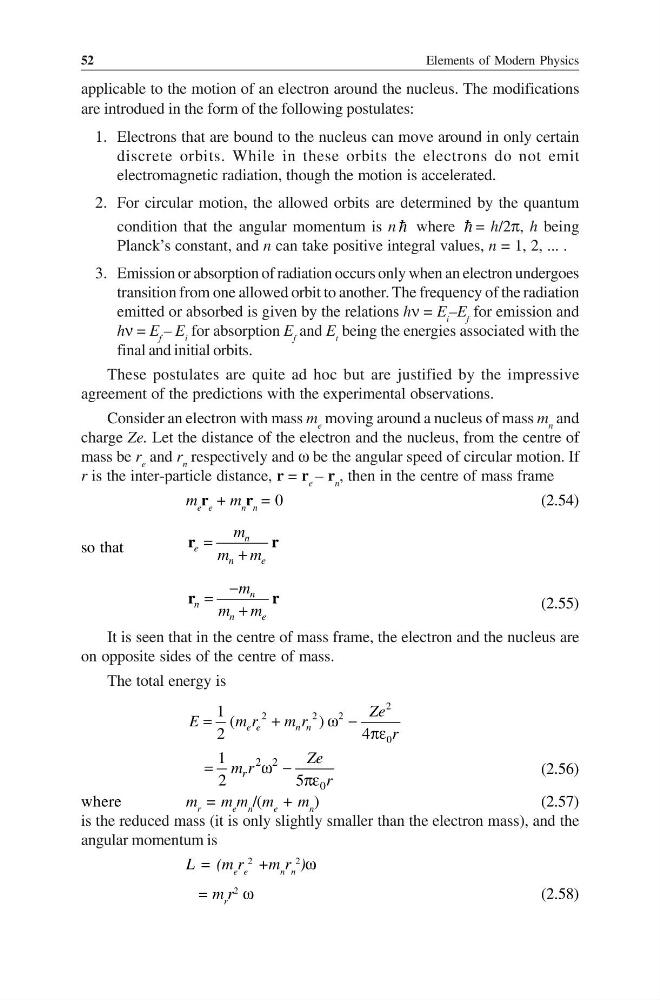
Consider an electron with mass m e moving around a nucleus of mass m n and
charge Ze. Let the distance of the electron and the nucleus, from the centre of
mass be r e and r n respectively and ω be the angular speed of circular motion. If
r is the inter-particle distance, r = r e – r n , then in the centre of mass frame
m e r e + m n r n = 0
(2.54)
so that
=
+
n
e
n
e
m
m m
r
r
−
=
+
n
n
n
e
m
m m
r
r
(2.55)
It is seen that in the centre of mass frame, the electron and the nucleus are
on opposite sides of the centre of mass.
The total energy is
2
2
2
2
0
1 (
)
2
4
e e
n n
Ze
E
mr
m r
r
=
+
ω − πε
2 2
0
1
2
5
=
ω − πε
r
Ze
m r
r
(2.56)
where
m r = m e m n /(m e + m n )
(2.57)
is the reduced mass (it is only slightly smaller than the electron mass), and the
angular momentum is
L = (m e r e
2
+m n r n
2
)ω
= m r r
2
ω
(2.58)
52
applicable to the motion of an electron around the nucleus. The modifications
are introdued in the form of the following postulates:
1. Electrons that are bound to the nucleus can move around in only certain
discrete orbits. While in these orbits the electrons do not emit
electromagnetic radiation, though the motion is accelerated.
2. For circular motion, the allowed orbits are determined by the quantum
condition that the angular momentum is n where = h/2π, h being
Planck’s constant, and n can take positive integral values, n = 1, 2, ... .
3. Emission or absorption of radiation occurs only when an electron undergoes
transition from one allowed orbit to another. The frequency of the radiation
emitted or absorbed is given by the relations hν = E i –E f for emission and
hν = E f – E i for absorption E f and E t being the energies associated with the
final and initial orbits.
These postulates are quite ad hoc but are justified by the impressive
agreement of the predictions with the experimental observations.
Consider an electron with mass m e moving around a nucleus of mass m n and
charge Ze. Let the distance of the electron and the nucleus, from the centre of
mass be r e and r n respectively and ω be the angular speed of circular motion. If
r is the inter-particle distance, r = r e – r n , then in the centre of mass frame
m e r e + m n r n = 0
(2.54)
so that
=
+
n
e
n
e
m
m m
r
r
−
=
+
n
n
n
e
m
m m
r
r
(2.55)
It is seen that in the centre of mass frame, the electron and the nucleus are
on opposite sides of the centre of mass.
The total energy is
2
2
2
2
0
1 (
)
2
4
e e
n n
Ze
E
mr
m r
r
=
+
ω − πε
2 2
0
1
2
5
=
ω − πε
r
Ze
m r
r
(2.56)
where
m r = m e m n /(m e + m n )
(2.57)
is the reduced mass (it is only slightly smaller than the electron mass), and the
angular momentum is
L = (m e r e
2
+m n r n
2
)ω
= m r r
2
ω
(2.58)