

Elements of Modern Physics
46
and the difficulty of detecting neutrons which are electrically neutral. They
are usually detected by the α particle emitted through their reaction with
boron nuclei.
2.5 ATOMIC SPECTRA
De Broglie’s idea allows us to discuss both radiation and particles such as
electrons, in a unified manner. They behave like particles in the sense that they
have discrete energy and momentum, and yet are diffracted as waves. In this
respect, there is no qualitative difference between photons which have vanishing
mass and particles such as electrons, neutron and proton which have nonvanishing
mass (there are subtle differences, however). Now, for radiation inside a box,
one has stationary waves with discrete frequencies, and the corresponding photons
have discrete energies. It might then be expected that particles such as electrons
also have discrete energies if they are confined to a finite volume. Such a situation
is simulated by an electron which is bound inside an atom, and the atomic spectra
do indicate that the electron indeed has discrete energies.
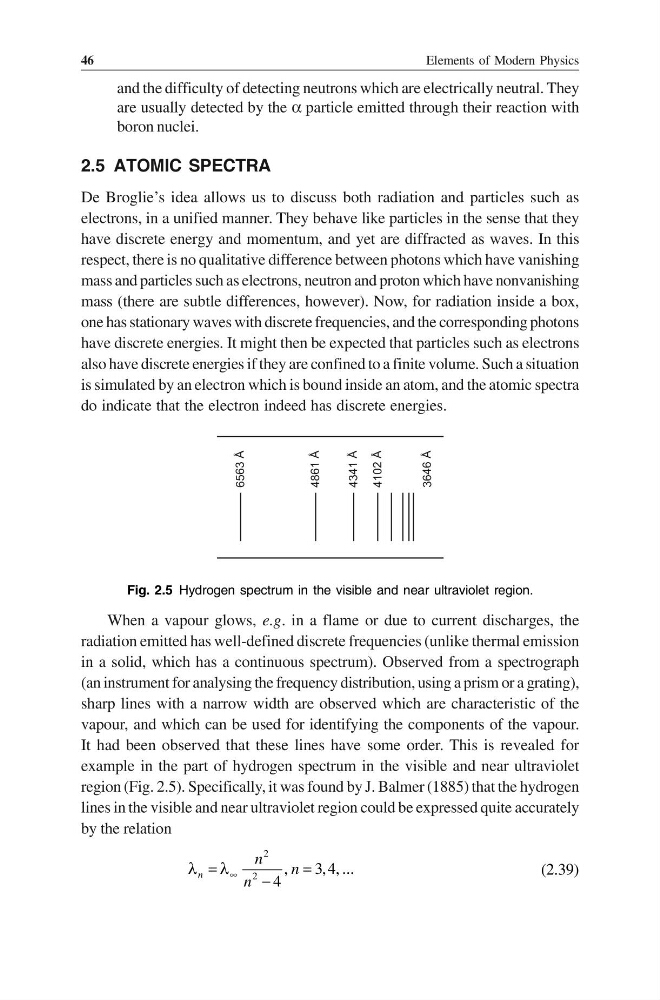
Fig. 2.5 Hydrogen spectrum in the visible and near ultraviolet region.
When a vapour glows, e.g. in a flame or due to current discharges, the
radiation emitted has well-defined discrete frequencies (unlike thermal emission
in a solid, which has a continuous spectrum). Observed from a spectrograph
(an instrument for analysing the frequency distribution, using a prism or a grating),
sharp lines with a narrow width are observed which are characteristic of the
vapour, and which can be used for identifying the components of the vapour.
It had been observed that these lines have some order. This is revealed for
example in the part of hydrogen spectrum in the visible and near ultraviolet
region (Fig. 2.5). Specifically, it was found by J. Balmer (1885) that the hydrogen
lines in the visible and near ultraviolet region could be expressed quite accurately
by the relation
2
2
,
3, 4, ...
4
n
n
n
n
∞
λ = λ
=
−
(2.39)
46
and the difficulty of detecting neutrons which are electrically neutral. They
are usually detected by the α particle emitted through their reaction with
boron nuclei.
2.5 ATOMIC SPECTRA
De Broglie’s idea allows us to discuss both radiation and particles such as
electrons, in a unified manner. They behave like particles in the sense that they
have discrete energy and momentum, and yet are diffracted as waves. In this
respect, there is no qualitative difference between photons which have vanishing
mass and particles such as electrons, neutron and proton which have nonvanishing
mass (there are subtle differences, however). Now, for radiation inside a box,
one has stationary waves with discrete frequencies, and the corresponding photons
have discrete energies. It might then be expected that particles such as electrons
also have discrete energies if they are confined to a finite volume. Such a situation
is simulated by an electron which is bound inside an atom, and the atomic spectra
do indicate that the electron indeed has discrete energies.
Fig. 2.5 Hydrogen spectrum in the visible and near ultraviolet region.
When a vapour glows, e.g. in a flame or due to current discharges, the
radiation emitted has well-defined discrete frequencies (unlike thermal emission
in a solid, which has a continuous spectrum). Observed from a spectrograph
(an instrument for analysing the frequency distribution, using a prism or a grating),
sharp lines with a narrow width are observed which are characteristic of the
vapour, and which can be used for identifying the components of the vapour.
It had been observed that these lines have some order. This is revealed for
example in the part of hydrogen spectrum in the visible and near ultraviolet
region (Fig. 2.5). Specifically, it was found by J. Balmer (1885) that the hydrogen
lines in the visible and near ultraviolet region could be expressed quite accurately
by the relation
2
2
,
3, 4, ...
4
n
n
n
n
∞
λ = λ
=
−
(2.39)