

General Relativity and Cosmology
407
σ = r/R(t)
(11.60)
in terms of which the separation between fundamental observers does not change
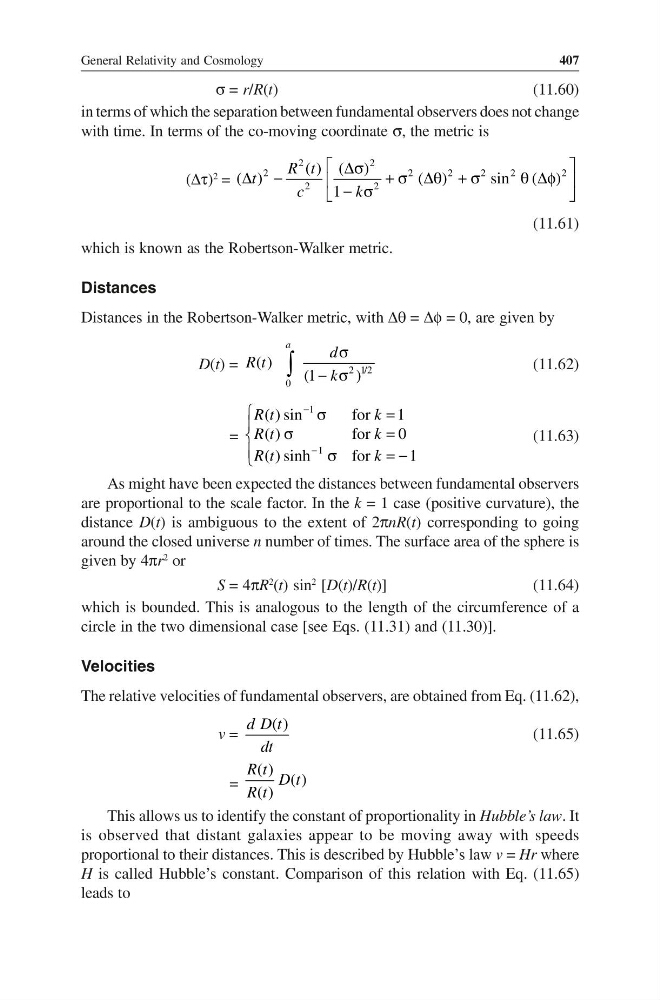
with time. In terms of the co-moving coordinate σ, the metric is
(∆τ)
2
=
2
2
2
2
2
2
2
2
2
2
( ) ( )
( )
( )
sin ( )
1
R t
t
c
k
∆σ
∆ −
+ σ ∆θ + σ
θ ∆φ
− σ
(11.61)
which is known as the Robertson-Walker metric.
Distances
Distances in the Robertson-Walker metric, with ∆θ = ∆φ = 0, are given by
D(t) =
2 1/2
0
( )
(1
)
a
d
R t
k
σ
− σ
∫
(11.62)
=
1
1
( ) sin
for
1
( )
for
0
( ) sinh
for
1
R t
k
R t
k
R t
k
−
−
σ
=
σ
=
σ
=−
(11.63)
As might have been expected the distances between fundamental observers
are proportional to the scale factor. In the k = 1 case (positive curvature), the
distance D(t) is ambiguous to the extent of 2πnR(t) corresponding to going
around the closed universe n number of times. The surface area of the sphere is
given by 4πr
2
or
S = 4πR
2
(t) sin
2
[D(t)/R(t)]
(11.64)
which is bounded. This is analogous to the length of the circumference of a
circle in the two dimensional case [see Eqs. (11.31) and (11.30)].
Velocities
The relative velocities of fundamental observers, are obtained from Eq. (11.62),
v =
( )
d D t
dt
(11.65)
=
( ) ( )
( )
R t D t
R t
This allows us to identify the constant of proportionality in Hubble’s law. It
is observed that distant galaxies appear to be moving away with speeds
proportional to their distances. This is described by Hubble’s law v = Hr where
H is called Hubble’s constant. Comparison of this relation with Eq. (11.65)
leads to
407
σ = r/R(t)
(11.60)
in terms of which the separation between fundamental observers does not change
with time. In terms of the co-moving coordinate σ, the metric is
(∆τ)
2
=
2
2
2
2
2
2
2
2
2
2
( ) ( )
( )
( )
sin ( )
1
R t
t
c
k
∆σ
∆ −
+ σ ∆θ + σ
θ ∆φ
− σ
(11.61)
which is known as the Robertson-Walker metric.
Distances
Distances in the Robertson-Walker metric, with ∆θ = ∆φ = 0, are given by
D(t) =
2 1/2
0
( )
(1
)
a
d
R t
k
σ
− σ
∫
(11.62)
=
1
1
( ) sin
for
1
( )
for
0
( ) sinh
for
1
R t
k
R t
k
R t
k
−
−
σ
=
σ
=
σ
=−
(11.63)
As might have been expected the distances between fundamental observers
are proportional to the scale factor. In the k = 1 case (positive curvature), the
distance D(t) is ambiguous to the extent of 2πnR(t) corresponding to going
around the closed universe n number of times. The surface area of the sphere is
given by 4πr
2
or
S = 4πR
2
(t) sin
2
[D(t)/R(t)]
(11.64)
which is bounded. This is analogous to the length of the circumference of a
circle in the two dimensional case [see Eqs. (11.31) and (11.30)].
Velocities
The relative velocities of fundamental observers, are obtained from Eq. (11.62),
v =
( )
d D t
dt
(11.65)
=
( ) ( )
( )
R t D t
R t
This allows us to identify the constant of proportionality in Hubble’s law. It
is observed that distant galaxies appear to be moving away with speeds
proportional to their distances. This is described by Hubble’s law v = Hr where
H is called Hubble’s constant. Comparison of this relation with Eq. (11.65)
leads to