

Elementary Particles
389
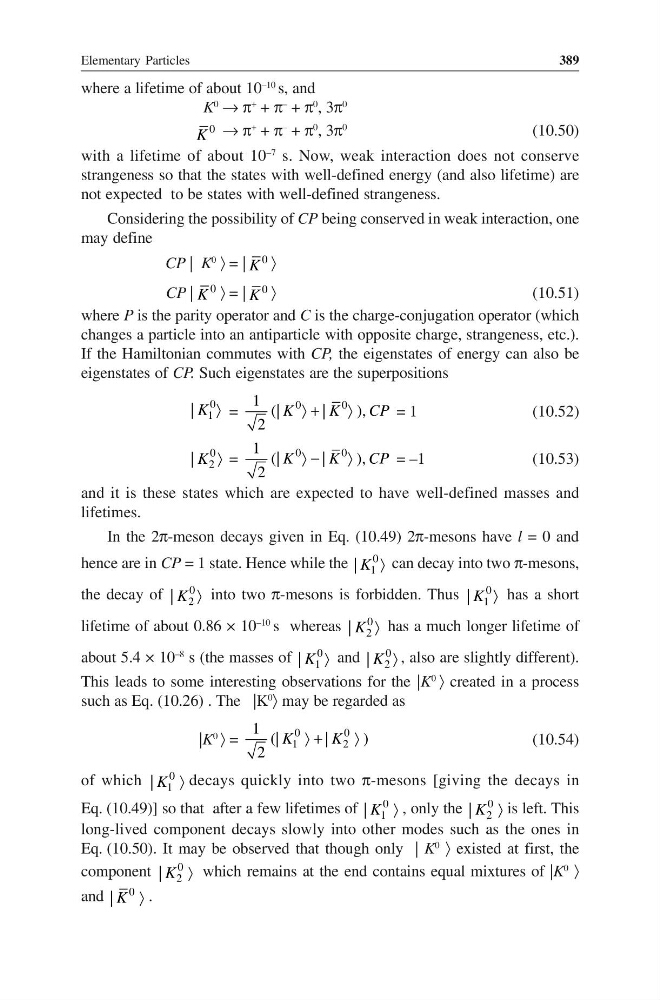
where a lifetime of about 10
–10
s, and
K
0
→ π
+
+ π
–
+ π
0
, 3π
0
0
K → π
+
+ π
–
+ π
0
, 3π
0
(10.50)
with a lifetime of about 10
–7
s. Now, weak interaction does not conserve
strangeness so that the states with well-defined energy (and also lifetime) are
not expected to be states with well-defined strangeness.
Considering the possibility of CP being conserved in weak interaction, one
may define
CP | K
0
〉 = | 0
K 〉
CP |
0
K 〉 = | 0
K 〉
(10.51)
where P is the parity operator and C is the charge-conjugation operator (which
changes a particle into an antiparticle with opposite charge, strangeness, etc.).
If the Hamiltonian commutes with CP, the eigenstates of energy can also be
eigenstates of CP. Such eigenstates are the superpositions
0
1
| K 〉 =
0
0
1 (|
|
),
2
K
K
CP
〉 +
〉
= 1
(10.52)
0
2
| K 〉 =
0
0
1 (|
|
),
2
K
K
CP
〉 −
〉
= –1
(10.53)
and it is these states which are expected to have well-defined masses and
lifetimes.
In the 2π-meson decays given in Eq. (10.49) 2π-mesons have l = 0 and
hence are in CP = 1 state. Hence while the
0
1
| K 〉 can decay into two π-mesons,
the decay of
0
2
| K 〉 into two π-mesons is forbidden. Thus
0
1
| K 〉 has a short
lifetime of about 0.86 × 10
–10
s whereas
0
2
| K 〉 has a much longer lifetime of
about 5.4 × 10
–8
s (the masses of
0
1
| K 〉 and
0
2
| K 〉 , also are slightly different).
This leads to some interesting observations for the |K
0
〉 created in a process
such as Eq. (10.26) . The |K
0
〉 may be regarded as
|K
0
〉 =
0
0
1
2
1 (|
|
)
2
K
K
〉 +
〉
(10.54)
of which
0
1
| K 〉 decays quickly into two π-mesons [giving the decays in
Eq. (10.49)] so that after a few lifetimes of
0
1
| K 〉 , only the
0
2
| K 〉 is left. This
long-lived component decays slowly into other modes such as the ones in
Eq. (10.50). It may be observed that though only | K
0
〉 existed at first, the
component
0
2
| K 〉 which remains at the end contains equal mixtures of |K
0
〉
and
0
| K 〉 .
389
where a lifetime of about 10
–10
s, and
K
0
→ π
+
+ π
–
+ π
0
, 3π
0
0
K → π
+
+ π
–
+ π
0
, 3π
0
(10.50)
with a lifetime of about 10
–7
s. Now, weak interaction does not conserve
strangeness so that the states with well-defined energy (and also lifetime) are
not expected to be states with well-defined strangeness.
Considering the possibility of CP being conserved in weak interaction, one
may define
CP | K
0
〉 = | 0
K 〉
CP |
0
K 〉 = | 0
K 〉
(10.51)
where P is the parity operator and C is the charge-conjugation operator (which
changes a particle into an antiparticle with opposite charge, strangeness, etc.).
If the Hamiltonian commutes with CP, the eigenstates of energy can also be
eigenstates of CP. Such eigenstates are the superpositions
0
1
| K 〉 =
0
0
1 (|
|
),
2
K
K
CP
〉 +
〉
= 1
(10.52)
0
2
| K 〉 =
0
0
1 (|
|
),
2
K
K
CP
〉 −
〉
= –1
(10.53)
and it is these states which are expected to have well-defined masses and
lifetimes.
In the 2π-meson decays given in Eq. (10.49) 2π-mesons have l = 0 and
hence are in CP = 1 state. Hence while the
0
1
| K 〉 can decay into two π-mesons,
the decay of
0
2
| K 〉 into two π-mesons is forbidden. Thus
0
1
| K 〉 has a short
lifetime of about 0.86 × 10
–10
s whereas
0
2
| K 〉 has a much longer lifetime of
about 5.4 × 10
–8
s (the masses of
0
1
| K 〉 and
0
2
| K 〉 , also are slightly different).
This leads to some interesting observations for the |K
0
〉 created in a process
such as Eq. (10.26) . The |K
0
〉 may be regarded as
|K
0
〉 =
0
0
1
2
1 (|
|
)
2
K
K
〉 +
〉
(10.54)
of which
0
1
| K 〉 decays quickly into two π-mesons [giving the decays in
Eq. (10.49)] so that after a few lifetimes of
0
1
| K 〉 , only the
0
2
| K 〉 is left. This
long-lived component decays slowly into other modes such as the ones in
Eq. (10.50). It may be observed that though only | K
0
〉 existed at first, the
component
0
2
| K 〉 which remains at the end contains equal mixtures of |K
0
〉
and
0
| K 〉 .