

Elements of Modern Physics
386
alcohol vapour, from the top (kept at about 10°C) to the bottom (kept at
about – 70° C by using solid carbon dioxide). This gives a layer of supersaturated
vapour (a few centimeters thick) near the bottom. The diffusion chamber has
the advantage that it can work continuously.
Bubble Chamber and Spark Chamber
In the bubble chamber (Glaser, 1952), the supersaturated vapour is replaced by
a superheated liquid and the particle track is observed by the boiling of the
liquid along the path of the particle. The superheated condition is obtained by
first heating a liquid (such as hydrogen, xenon, propane, etc.) under pressure so
that it is near the boiling point at that pressure. A sudden lowering of pressure
produces a superheated state which survives for a short time. If high-energy,
ionizing particles pass through this liquid, bubbles are formed along the track,
on account of the electrons knocked out of the atoms by the charged particles,
and the track can be photographed. It is a very important feature of bubble
chambers that the working liquid itself can serve as a target for the charged
particles. A bubble chamber, like the cloud chamber, works in cycles, since the
superheated state lasts only for a short time.
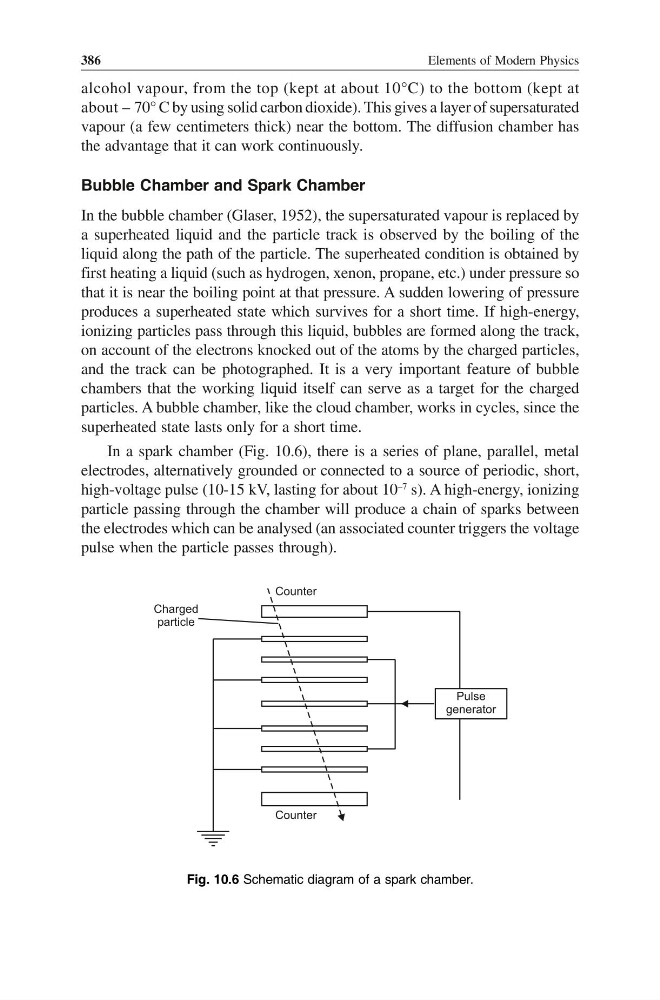
In a spark chamber (Fig. 10.6), there is a series of plane, parallel, metal
electrodes, alternatively grounded or connected to a source of periodic, short,
high-voltage pulse (10-15 kV, lasting for about 10
–7
s). A high-energy, ionizing
particle passing through the chamber will produce a chain of sparks between
the electrodes which can be analysed (an associated counter triggers the voltage
pulse when the particle passes through).
Pulse
generator
Counter
Charged
particle
Counter
Fig. 10.6 Schematic diagram of a spark chamber.
386
alcohol vapour, from the top (kept at about 10°C) to the bottom (kept at
about – 70° C by using solid carbon dioxide). This gives a layer of supersaturated
vapour (a few centimeters thick) near the bottom. The diffusion chamber has
the advantage that it can work continuously.
Bubble Chamber and Spark Chamber
In the bubble chamber (Glaser, 1952), the supersaturated vapour is replaced by
a superheated liquid and the particle track is observed by the boiling of the
liquid along the path of the particle. The superheated condition is obtained by
first heating a liquid (such as hydrogen, xenon, propane, etc.) under pressure so
that it is near the boiling point at that pressure. A sudden lowering of pressure
produces a superheated state which survives for a short time. If high-energy,
ionizing particles pass through this liquid, bubbles are formed along the track,
on account of the electrons knocked out of the atoms by the charged particles,
and the track can be photographed. It is a very important feature of bubble
chambers that the working liquid itself can serve as a target for the charged
particles. A bubble chamber, like the cloud chamber, works in cycles, since the
superheated state lasts only for a short time.
In a spark chamber (Fig. 10.6), there is a series of plane, parallel, metal
electrodes, alternatively grounded or connected to a source of periodic, short,
high-voltage pulse (10-15 kV, lasting for about 10
–7
s). A high-energy, ionizing
particle passing through the chamber will produce a chain of sparks between
the electrodes which can be analysed (an associated counter triggers the voltage
pulse when the particle passes through).
Pulse
generator
Counter
Charged
particle
Counter
Fig. 10.6 Schematic diagram of a spark chamber.