

Elements of Modern Physics
384
To the target
Injections of
protons from a
linear accelerator
Proton beam
Magnets with
alternating gradients
Radio-frequency
acceleration regions
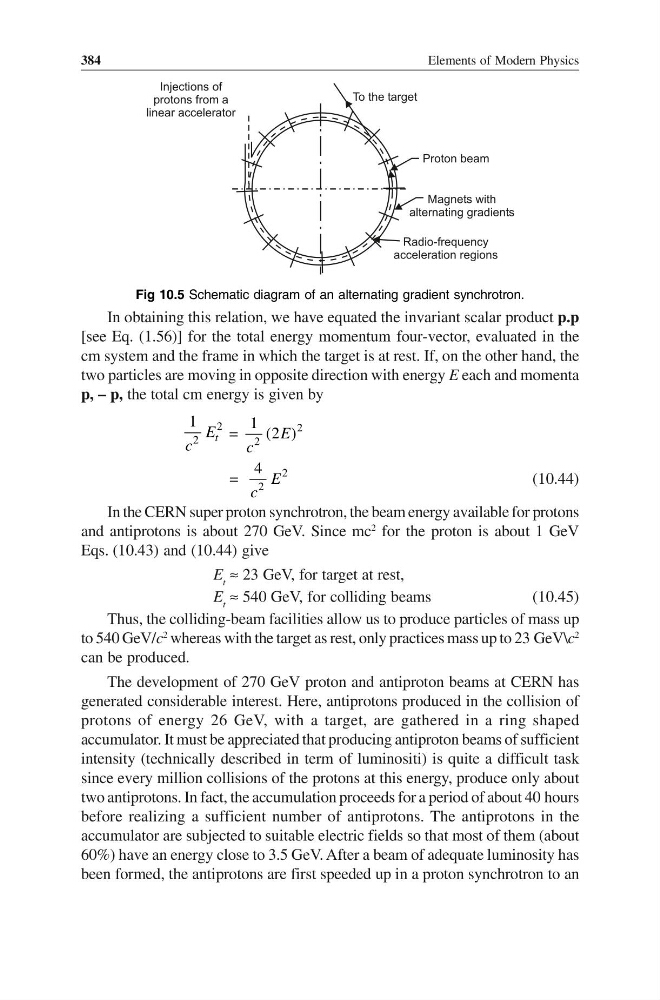
Fig 10.5 Schematic diagram of an alternating gradient synchrotron.
In obtaining this relation, we have equated the invariant scalar product p.p
[see Eq. (1.56)] for the total energy momentum four-vector, evaluated in the
cm system and the frame in which the target is at rest. If, on the other hand, the
two particles are moving in opposite direction with energy E each and momenta
p, – p, the total cm energy is given by
2
2
1
t
E
c
=
2
2
1 (2 )
E
c
=
2
2
4 E
c
(10.44)
In the CERN super proton synchrotron, the beam energy available for protons
and antiprotons is about 270 GeV. Since mc
2
for the proton is about 1 GeV
Eqs. (10.43) and (10.44) give
E t ≈ 23 GeV, for target at rest,
E t ≈ 540 GeV, for colliding beams
(10.45)
Thus, the colliding-beam facilities allow us to produce particles of mass up
to 540 GeV/c
2
whereas with the target as rest, only practices mass up to 23 GeV\c
2
can be produced.
The development of 270 GeV proton and antiproton beams at CERN has
generated considerable interest. Here, antiprotons produced in the collision of
protons of energy 26 GeV, with a target, are gathered in a ring shaped
accumulator. It must be appreciated that producing antiproton beams of sufficient
intensity (technically described in term of luminositi) is quite a difficult task
since every million collisions of the protons at this energy, produce only about
two antiprotons. In fact, the accumulation proceeds for a period of about 40 hours
before realizing a sufficient number of antiprotons. The antiprotons in the
accumulator are subjected to suitable electric fields so that most of them (about
60%) have an energy close to 3.5 GeV. After a beam of adequate luminosity has
been formed, the antiprotons are first speeded up in a proton synchrotron to an
384
To the target
Injections of
protons from a
linear accelerator
Proton beam
Magnets with
alternating gradients
Radio-frequency
acceleration regions
Fig 10.5 Schematic diagram of an alternating gradient synchrotron.
In obtaining this relation, we have equated the invariant scalar product p.p
[see Eq. (1.56)] for the total energy momentum four-vector, evaluated in the
cm system and the frame in which the target is at rest. If, on the other hand, the
two particles are moving in opposite direction with energy E each and momenta
p, – p, the total cm energy is given by
2
2
1
t
E
c
=
2
2
1 (2 )
E
c
=
2
2
4 E
c
(10.44)
In the CERN super proton synchrotron, the beam energy available for protons
and antiprotons is about 270 GeV. Since mc
2
for the proton is about 1 GeV
Eqs. (10.43) and (10.44) give
E t ≈ 23 GeV, for target at rest,
E t ≈ 540 GeV, for colliding beams
(10.45)
Thus, the colliding-beam facilities allow us to produce particles of mass up
to 540 GeV/c
2
whereas with the target as rest, only practices mass up to 23 GeV\c
2
can be produced.
The development of 270 GeV proton and antiproton beams at CERN has
generated considerable interest. Here, antiprotons produced in the collision of
protons of energy 26 GeV, with a target, are gathered in a ring shaped
accumulator. It must be appreciated that producing antiproton beams of sufficient
intensity (technically described in term of luminositi) is quite a difficult task
since every million collisions of the protons at this energy, produce only about
two antiprotons. In fact, the accumulation proceeds for a period of about 40 hours
before realizing a sufficient number of antiprotons. The antiprotons in the
accumulator are subjected to suitable electric fields so that most of them (about
60%) have an energy close to 3.5 GeV. After a beam of adequate luminosity has
been formed, the antiprotons are first speeded up in a proton synchrotron to an