

Elements of Modern Physics
378
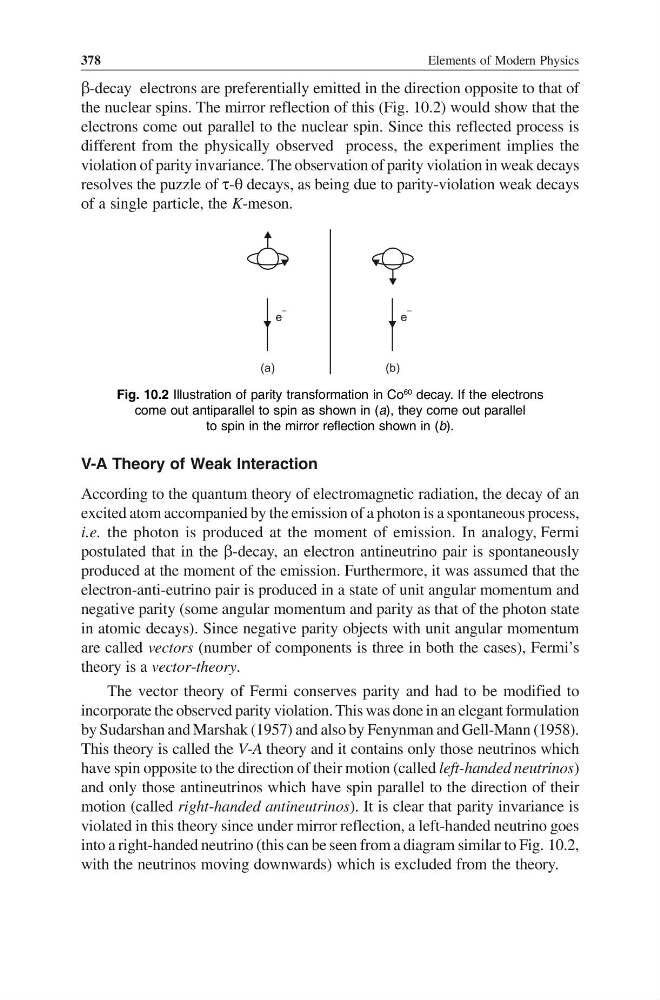
β-decay electrons are preferentially emitted in the direction opposite to that of
the nuclear spins. The mirror reflection of this (Fig. 10.2) would show that the
electrons come out parallel to the nuclear spin. Since this reflected process is
different from the physically observed process, the experiment implies the
violation of parity invariance. The observation of parity violation in weak decays
resolves the puzzle of τ-θ decays, as being due to parity-violation weak decays
of a single particle, the K-meson.
e
–
(a)
e
–
(b)
Fig. 10.2 Illustration of parity transformation in Co
60
decay. If the electrons
come out antiparallel to spin as shown in (a), they come out parallel
to spin in the mirror reflection shown in (b).
V-A Theory of Weak Interaction
According to the quantum theory of electromagnetic radiation, the decay of an
excited atom accompanied by the emission of a photon is a spontaneous process,
i.e. the photon is produced at the moment of emission. In analogy, Fermi
postulated that in the β-decay, an electron antineutrino pair is spontaneously
produced at the moment of the emission. Furthermore, it was assumed that the
electron-anti-eutrino pair is produced in a state of unit angular momentum and
negative parity (some angular momentum and parity as that of the photon state
in atomic decays). Since negative parity objects with unit angular momentum
are called vectors (number of components is three in both the cases), Fermi’s
theory is a vector-theory.
The vector theory of Fermi conserves parity and had to be modified to
incorporate the observed parity violation. This was done in an elegant formulation
by Sudarshan and Marshak (1957) and also by Fenynman and Gell-Mann (1958).
This theory is called the V-A theory and it contains only those neutrinos which
have spin opposite to the direction of their motion (called left-handed neutrinos)
and only those antineutrinos which have spin parallel to the direction of their
motion (called right-handed antineutrinos). It is clear that parity invariance is
violated in this theory since under mirror reflection, a left-handed neutrino goes
into a right-handed neutrino (this can be seen from a diagram similar to Fig. 10.2,
with the neutrinos moving downwards) which is excluded from the theory.
378
β-decay electrons are preferentially emitted in the direction opposite to that of
the nuclear spins. The mirror reflection of this (Fig. 10.2) would show that the
electrons come out parallel to the nuclear spin. Since this reflected process is
different from the physically observed process, the experiment implies the
violation of parity invariance. The observation of parity violation in weak decays
resolves the puzzle of τ-θ decays, as being due to parity-violation weak decays
of a single particle, the K-meson.
e
–
(a)
e
–
(b)
Fig. 10.2 Illustration of parity transformation in Co
60
decay. If the electrons
come out antiparallel to spin as shown in (a), they come out parallel
to spin in the mirror reflection shown in (b).
V-A Theory of Weak Interaction
According to the quantum theory of electromagnetic radiation, the decay of an
excited atom accompanied by the emission of a photon is a spontaneous process,
i.e. the photon is produced at the moment of emission. In analogy, Fermi
postulated that in the β-decay, an electron antineutrino pair is spontaneously
produced at the moment of the emission. Furthermore, it was assumed that the
electron-anti-eutrino pair is produced in a state of unit angular momentum and
negative parity (some angular momentum and parity as that of the photon state
in atomic decays). Since negative parity objects with unit angular momentum
are called vectors (number of components is three in both the cases), Fermi’s
theory is a vector-theory.
The vector theory of Fermi conserves parity and had to be modified to
incorporate the observed parity violation. This was done in an elegant formulation
by Sudarshan and Marshak (1957) and also by Fenynman and Gell-Mann (1958).
This theory is called the V-A theory and it contains only those neutrinos which
have spin opposite to the direction of their motion (called left-handed neutrinos)
and only those antineutrinos which have spin parallel to the direction of their
motion (called right-handed antineutrinos). It is clear that parity invariance is
violated in this theory since under mirror reflection, a left-handed neutrino goes
into a right-handed neutrino (this can be seen from a diagram similar to Fig. 10.2,
with the neutrinos moving downwards) which is excluded from the theory.