

Special Theory of Relativity
27
3
4 0
′
=
′
πε
q
r
r
(1.92)
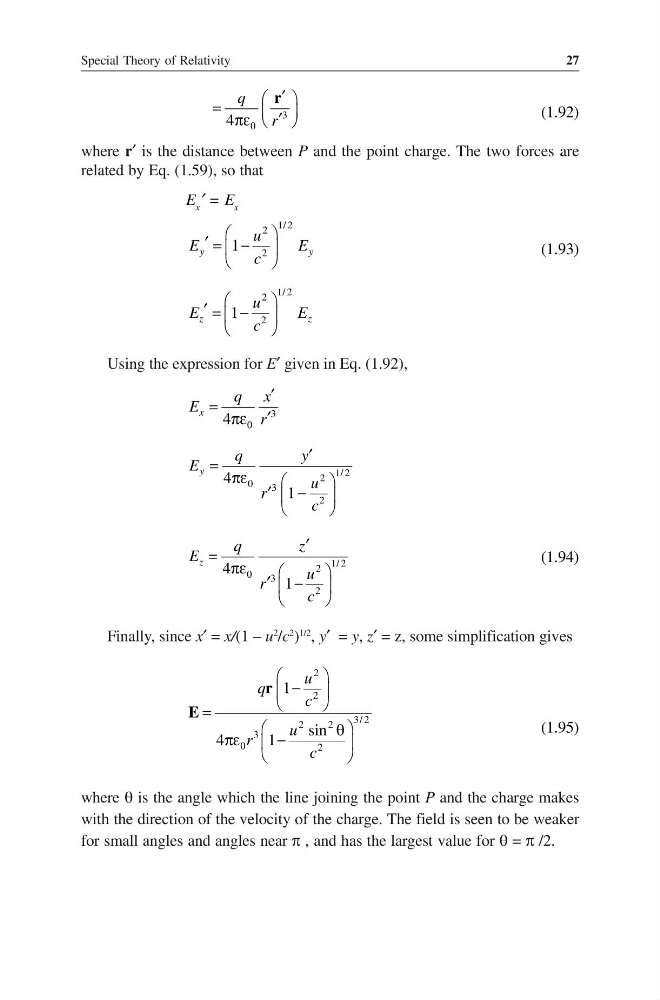
where r′ is the distance between P and the point charge. The two forces are
related by Eq. (1.59), so that
E x ′ = E x
1/ 2
2
2
1
y
y
u
E
E
c
′ = −
(1.93)
1/ 2
2
2
1
z
z
u
E
E
c
′ = −
Using the expression for E′ given in Eq. (1.92),
3
4
x
q x
E
r
0
′
=
′
πε
1/ 2
2
0
2
4
1
3
′
= πε
′
−
y
q
y
E
u
r
c
1/ 2
2
3
2
4
1
z
q
z
E
u
r
c
0
′
= πε
′ −
(1.94)
Finally, since x′ = x/(1 – u
2
/c
2
)
1/2
, y′ = y, z′ = z, some simplification gives
2
2
3/ 2
2
2
3
2
1
sin
4
1
0
−
=
θ
πε
−
u
q
c
u
r
c
r
E
(1.95)
where θ is the angle which the line joining the point P and the charge makes
with the direction of the velocity of the charge. The field is seen to be weaker
for small angles and angles near π , and has the largest value for θ = π /2.
27
3
4 0
′
=
′
πε
q
r
r
(1.92)
where r′ is the distance between P and the point charge. The two forces are
related by Eq. (1.59), so that
E x ′ = E x
1/ 2
2
2
1
y
y
u
E
E
c
′ = −
(1.93)
1/ 2
2
2
1
z
z
u
E
E
c
′ = −
Using the expression for E′ given in Eq. (1.92),
3
4
x
q x
E
r
0
′
=
′
πε
1/ 2
2
0
2
4
1
3
′
= πε
′
−
y
q
y
E
u
r
c
1/ 2
2
3
2
4
1
z
q
z
E
u
r
c
0
′
= πε
′ −
(1.94)
Finally, since x′ = x/(1 – u
2
/c
2
)
1/2
, y′ = y, z′ = z, some simplification gives
2
2
3/ 2
2
2
3
2
1
sin
4
1
0
−
=
θ
πε
−
u
q
c
u
r
c
r
E
(1.95)
where θ is the angle which the line joining the point P and the charge makes
with the direction of the velocity of the charge. The field is seen to be weaker
for small angles and angles near π , and has the largest value for θ = π /2.