

The Nucleus
357
of energy, in that they have hardly any radioactivity problem, produce negligible
pollution, and their sources are widely distributed.
Uncontrolled Fusion
Uncontrolled fusion can be achieved by using an atom bomb whose explosion
produces temperatures of the order of 10
7
K. For example, such an atom bomb
can ignite a fuel of deuterium and tritium, leading to the fusion reaction in
Eq. (9.116). This is the source of energy in what is known as the hydrogen or
thermonuclear bomb.
Fusion reactions are the source of energy in the sun and the stars, inside
which temperatures are of the order of 10
7
-10
8
K. The energy there is produced
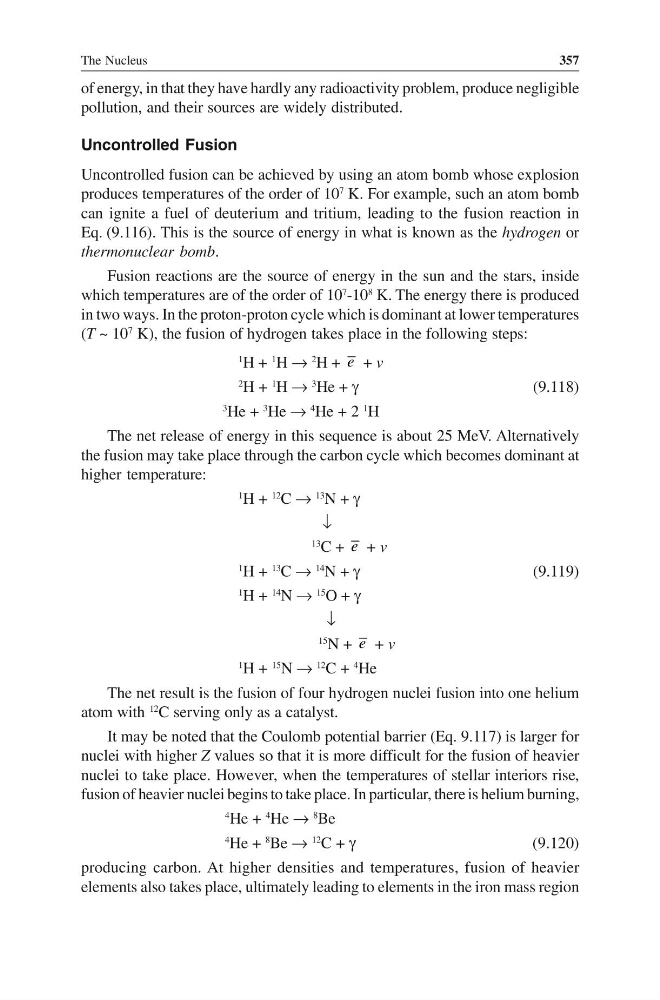
in two ways. In the proton-proton cycle which is dominant at lower temperatures
(T ~ 10
7
K), the fusion of hydrogen takes place in the following steps:
1
H +
1
H →
2
H + e + v
2
H +
1
H →
3
He + γ
(9.118)
3
He +
3
He →
4
He + 2
1
H
The net release of energy in this sequence is about 25 MeV. Alternatively
the fusion may take place through the carbon cycle which becomes dominant at
higher temperature:
1
H +
12
C →
13
N + γ
↓
13
C + e + v
1
H +
13
C →
14
N + γ
(9.119)
1
H +
14
N →
15
O + γ
↓
15
N + e + v
1
H +
15
N →
12
C +
4
He
The net result is the fusion of four hydrogen nuclei fusion into one helium
atom with
12
C serving only as a catalyst.
It may be noted that the Coulomb potential barrier (Eq. 9.117) is larger for
nuclei with higher Z values so that it is more difficult for the fusion of heavier
nuclei to take place. However, when the temperatures of stellar interiors rise,
fusion of heavier nuclei begins to take place. In particular, there is helium burning,
4
He +
4
He →
8
Be
4
He +
8
Be →
12
C + γ
(9.120)
producing carbon. At higher densities and temperatures, fusion of heavier
elements also takes place, ultimately leading to elements in the iron mass region
357
of energy, in that they have hardly any radioactivity problem, produce negligible
pollution, and their sources are widely distributed.
Uncontrolled Fusion
Uncontrolled fusion can be achieved by using an atom bomb whose explosion
produces temperatures of the order of 10
7
K. For example, such an atom bomb
can ignite a fuel of deuterium and tritium, leading to the fusion reaction in
Eq. (9.116). This is the source of energy in what is known as the hydrogen or
thermonuclear bomb.
Fusion reactions are the source of energy in the sun and the stars, inside
which temperatures are of the order of 10
7
-10
8
K. The energy there is produced
in two ways. In the proton-proton cycle which is dominant at lower temperatures
(T ~ 10
7
K), the fusion of hydrogen takes place in the following steps:
1
H +
1
H →
2
H + e + v
2
H +
1
H →
3
He + γ
(9.118)
3
He +
3
He →
4
He + 2
1
H
The net release of energy in this sequence is about 25 MeV. Alternatively
the fusion may take place through the carbon cycle which becomes dominant at
higher temperature:
1
H +
12
C →
13
N + γ
↓
13
C + e + v
1
H +
13
C →
14
N + γ
(9.119)
1
H +
14
N →
15
O + γ
↓
15
N + e + v
1
H +
15
N →
12
C +
4
He
The net result is the fusion of four hydrogen nuclei fusion into one helium
atom with
12
C serving only as a catalyst.
It may be noted that the Coulomb potential barrier (Eq. 9.117) is larger for
nuclei with higher Z values so that it is more difficult for the fusion of heavier
nuclei to take place. However, when the temperatures of stellar interiors rise,
fusion of heavier nuclei begins to take place. In particular, there is helium burning,
4
He +
4
He →
8
Be
4
He +
8
Be →
12
C + γ
(9.120)
producing carbon. At higher densities and temperatures, fusion of heavier
elements also takes place, ultimately leading to elements in the iron mass region