

Special Theory of Relativity
25
not have been feasible. Therefore, it is time-dilation which makes the experiment
feasible.
Example 3
It should be emphasized that it is only the speed of light in vacuum that is invariant.
In particular, the speed of light in water is not invariant with respect to different
inertial observers, as was shown by Fizeau (1851).
Consider the passage of light through a tube of length l, containing water at
rest. The speed of light in water is c/n where n is the refractive index of water.
If the water now flows with velocity v parallel to the direction of propagation of
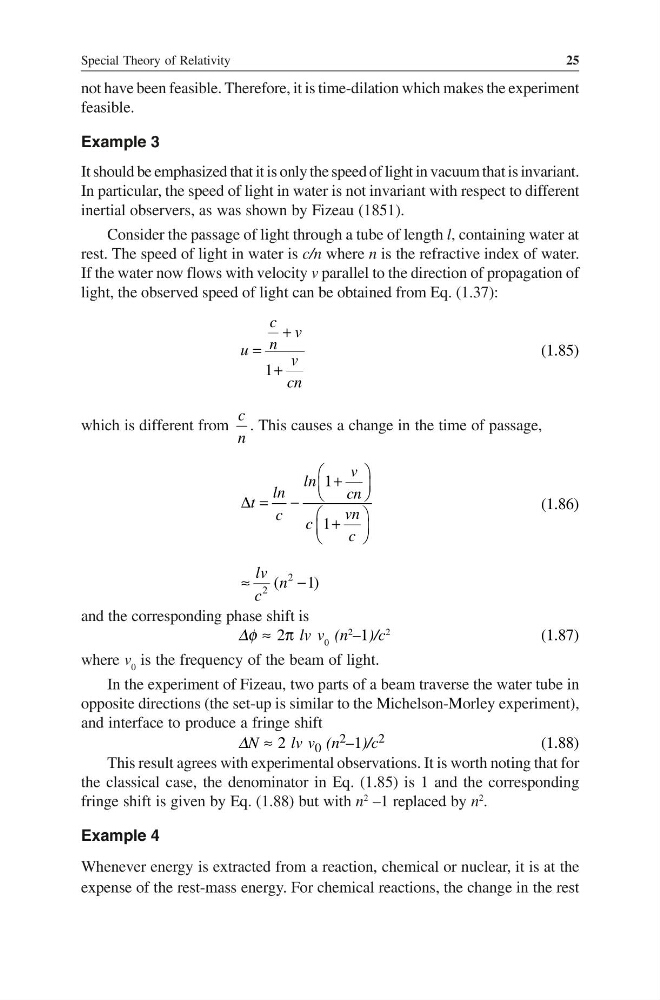
light, the observed speed of light can be obtained from Eq. (1.37):
1
c v
n
u
v
cn
+
=
+
(1.85)
which is different from
c
n
. This causes a change in the time of passage,
1
1
v
ln
ln
cn
t
vn
c c
c
+
∆ = −
+
(1.86)
2
2
(
1)
lv n
c
≈
−
and the corresponding phase shift is
∆φ ≈ 2π lv v 0 (n
2
–1)/c
2
(1.87)
where v 0 is the frequency of the beam of light.
In the experiment of Fizeau, two parts of a beam traverse the water tube in
opposite directions (the set-up is similar to the Michelson-Morley experiment),
and interface to produce a fringe shift
∆N ≈ 2 lv v 0 (n 2 –1)/c 2
(1.88)
This result agrees with experimental observations. It is worth noting that for
the classical case, the denominator in Eq. (1.85) is 1 and the corresponding
fringe shift is given by Eq. (1.88) but with n
2
–1 replaced by n
2
.
Example 4
Whenever energy is extracted from a reaction, chemical or nuclear, it is at the
expense of the rest-mass energy. For chemical reactions, the change in the rest
25
not have been feasible. Therefore, it is time-dilation which makes the experiment
feasible.
Example 3
It should be emphasized that it is only the speed of light in vacuum that is invariant.
In particular, the speed of light in water is not invariant with respect to different
inertial observers, as was shown by Fizeau (1851).
Consider the passage of light through a tube of length l, containing water at
rest. The speed of light in water is c/n where n is the refractive index of water.
If the water now flows with velocity v parallel to the direction of propagation of
light, the observed speed of light can be obtained from Eq. (1.37):
1
c v
n
u
v
cn
+
=
+
(1.85)
which is different from
c
n
. This causes a change in the time of passage,
1
1
v
ln
ln
cn
t
vn
c c
c
+
∆ = −
+
(1.86)
2
2
(
1)
lv n
c
≈
−
and the corresponding phase shift is
∆φ ≈ 2π lv v 0 (n
2
–1)/c
2
(1.87)
where v 0 is the frequency of the beam of light.
In the experiment of Fizeau, two parts of a beam traverse the water tube in
opposite directions (the set-up is similar to the Michelson-Morley experiment),
and interface to produce a fringe shift
∆N ≈ 2 lv v 0 (n 2 –1)/c 2
(1.88)
This result agrees with experimental observations. It is worth noting that for
the classical case, the denominator in Eq. (1.85) is 1 and the corresponding
fringe shift is given by Eq. (1.88) but with n
2
–1 replaced by n
2
.
Example 4
Whenever energy is extracted from a reaction, chemical or nuclear, it is at the
expense of the rest-mass energy. For chemical reactions, the change in the rest