

Elements of Modern Physics
344
A = a + 4n
(9.86)
Thus, four series exist corresponding to a = 1, 2, 3. These are summarized
below along with the half-life in years (τ
1/2
≈ 0.69 τ av ) of the longest-lived
member:
Series
Mass number
Longest lived
Final stable
nucleus
nucleus
Thorium
4n
232
Th (1.39 × 10
10
)
208
Pb
Neptunium
4n + 1
237
Np(2.25 × 10
6
)
209
Bi
Uranium
4n + 2
238
U(4.51 × 10
9
)
206
Pb
Actinium
4n + 3
235
U(7.07 × 18
6
)
207
Pb
Of these, the thorium, uranium and actinium series are observed in nature.
The neptunium series is not observed in nature since its longest lived member,
237
Np has a half-life of about 2.25 × 10
6
years and whatever amount was created
at the early stages of the universe would have decayed by now. However,
237
Np
can be artificially produced, e.g. from
236
U by the capture of neutron followed
by β
–
decay. All these elements undergo a series of α and β
–
decays till they are
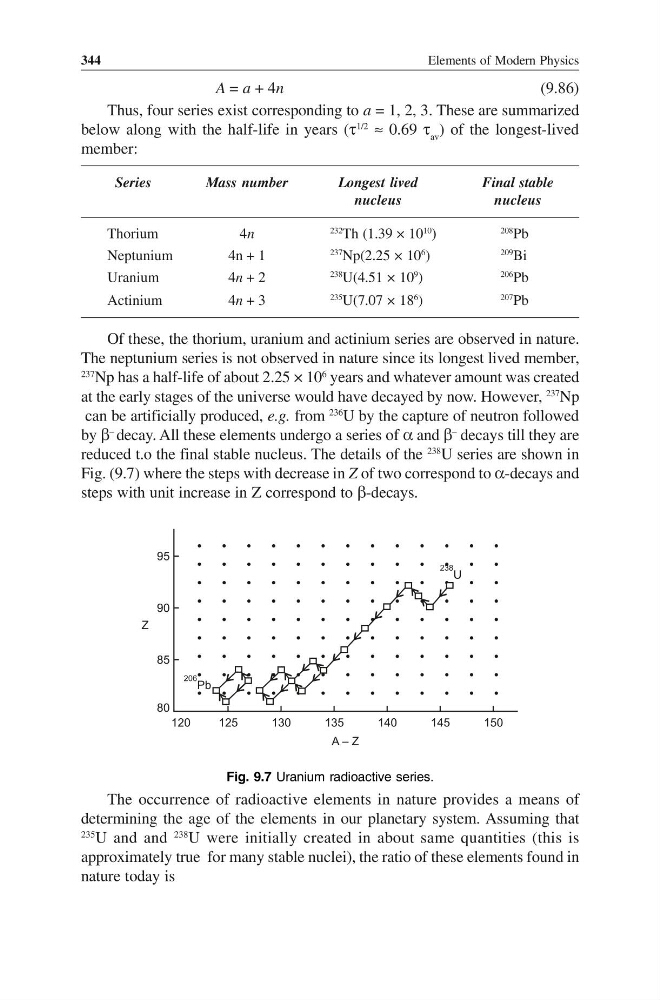
reduced t.o the final stable nucleus. The details of the
238
U series are shown in
Fig. (9.7) where the steps with decrease in Z of two correspond to α-decays and
steps with unit increase in Z correspond to β-decays.
95
90
85
80
Z
120
125
130
135
140
145
150
A – Z
238 U
206 Pb
Fig. 9.7 Uranium radioactive series.
The occurrence of radioactive elements in nature provides a means of
determining the age of the elements in our planetary system. Assuming that
235
U and and
238
U were initially created in about same quantities (this is
approximately true for many stable nuclei), the ratio of these elements found in
nature today is
344
A = a + 4n
(9.86)
Thus, four series exist corresponding to a = 1, 2, 3. These are summarized
below along with the half-life in years (τ
1/2
≈ 0.69 τ av ) of the longest-lived
member:
Series
Mass number
Longest lived
Final stable
nucleus
nucleus
Thorium
4n
232
Th (1.39 × 10
10
)
208
Pb
Neptunium
4n + 1
237
Np(2.25 × 10
6
)
209
Bi
Uranium
4n + 2
238
U(4.51 × 10
9
)
206
Pb
Actinium
4n + 3
235
U(7.07 × 18
6
)
207
Pb
Of these, the thorium, uranium and actinium series are observed in nature.
The neptunium series is not observed in nature since its longest lived member,
237
Np has a half-life of about 2.25 × 10
6
years and whatever amount was created
at the early stages of the universe would have decayed by now. However,
237
Np
can be artificially produced, e.g. from
236
U by the capture of neutron followed
by β
–
decay. All these elements undergo a series of α and β
–
decays till they are
reduced t.o the final stable nucleus. The details of the
238
U series are shown in
Fig. (9.7) where the steps with decrease in Z of two correspond to α-decays and
steps with unit increase in Z correspond to β-decays.
95
90
85
80
Z
120
125
130
135
140
145
150
A – Z
238 U
206 Pb
Fig. 9.7 Uranium radioactive series.
The occurrence of radioactive elements in nature provides a means of
determining the age of the elements in our planetary system. Assuming that
235
U and and
238
U were initially created in about same quantities (this is
approximately true for many stable nuclei), the ratio of these elements found in
nature today is