

The Nucleus
333
part) satisfies the required exchange symmetry, the rotational wave function
must be even under r → – r which effects an interchange of particles. Because
of the relation 0 (
,
) ( 1)
( , ),
m
lm
l
Y
Y
π − θ π + φ = −
θ φ this implies that only I = 0,
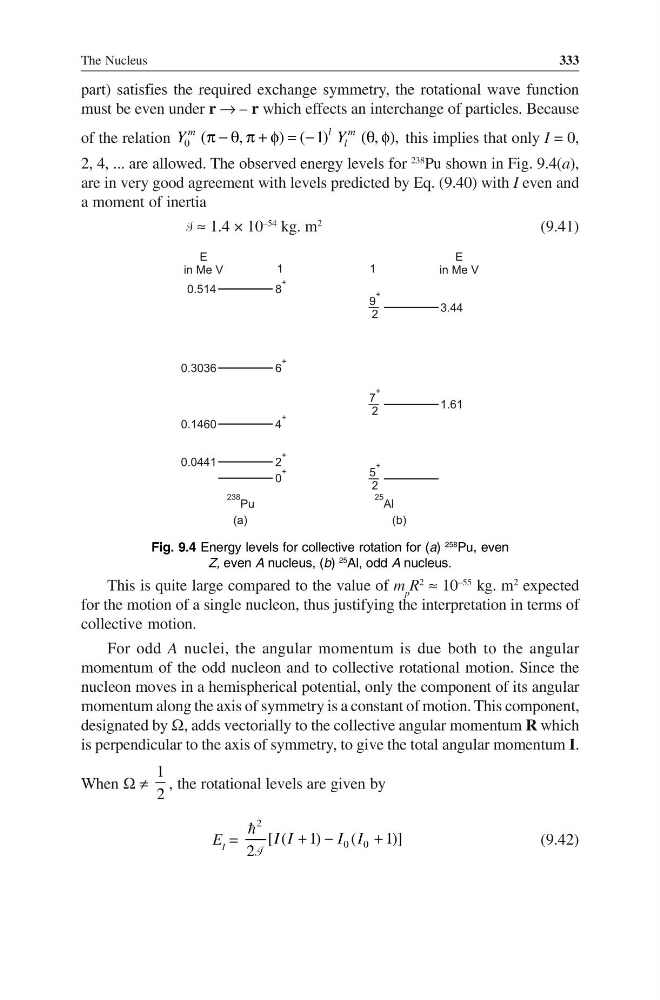
2, 4, ... are allowed. The observed energy levels for
238
Pu shown in Fig. 9.4(a),
are in very good agreement with levels predicted by Eq. (9.40) with I even and
a moment of inertia
I ≈ 1.4 × 10
–54
kg. m
2
(9.41)
1
E
in Me V
0.514
8
+
1
9
2
+
E
in Me V
3.44
0.3036
6
+
7
2
+
1.61
0.1460
4
+
0.0441
2
+
0
+
5
2
+
238 Pu
25 Al
(a)
(b)
Fig. 9.4 Energy levels for collective rotation for (a)
258
Pu, even
Z, even A nucleus, (b)
25
Al, odd A nucleus.
This is quite large compared to the value of m p R
2
≈ 10
–55
kg. m
2
expected
for the motion of a single nucleon, thus justifying the interpretation in terms of
collective motion.
For odd A nuclei, the angular momentum is due both to the angular
momentum of the odd nucleon and to collective rotational motion. Since the
nucleon moves in a hemispherical potential, only the component of its angular
momentum along the axis of symmetry is a constant of motion. This component,
designated by Ω, adds vectorially to the collective angular momentum R which
is perpendicular to the axis of symmetry, to give the total angular momentum I.
When Ω ≠
1
2
, the rotational levels are given by
E I =
2
0 0
[ ( 1)
(
1)]
2
I I
I I
+ −
+
I
(9.42)
333
part) satisfies the required exchange symmetry, the rotational wave function
must be even under r → – r which effects an interchange of particles. Because
of the relation 0 (
,
) ( 1)
( , ),
m
lm
l
Y
Y
π − θ π + φ = −
θ φ this implies that only I = 0,
2, 4, ... are allowed. The observed energy levels for
238
Pu shown in Fig. 9.4(a),
are in very good agreement with levels predicted by Eq. (9.40) with I even and
a moment of inertia
I ≈ 1.4 × 10
–54
kg. m
2
(9.41)
1
E
in Me V
0.514
8
+
1
9
2
+
E
in Me V
3.44
0.3036
6
+
7
2
+
1.61
0.1460
4
+
0.0441
2
+
0
+
5
2
+
238 Pu
25 Al
(a)
(b)
Fig. 9.4 Energy levels for collective rotation for (a)
258
Pu, even
Z, even A nucleus, (b)
25
Al, odd A nucleus.
This is quite large compared to the value of m p R
2
≈ 10
–55
kg. m
2
expected
for the motion of a single nucleon, thus justifying the interpretation in terms of
collective motion.
For odd A nuclei, the angular momentum is due both to the angular
momentum of the odd nucleon and to collective rotational motion. Since the
nucleon moves in a hemispherical potential, only the component of its angular
momentum along the axis of symmetry is a constant of motion. This component,
designated by Ω, adds vectorially to the collective angular momentum R which
is perpendicular to the axis of symmetry, to give the total angular momentum I.
When Ω ≠
1
2
, the rotational levels are given by
E I =
2
0 0
[ ( 1)
(
1)]
2
I I
I I
+ −
+
I
(9.42)