

Elements of Modern Physics
324
para and ortho modifications of a homonuclear molecule, have intensities in
the ratio of I/(I + 1) so that the rotational band will show alternating intensity. A
measurement of these intensities allows the determination of the angular
momentum I of the nucleus especially for small I values. It is worth noting that
this method depends on the exchange symmetries of the wave functions and
not on the magnetic moment associated with the nucleus.
The magnetic moment of a nucleus is associated with its angular
momentum I, and may be expressed (at least for the purpose of calculating the
expectation values within multiplets) as
µ =
p
e g
m
I
(9.18)
The gyromagnetic ratio g can be obtained from the nuclear magnetic
resonance experiments using atomic beams. From the resonance frequency
ω =
p
e gB
m
(9.19)
g and hence the magnetic moment is obtained.
Empirically, it is observed that even A and even Z nuclei have zero angular
momentum and zero magnetic moment, even A and odd Z nuclei have integral
angular momentum, and odd A nuclei have half-integral angular momentum.
The angular momenta of nuclei are generally found to be small. These
observations suggest that the angular momenta of protons, as also on neutrons,
separately compensate one another. This has a bearing on the validity of nuclear
models.
Electric Quadrupole Moment
A nucleus is usually non-spherical (though in a few cases it may be spherical).
The distortion which is along the axis of rotation is expressed in terms of the
electric quadrupole moment Q,
Q =
2
2
1 (3
) ( )
z r
r dV
e
−
ρ
∫
(9.20)
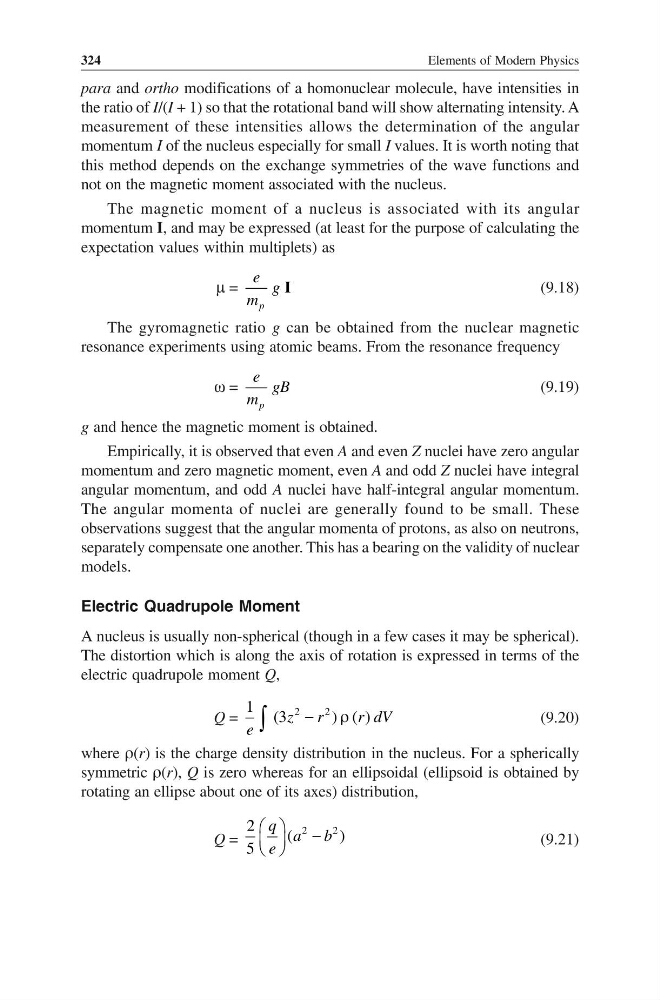
where ρ(r) is the charge density distribution in the nucleus. For a spherically
symmetric ρ(r), Q is zero whereas for an ellipsoidal (ellipsoid is obtained by
rotating an ellipse about one of its axes) distribution,
Q =
2
2
2
(
)
5
q a b
e
−
(9.21)
324
para and ortho modifications of a homonuclear molecule, have intensities in
the ratio of I/(I + 1) so that the rotational band will show alternating intensity. A
measurement of these intensities allows the determination of the angular
momentum I of the nucleus especially for small I values. It is worth noting that
this method depends on the exchange symmetries of the wave functions and
not on the magnetic moment associated with the nucleus.
The magnetic moment of a nucleus is associated with its angular
momentum I, and may be expressed (at least for the purpose of calculating the
expectation values within multiplets) as
µ =
p
e g
m
I
(9.18)
The gyromagnetic ratio g can be obtained from the nuclear magnetic
resonance experiments using atomic beams. From the resonance frequency
ω =
p
e gB
m
(9.19)
g and hence the magnetic moment is obtained.
Empirically, it is observed that even A and even Z nuclei have zero angular
momentum and zero magnetic moment, even A and odd Z nuclei have integral
angular momentum, and odd A nuclei have half-integral angular momentum.
The angular momenta of nuclei are generally found to be small. These
observations suggest that the angular momenta of protons, as also on neutrons,
separately compensate one another. This has a bearing on the validity of nuclear
models.
Electric Quadrupole Moment
A nucleus is usually non-spherical (though in a few cases it may be spherical).
The distortion which is along the axis of rotation is expressed in terms of the
electric quadrupole moment Q,
Q =
2
2
1 (3
) ( )
z r
r dV
e
−
ρ
∫
(9.20)
where ρ(r) is the charge density distribution in the nucleus. For a spherically
symmetric ρ(r), Q is zero whereas for an ellipsoidal (ellipsoid is obtained by
rotating an ellipse about one of its axes) distribution,
Q =
2
2
2
(
)
5
q a b
e
−
(9.21)