

The Nucleus
321
Unstable Nuclei
If a lower energy state is available to a nucleus, it will, in general, be unstable
and decay with the emission of a photon, or an α-particle, or some leptons (i.e.
e, v etc. see Sec. 10.1), provided the basic conservation laws, such as conservation
of energy, momentum, charge, etc. allow the decay. The neutron β-decay in
Eq. (9.2) is one such example. These decays are characterized by the lifetime τ
of the nucleus (the lifetime was discussed in Sec. 6.4), such that the number of
undecayed nuclei N(t) is given by
N(t) = N(0) exp (– t/τ)
(9.4)
where N(0) is the number of nuclei at time t = 0. The lifetimes of the nuclei vary
from the unmeasurably small values of τ < 10
–6
s (they may be indirectly
estimated), to the very large values of τ ~ 10
100
years.
The important classes of nuclear decays are the following:
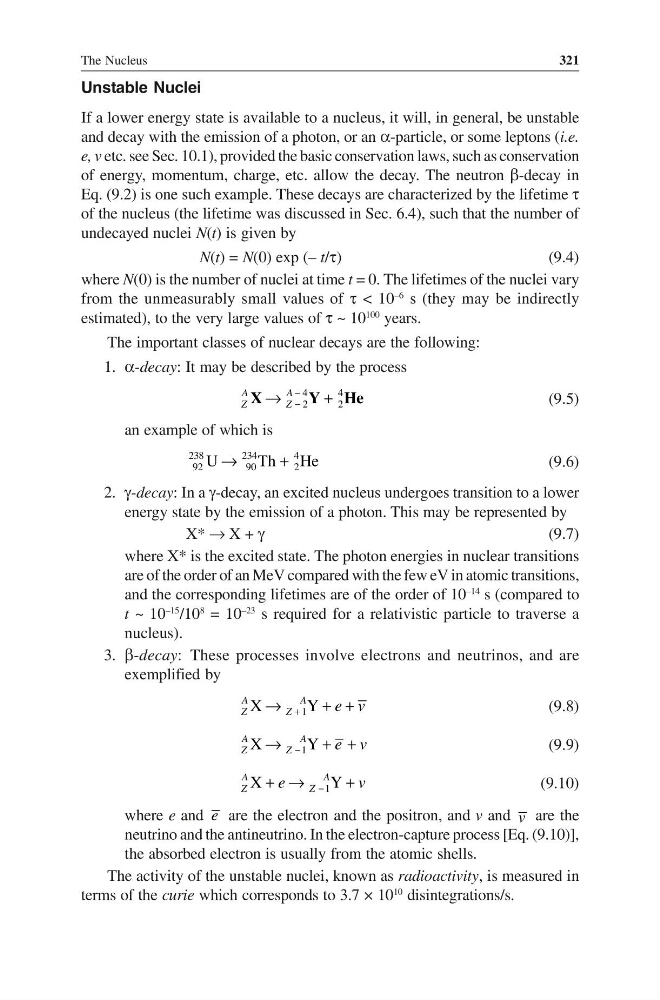
1. α-decay: It may be described by the process
4
4
2
2
A
A
Z
Z
−
−
→
+
X
Y He
(9.5)
an example of which is
238
234
4
92
90
2
U
Th He
→
+
(9.6)
2. γ-decay: In a γ-decay, an excited nucleus undergoes transition to a lower
energy state by the emission of a photon. This may be represented by
X* → X + γ
(9.7)
where X* is the excited state. The photon energies in nuclear transitions
are of the order of an MeV compared with the few eV in atomic transitions,
and the corresponding lifetimes are of the order of 10
–14
s (compared to
t ~ 10
–15
/10
8
= 10
–23
s required for a relativistic particle to traverse a
nucleus).
3. β-decay: These processes involve electrons and neutrinos, and are
exemplified by
1
X
Y
A
A
Z
Z
e v
+
→
+ +
(9.8)
1
X
Y
A
A
Z
Z
e v
−
→
+ +
(9.9)
1
X
Y
A
A
Z
Z
e
v
−
+ →
+
(9.10)
where e and e are the electron and the positron, and v and v are the
neutrino and the antineutrino. In the electron-capture process [Eq. (9.10)],
the absorbed electron is usually from the atomic shells.
The activity of the unstable nuclei, known as radioactivity, is measured in
terms of the curie which corresponds to 3.7 × 10
10
disintegrations/s.
321
Unstable Nuclei
If a lower energy state is available to a nucleus, it will, in general, be unstable
and decay with the emission of a photon, or an α-particle, or some leptons (i.e.
e, v etc. see Sec. 10.1), provided the basic conservation laws, such as conservation
of energy, momentum, charge, etc. allow the decay. The neutron β-decay in
Eq. (9.2) is one such example. These decays are characterized by the lifetime τ
of the nucleus (the lifetime was discussed in Sec. 6.4), such that the number of
undecayed nuclei N(t) is given by
N(t) = N(0) exp (– t/τ)
(9.4)
where N(0) is the number of nuclei at time t = 0. The lifetimes of the nuclei vary
from the unmeasurably small values of τ < 10
–6
s (they may be indirectly
estimated), to the very large values of τ ~ 10
100
years.
The important classes of nuclear decays are the following:
1. α-decay: It may be described by the process
4
4
2
2
A
A
Z
Z
−
−
→
+
X
Y He
(9.5)
an example of which is
238
234
4
92
90
2
U
Th He
→
+
(9.6)
2. γ-decay: In a γ-decay, an excited nucleus undergoes transition to a lower
energy state by the emission of a photon. This may be represented by
X* → X + γ
(9.7)
where X* is the excited state. The photon energies in nuclear transitions
are of the order of an MeV compared with the few eV in atomic transitions,
and the corresponding lifetimes are of the order of 10
–14
s (compared to
t ~ 10
–15
/10
8
= 10
–23
s required for a relativistic particle to traverse a
nucleus).
3. β-decay: These processes involve electrons and neutrinos, and are
exemplified by
1
X
Y
A
A
Z
Z
e v
+
→
+ +
(9.8)
1
X
Y
A
A
Z
Z
e v
−
→
+ +
(9.9)
1
X
Y
A
A
Z
Z
e
v
−
+ →
+
(9.10)
where e and e are the electron and the positron, and v and v are the
neutrino and the antineutrino. In the electron-capture process [Eq. (9.10)],
the absorbed electron is usually from the atomic shells.
The activity of the unstable nuclei, known as radioactivity, is measured in
terms of the curie which corresponds to 3.7 × 10
10
disintegrations/s.