

Solid State Physics
315
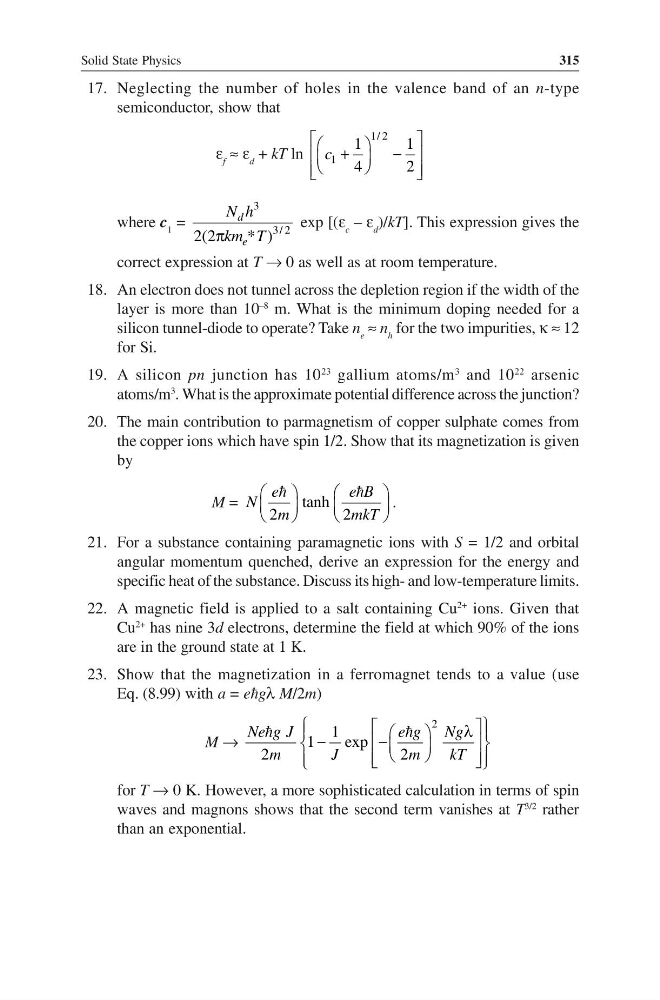
17. Neglecting the number of holes in the valence band of an n-type
semiconductor, show that
ε f ≈ ε d + kT ln
1/ 2
1
1
1
4
2
c
+
−
where c 1 =
3
3/ 2
2(2
* )
d
e
N h
km T
π
exp [(ε c – ε d )/kT]. This expression gives the
correct expression at T → 0 as well as at room temperature.
18. An electron does not tunnel across the depletion region if the width of the
layer is more than 10
–8
m. What is the minimum doping needed for a
silicon tunnel-diode to operate? Take n e ≈ n h for the two impurities, κ ≈ 12
for Si.
19. A silicon pn junction has 10
23
gallium atoms/m
3
and 10
22
arsenic
atoms/m
3
. What is the approximate potential difference across the junction?
20. The main contribution to parmagnetism of copper sulphate comes from
the copper ions which have spin 1/2. Show that its magnetization is given
by
M =
tanh
2
2
e
eB
N m
m k T
.
21. For a substance containing paramagnetic ions with S = 1/2 and orbital
angular momentum quenched, derive an expression for the energy and
specific heat of the substance. Discuss its high- and low-temperature limits.
22. A magnetic field is applied to a salt containing Cu
2+
ions. Given that
Cu
2+
has nine 3d electrons, determine the field at which 90% of the ions
are in the ground state at 1 K.
23. Show that the magnetization in a ferromagnet tends to a value (use
Eq. (8.99) with a = egλ M/2m)
M →
2
1
1
exp
2
2
Ne g J
e g Ng
m
J
m
k T
λ
−
−
for T → 0 K. However, a more sophisticated calculation in terms of spin
waves and magnons shows that the second term vanishes at T
3/2
rather
than an exponential.
315
17. Neglecting the number of holes in the valence band of an n-type
semiconductor, show that
ε f ≈ ε d + kT ln
1/ 2
1
1
1
4
2
c
+
−
where c 1 =
3
3/ 2
2(2
* )
d
e
N h
km T
π
exp [(ε c – ε d )/kT]. This expression gives the
correct expression at T → 0 as well as at room temperature.
18. An electron does not tunnel across the depletion region if the width of the
layer is more than 10
–8
m. What is the minimum doping needed for a
silicon tunnel-diode to operate? Take n e ≈ n h for the two impurities, κ ≈ 12
for Si.
19. A silicon pn junction has 10
23
gallium atoms/m
3
and 10
22
arsenic
atoms/m
3
. What is the approximate potential difference across the junction?
20. The main contribution to parmagnetism of copper sulphate comes from
the copper ions which have spin 1/2. Show that its magnetization is given
by
M =
tanh
2
2
e
eB
N m
m k T
.
21. For a substance containing paramagnetic ions with S = 1/2 and orbital
angular momentum quenched, derive an expression for the energy and
specific heat of the substance. Discuss its high- and low-temperature limits.
22. A magnetic field is applied to a salt containing Cu
2+
ions. Given that
Cu
2+
has nine 3d electrons, determine the field at which 90% of the ions
are in the ground state at 1 K.
23. Show that the magnetization in a ferromagnet tends to a value (use
Eq. (8.99) with a = egλ M/2m)
M →
2
1
1
exp
2
2
Ne g J
e g Ng
m
J
m
k T
λ
−
−
for T → 0 K. However, a more sophisticated calculation in terms of spin
waves and magnons shows that the second term vanishes at T
3/2
rather
than an exponential.