

Solid State Physics
313
(usually produced by adding chemical impurities, e.g., zinc sulphide). The
trapped electrons then are de-excited, with the emission of radiation after a
time delay (phosphorescence). Fluorescence and phosphorescence are together
known as luminescence and are used in fluorescent lamps, television picture
tubes, etc.
PROBLEMS
1. It requires an energy of 5.14 eV to remove the valence electron of Na and
an energy of 3.80 eV is released when an electron is added to Cl. Assuming
a value of n = 10 in Eq. (8.3), and an interatomic spacing of 2.82 Å, obtain
the cohesive energy/ion pair, and the repulsive energy.
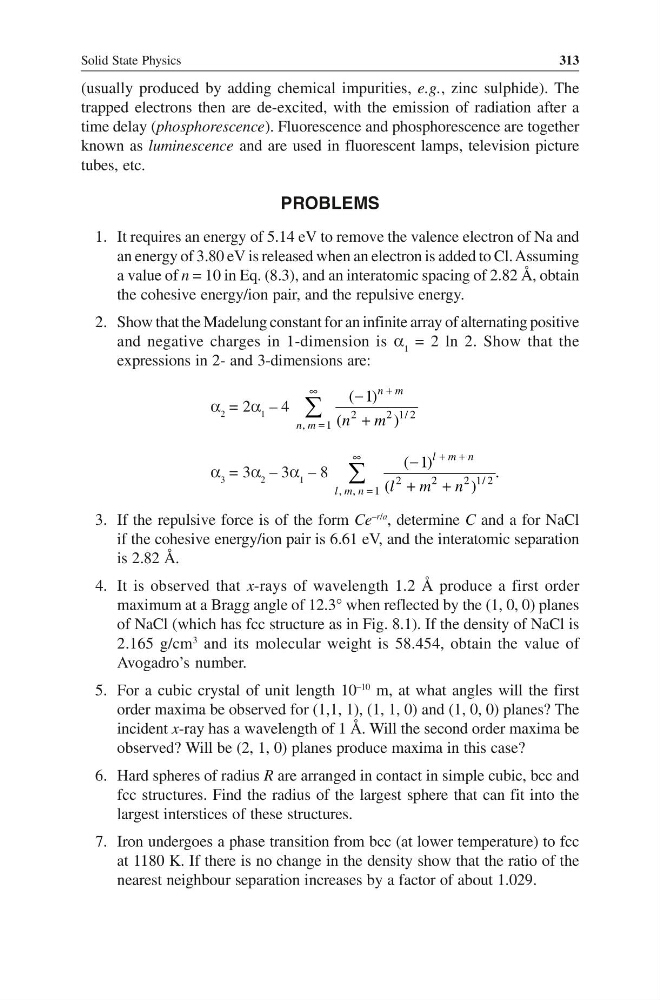
2. Show that the Madelung constant for an infinite array of alternating positive
and negative charges in 1-dimension is α 1 = 2 ln 2. Show that the
expressions in 2- and 3-dimensions are:
α 2 = 2α 1 – 4
2
2 1/2
,
1
( 1)
(
)
+
∞
=
−
+
∑
n m
n m
n
m
α 3 = 3α 2 – 3α 1 – 8
2
2
2 1/2
, ,
1
( 1)
.
(
)
+ +
∞
=
−
+
+
∑
l m n
l m n
l
m
n
3. If the repulsive force is of the form Ce
–r/a
, determine C and a for NaCl
if the cohesive energy/ion pair is 6.61 eV, and the interatomic separation
is 2.82 Å.
4. It is observed that x-rays of wavelength 1.2 Å produce a first order
maximum at a Bragg angle of 12.3° when reflected by the (1, 0, 0) planes
of NaCl (which has fcc structure as in Fig. 8.1). If the density of NaCl is
2.165 g/cm
3
and its molecular weight is 58.454, obtain the value of
Avogadro’s number.
5. For a cubic crystal of unit length 10
–10
m, at what angles will the first
order maxima be observed for (1,1, 1), (1, 1, 0) and (1, 0, 0) planes? The
incident x-ray has a wavelength of 1 Å. Will the second order maxima be
observed? Will be (2, 1, 0) planes produce maxima in this case?
6. Hard spheres of radius R are arranged in contact in simple cubic, bcc and
fcc structures. Find the radius of the largest sphere that can fit into the
largest interstices of these structures.
7. Iron undergoes a phase transition from bcc (at lower temperature) to fcc
at 1180 K. If there is no change in the density show that the ratio of the
nearest neighbour separation increases by a factor of about 1.029.
313
(usually produced by adding chemical impurities, e.g., zinc sulphide). The
trapped electrons then are de-excited, with the emission of radiation after a
time delay (phosphorescence). Fluorescence and phosphorescence are together
known as luminescence and are used in fluorescent lamps, television picture
tubes, etc.
PROBLEMS
1. It requires an energy of 5.14 eV to remove the valence electron of Na and
an energy of 3.80 eV is released when an electron is added to Cl. Assuming
a value of n = 10 in Eq. (8.3), and an interatomic spacing of 2.82 Å, obtain
the cohesive energy/ion pair, and the repulsive energy.
2. Show that the Madelung constant for an infinite array of alternating positive
and negative charges in 1-dimension is α 1 = 2 ln 2. Show that the
expressions in 2- and 3-dimensions are:
α 2 = 2α 1 – 4
2
2 1/2
,
1
( 1)
(
)
+
∞
=
−
+
∑
n m
n m
n
m
α 3 = 3α 2 – 3α 1 – 8
2
2
2 1/2
, ,
1
( 1)
.
(
)
+ +
∞
=
−
+
+
∑
l m n
l m n
l
m
n
3. If the repulsive force is of the form Ce
–r/a
, determine C and a for NaCl
if the cohesive energy/ion pair is 6.61 eV, and the interatomic separation
is 2.82 Å.
4. It is observed that x-rays of wavelength 1.2 Å produce a first order
maximum at a Bragg angle of 12.3° when reflected by the (1, 0, 0) planes
of NaCl (which has fcc structure as in Fig. 8.1). If the density of NaCl is
2.165 g/cm
3
and its molecular weight is 58.454, obtain the value of
Avogadro’s number.
5. For a cubic crystal of unit length 10
–10
m, at what angles will the first
order maxima be observed for (1,1, 1), (1, 1, 0) and (1, 0, 0) planes? The
incident x-ray has a wavelength of 1 Å. Will the second order maxima be
observed? Will be (2, 1, 0) planes produce maxima in this case?
6. Hard spheres of radius R are arranged in contact in simple cubic, bcc and
fcc structures. Find the radius of the largest sphere that can fit into the
largest interstices of these structures.
7. Iron undergoes a phase transition from bcc (at lower temperature) to fcc
at 1180 K. If there is no change in the density show that the ratio of the
nearest neighbour separation increases by a factor of about 1.029.