

Solid State Physics
303
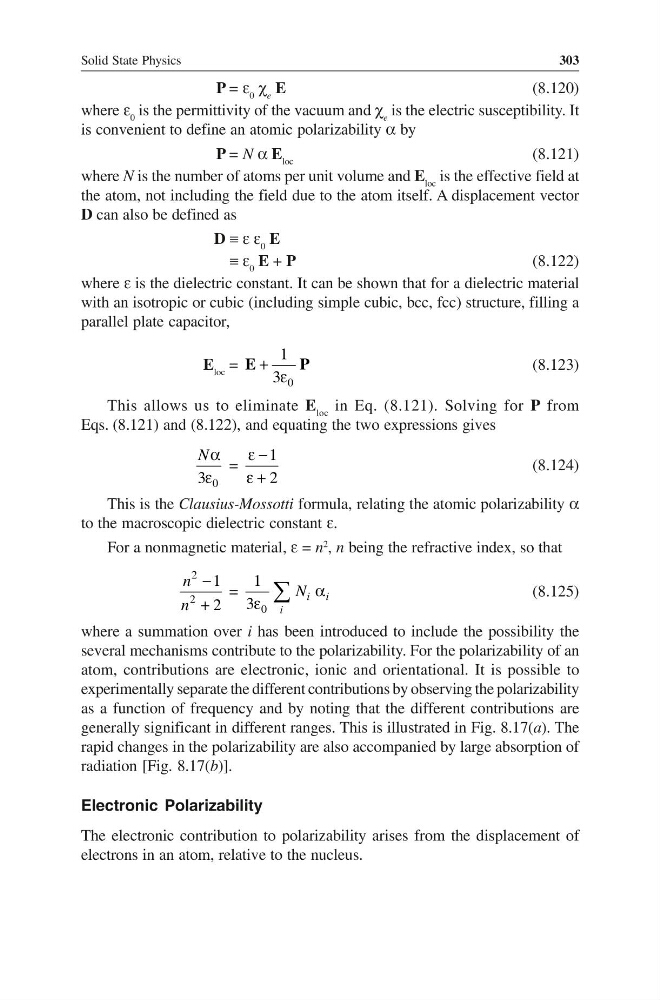
P = ε 0 χ e E
(8.120)
where ε 0 is the permittivity of the vacuum and χ e is the electric susceptibility. It
is convenient to define an atomic polarizability α by
P = N α E loc
(8.121)
where N is the number of atoms per unit volume and E loc is the effective field at
the atom, not including the field due to the atom itself. A displacement vector
D can also be defined as
D ≡ ε ε 0 E
≡ ε 0 E + P
(8.122)
where ε is the dielectric constant. It can be shown that for a dielectric material
with an isotropic or cubic (including simple cubic, bcc, fcc) structure, filling a
parallel plate capacitor,
E loc =
0
1
3
+ ε
E
P
(8.123)
This allows us to eliminate E loc in Eq. (8.121). Solving for P from
Eqs. (8.121) and (8.122), and equating the two expressions gives
0
3
α
ε
N =
1
2
ε −
ε +
(8.124)
This is the Clausius-Mossotti formula, relating the atomic polarizability α
to the macroscopic dielectric constant ε.
For a nonmagnetic material, ε = n
2
, n being the refractive index, so that
2
2
1
2
−
+
n
n
=
0
1
3
α
ε
∑ i i
i
N
(8.125)
where a summation over i has been introduced to include the possibility the
several mechanisms contribute to the polarizability. For the polarizability of an
atom, contributions are electronic, ionic and orientational. It is possible to
experimentally separate the different contributions by observing the polarizability
as a function of frequency and by noting that the different contributions are
generally significant in different ranges. This is illustrated in Fig. 8.17(a). The
rapid changes in the polarizability are also accompanied by large absorption of
radiation [Fig. 8.17(b)].
Electronic Polarizability
The electronic contribution to polarizability arises from the displacement of
electrons in an atom, relative to the nucleus.
303
P = ε 0 χ e E
(8.120)
where ε 0 is the permittivity of the vacuum and χ e is the electric susceptibility. It
is convenient to define an atomic polarizability α by
P = N α E loc
(8.121)
where N is the number of atoms per unit volume and E loc is the effective field at
the atom, not including the field due to the atom itself. A displacement vector
D can also be defined as
D ≡ ε ε 0 E
≡ ε 0 E + P
(8.122)
where ε is the dielectric constant. It can be shown that for a dielectric material
with an isotropic or cubic (including simple cubic, bcc, fcc) structure, filling a
parallel plate capacitor,
E loc =
0
1
3
+ ε
E
P
(8.123)
This allows us to eliminate E loc in Eq. (8.121). Solving for P from
Eqs. (8.121) and (8.122), and equating the two expressions gives
0
3
α
ε
N =
1
2
ε −
ε +
(8.124)
This is the Clausius-Mossotti formula, relating the atomic polarizability α
to the macroscopic dielectric constant ε.
For a nonmagnetic material, ε = n
2
, n being the refractive index, so that
2
2
1
2
−
+
n
n
=
0
1
3
α
ε
∑ i i
i
N
(8.125)
where a summation over i has been introduced to include the possibility the
several mechanisms contribute to the polarizability. For the polarizability of an
atom, contributions are electronic, ionic and orientational. It is possible to
experimentally separate the different contributions by observing the polarizability
as a function of frequency and by noting that the different contributions are
generally significant in different ranges. This is illustrated in Fig. 8.17(a). The
rapid changes in the polarizability are also accompanied by large absorption of
radiation [Fig. 8.17(b)].
Electronic Polarizability
The electronic contribution to polarizability arises from the displacement of
electrons in an atom, relative to the nucleus.