

Elements of Modern Physics
300
M
A¢
D¢
F
A
D
M =
2m kT
eh gl
x –
1
l
B o
.M =
Nehg
2m
f (x)
¢
f(x)
x
(a)
1
1
0 0
M(T) M(O)
T/T c
(b)
M
D
A
0
A¢
D¢
H = B /
o o
m
(c)
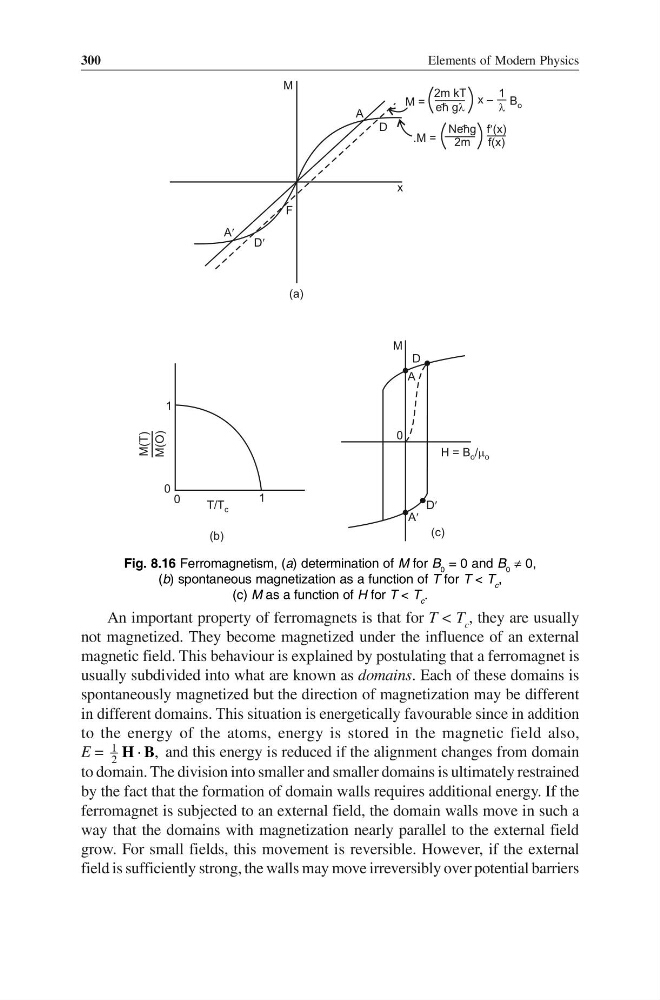
Fig. 8.16 Ferromagnetism, (a) determination of M for B 0 = 0 and B 0 ≠ 0,
(b) spontaneous magnetization as a function of T for T < T c ,
(c) M as a function of H for T < T c .
An important property of ferromagnets is that for T < T c , they are usually
not magnetized. They become magnetized under the influence of an external
magnetic field. This behaviour is explained by postulating that a ferromagnet is
usually subdivided into what are known as domains. Each of these domains is
spontaneously magnetized but the direction of magnetization may be different
in different domains. This situation is energetically favourable since in addition
to the energy of the atoms, energy is stored in the magnetic field also,
E = 1
2
,
⋅
H B and this energy is reduced if the alignment changes from domain
to domain. The division into smaller and smaller domains is ultimately restrained
by the fact that the formation of domain walls requires additional energy. If the
ferromagnet is subjected to an external field, the domain walls move in such a
way that the domains with magnetization nearly parallel to the external field
grow. For small fields, this movement is reversible. However, if the external
field is sufficiently strong, the walls may move irreversibly over potential barriers
300
M
A¢
D¢
F
A
D
M =
2m kT
eh gl
x –
1
l
B o
.M =
Nehg
2m
f (x)
¢
f(x)
x
(a)
1
1
0 0
M(T) M(O)
T/T c
(b)
M
D
A
0
A¢
D¢
H = B /
o o
m
(c)
Fig. 8.16 Ferromagnetism, (a) determination of M for B 0 = 0 and B 0 ≠ 0,
(b) spontaneous magnetization as a function of T for T < T c ,
(c) M as a function of H for T < T c .
An important property of ferromagnets is that for T < T c , they are usually
not magnetized. They become magnetized under the influence of an external
magnetic field. This behaviour is explained by postulating that a ferromagnet is
usually subdivided into what are known as domains. Each of these domains is
spontaneously magnetized but the direction of magnetization may be different
in different domains. This situation is energetically favourable since in addition
to the energy of the atoms, energy is stored in the magnetic field also,
E = 1
2
,
⋅
H B and this energy is reduced if the alignment changes from domain
to domain. The division into smaller and smaller domains is ultimately restrained
by the fact that the formation of domain walls requires additional energy. If the
ferromagnet is subjected to an external field, the domain walls move in such a
way that the domains with magnetization nearly parallel to the external field
grow. For small fields, this movement is reversible. However, if the external
field is sufficiently strong, the walls may move irreversibly over potential barriers