

Elements of Modern Physics
298
E =
,
,
−
⋅
≠
∑ ij i j
i j
J
i j
S S
(8.104)
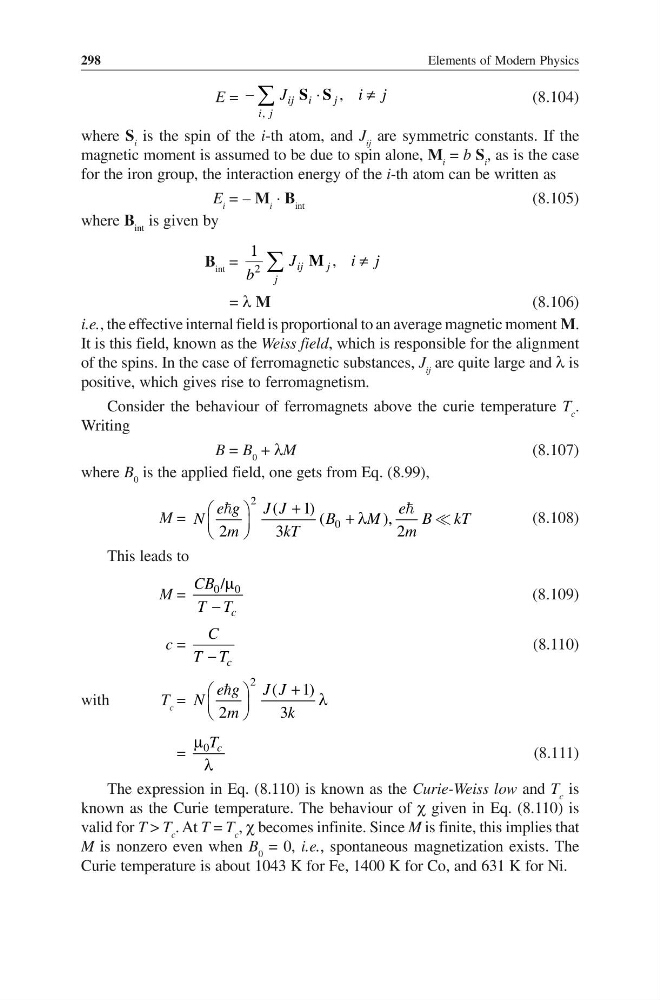
where S i is the spin of the i-th atom, and J ij are symmetric constants. If the
magnetic moment is assumed to be due to spin alone, M i = b S i , as is the case
for the iron group, the interaction energy of the i-th atom can be written as
E i = – M i ⋅ B int
(8.105)
where B int is given by
B int = 2
1
, ≠
∑ ij j
j
J
i j
b
M
= λ M
(8.106)
i.e., the effective internal field is proportional to an average magnetic moment M.
It is this field, known as the Weiss field, which is responsible for the alignment
of the spins. In the case of ferromagnetic substances, J ij are quite large and λ is
positive, which gives rise to ferromagnetism.
Consider the behaviour of ferromagnets above the curie temperature T c .
Writing
B = B 0 + λM
(8.107)
where B 0 is the applied field, one gets from Eq. (8.99),
M =
2
0
(
1) (
) ,
2
3
2
e g J J
e
N
B
M
B k T
m
kT
m
+
+ λ
(8.108)
This leads to
M =
0 0
/µ
− c
CB
T T
(8.109)
c = − c
C
T T
(8.110)
with
T c =
2 (
1)
2
3
+
λ
e g J J
N m
k
=
0
µ
λ
c
T
(8.111)
The expression in Eq. (8.110) is known as the Curie-Weiss low and T c is
known as the Curie temperature. The behaviour of χ given in Eq. (8.110) is
valid for T > T c . At T = T c , χ becomes infinite. Since M is finite, this implies that
M is nonzero even when B 0 = 0, i.e., spontaneous magnetization exists. The
Curie temperature is about 1043 K for Fe, 1400 K for Co, and 631 K for Ni.
298
E =
,
,
−
⋅
≠
∑ ij i j
i j
J
i j
S S
(8.104)
where S i is the spin of the i-th atom, and J ij are symmetric constants. If the
magnetic moment is assumed to be due to spin alone, M i = b S i , as is the case
for the iron group, the interaction energy of the i-th atom can be written as
E i = – M i ⋅ B int
(8.105)
where B int is given by
B int = 2
1
, ≠
∑ ij j
j
J
i j
b
M
= λ M
(8.106)
i.e., the effective internal field is proportional to an average magnetic moment M.
It is this field, known as the Weiss field, which is responsible for the alignment
of the spins. In the case of ferromagnetic substances, J ij are quite large and λ is
positive, which gives rise to ferromagnetism.
Consider the behaviour of ferromagnets above the curie temperature T c .
Writing
B = B 0 + λM
(8.107)
where B 0 is the applied field, one gets from Eq. (8.99),
M =
2
0
(
1) (
) ,
2
3
2
e g J J
e
N
B
M
B k T
m
kT
m
+
+ λ
(8.108)
This leads to
M =
0 0
/µ
− c
CB
T T
(8.109)
c = − c
C
T T
(8.110)
with
T c =
2 (
1)
2
3
+
λ
e g J J
N m
k
=
0
µ
λ
c
T
(8.111)
The expression in Eq. (8.110) is known as the Curie-Weiss low and T c is
known as the Curie temperature. The behaviour of χ given in Eq. (8.110) is
valid for T > T c . At T = T c , χ becomes infinite. Since M is finite, this implies that
M is nonzero even when B 0 = 0, i.e., spontaneous magnetization exists. The
Curie temperature is about 1043 K for Fe, 1400 K for Co, and 631 K for Ni.