

Solid State Physics
289
about 10
–8
s) and efficiently, the junction is subjected to a reverse bias so that
the carriers at the junction are subjected to a large potential difference. The pn
junction is also used as solid-state detector for measuring the energy of other
particles such as protons and electrons, the only difference in this case being
that these particles are not absorbed and come to rest after creating several
electron-hole pairs.
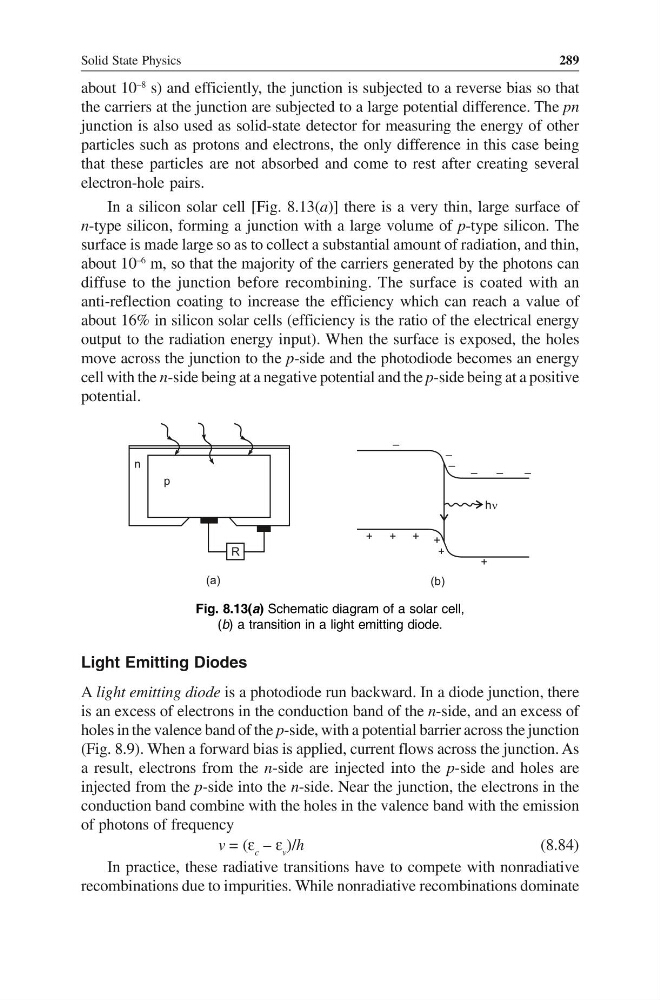
In a silicon solar cell [Fig. 8.13(a)] there is a very thin, large surface of
n-type silicon, forming a junction with a large volume of p-type silicon. The
surface is made large so as to collect a substantial amount of radiation, and thin,
about 10
–6
m, so that the majority of the carriers generated by the photons can
diffuse to the junction before recombining. The surface is coated with an
anti-reflection coating to increase the efficiency which can reach a value of
about 16% in silicon solar cells (efficiency is the ratio of the electrical energy
output to the radiation energy input). When the surface is exposed, the holes
move across the junction to the p-side and the photodiode becomes an energy
cell with the n-side being at a negative potential and the p-side being at a positive
potential.
n
p
R
(a)
–
–
hn
– –
–
–
+
+
+
+
+
(b)
+
Fig. 8.13(a) Schematic diagram of a solar cell,
(b) a transition in a light emitting diode.
Light Emitting Diodes
A light emitting diode is a photodiode run backward. In a diode junction, there
is an excess of electrons in the conduction band of the n-side, and an excess of
holes in the valence band of the p-side, with a potential barrier across the junction
(Fig. 8.9). When a forward bias is applied, current flows across the junction. As
a result, electrons from the n-side are injected into the p-side and holes are
injected from the p-side into the n-side. Near the junction, the electrons in the
conduction band combine with the holes in the valence band with the emission
of photons of frequency
v = (ε c – ε v )/h
(8.84)
In practice, these radiative transitions have to compete with nonradiative
recombinations due to impurities. While nonradiative recombinations dominate
289
about 10
–8
s) and efficiently, the junction is subjected to a reverse bias so that
the carriers at the junction are subjected to a large potential difference. The pn
junction is also used as solid-state detector for measuring the energy of other
particles such as protons and electrons, the only difference in this case being
that these particles are not absorbed and come to rest after creating several
electron-hole pairs.
In a silicon solar cell [Fig. 8.13(a)] there is a very thin, large surface of
n-type silicon, forming a junction with a large volume of p-type silicon. The
surface is made large so as to collect a substantial amount of radiation, and thin,
about 10
–6
m, so that the majority of the carriers generated by the photons can
diffuse to the junction before recombining. The surface is coated with an
anti-reflection coating to increase the efficiency which can reach a value of
about 16% in silicon solar cells (efficiency is the ratio of the electrical energy
output to the radiation energy input). When the surface is exposed, the holes
move across the junction to the p-side and the photodiode becomes an energy
cell with the n-side being at a negative potential and the p-side being at a positive
potential.
n
p
R
(a)
–
–
hn
– –
–
–
+
+
+
+
+
(b)
+
Fig. 8.13(a) Schematic diagram of a solar cell,
(b) a transition in a light emitting diode.
Light Emitting Diodes
A light emitting diode is a photodiode run backward. In a diode junction, there
is an excess of electrons in the conduction band of the n-side, and an excess of
holes in the valence band of the p-side, with a potential barrier across the junction
(Fig. 8.9). When a forward bias is applied, current flows across the junction. As
a result, electrons from the n-side are injected into the p-side and holes are
injected from the p-side into the n-side. Near the junction, the electrons in the
conduction band combine with the holes in the valence band with the emission
of photons of frequency
v = (ε c – ε v )/h
(8.84)
In practice, these radiative transitions have to compete with nonradiative
recombinations due to impurities. While nonradiative recombinations dominate