

Elements of Modern Physics
18
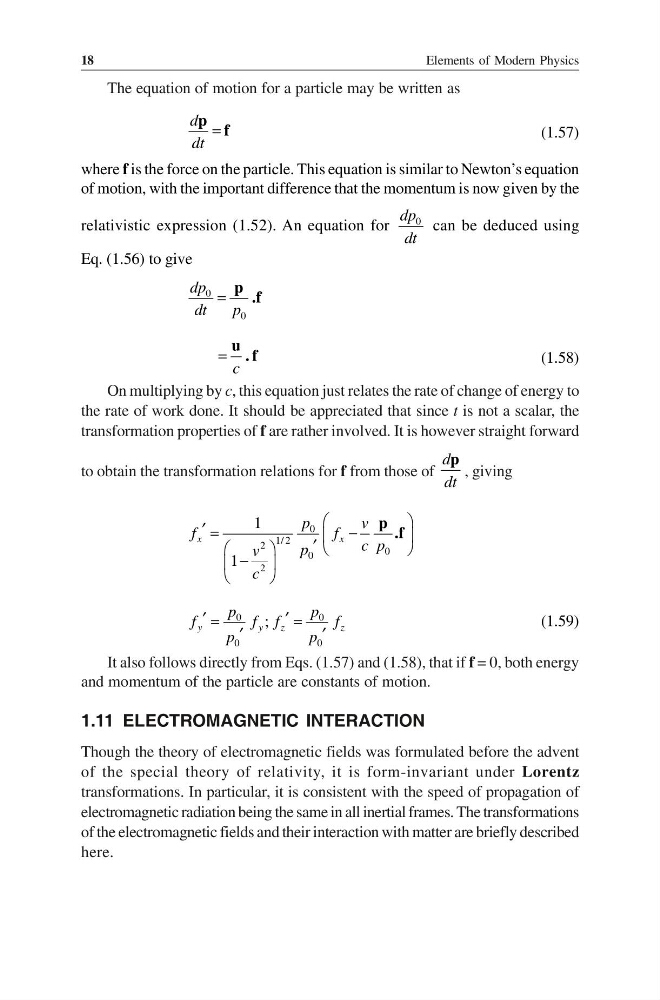
The equation of motion for a particle may be written as
d
dt
=
p f
(1.57)
where f is the force on the particle. This equation is similar to Newton’s equation
of motion, with the important difference that the momentum is now given by the
relativistic expression (1.52). An equation for
0
dp
dt
can be deduced using
Eq. (1.56) to give
0
0
=
dp
dt
p
p .f
= c
u . f
(1.58)
On multiplying by c, this equation just relates the rate of change of energy to
the rate of work done. It should be appreciated that since t is not a scalar, the
transformation properties of f are rather involved. It is however straight forward
to obtain the transformation relations for f from those of
d
dt
p , giving
0
1/ 2
2
0
0
2
1
1
′ =
−
′
−
x
x
p
v
f
f c p
p
v
c
p .f
0
0
0
0
;
y
y
z
z
p
p
f
f f
f
p
p
′
′
=
=
′
′
(1.59)
It also follows directly from Eqs. (1.57) and (1.58), that if f = 0, both energy
and momentum of the particle are constants of motion.
1.11 ELECTROMAGNETIC INTERACTION
Though the theory of electromagnetic fields was formulated before the advent
of the special theory of relativity, it is form-invariant under Lorentz
transformations. In particular, it is consistent with the speed of propagation of
electromagnetic radiation being the same in all inertial frames. The transformations
of the electromagnetic fields and their interaction with matter are briefly described
here.
18
The equation of motion for a particle may be written as
d
dt
=
p f
(1.57)
where f is the force on the particle. This equation is similar to Newton’s equation
of motion, with the important difference that the momentum is now given by the
relativistic expression (1.52). An equation for
0
dp
dt
can be deduced using
Eq. (1.56) to give
0
0
=
dp
dt
p
p .f
= c
u . f
(1.58)
On multiplying by c, this equation just relates the rate of change of energy to
the rate of work done. It should be appreciated that since t is not a scalar, the
transformation properties of f are rather involved. It is however straight forward
to obtain the transformation relations for f from those of
d
dt
p , giving
0
1/ 2
2
0
0
2
1
1
′ =
−
′
−
x
x
p
v
f
f c p
p
v
c
p .f
0
0
0
0
;
y
y
z
z
p
p
f
f f
f
p
p
′
′
=
=
′
′
(1.59)
It also follows directly from Eqs. (1.57) and (1.58), that if f = 0, both energy
and momentum of the particle are constants of motion.
1.11 ELECTROMAGNETIC INTERACTION
Though the theory of electromagnetic fields was formulated before the advent
of the special theory of relativity, it is form-invariant under Lorentz
transformations. In particular, it is consistent with the speed of propagation of
electromagnetic radiation being the same in all inertial frames. The transformations
of the electromagnetic fields and their interaction with matter are briefly described
here.