

Elements of Modern Physics
274
as efficient carriers of current. In this situation, an insulator can become a good
conductor and the effect is known as photoconductivity. It may be observed that
even at finite temperatures only a very small number of electrons are in the
conduction band (energy gap ∆E is very large compared to kT), and an insulator
remains a poor conductor of electric current.
3s
2p
2s
2s + 2p
2s + 2p
Energy
gap E
D
3s + 3p
3s + 3p
2p
2s
Small energy
gap E
D
1s
Metal
(a)
1s
Insulator
(b)
1s
Semiconductor
(c)
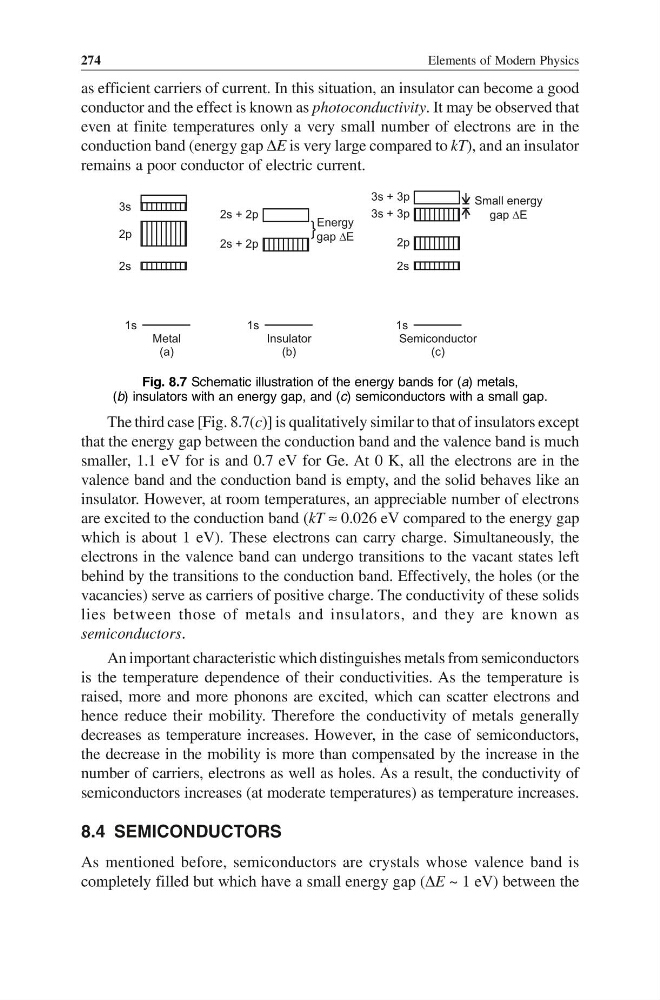
Fig. 8.7 Schematic illustration of the energy bands for (a) metals,
(b) insulators with an energy gap, and (c) semiconductors with a small gap.
The third case [Fig. 8.7(c)] is qualitatively similar to that of insulators except
that the energy gap between the conduction band and the valence band is much
smaller, 1.1 eV for is and 0.7 eV for Ge. At 0 K, all the electrons are in the
valence band and the conduction band is empty, and the solid behaves like an
insulator. However, at room temperatures, an appreciable number of electrons
are excited to the conduction band (kT ≈ 0.026 eV compared to the energy gap
which is about 1 eV). These electrons can carry charge. Simultaneously, the
electrons in the valence band can undergo transitions to the vacant states left
behind by the transitions to the conduction band. Effectively, the holes (or the
vacancies) serve as carriers of positive charge. The conductivity of these solids
lies between those of metals and insulators, and they are known as
semiconductors.
An important characteristic which distinguishes metals from semiconductors
is the temperature dependence of their conductivities. As the temperature is
raised, more and more phonons are excited, which can scatter electrons and
hence reduce their mobility. Therefore the conductivity of metals generally
decreases as temperature increases. However, in the case of semiconductors,
the decrease in the mobility is more than compensated by the increase in the
number of carriers, electrons as well as holes. As a result, the conductivity of
semiconductors increases (at moderate temperatures) as temperature increases.
8.4 SEMICONDUCTORS
As mentioned before, semiconductors are crystals whose valence band is
completely filled but which have a small energy gap (∆E ~ 1 eV) between the
274
as efficient carriers of current. In this situation, an insulator can become a good
conductor and the effect is known as photoconductivity. It may be observed that
even at finite temperatures only a very small number of electrons are in the
conduction band (energy gap ∆E is very large compared to kT), and an insulator
remains a poor conductor of electric current.
3s
2p
2s
2s + 2p
2s + 2p
Energy
gap E
D
3s + 3p
3s + 3p
2p
2s
Small energy
gap E
D
1s
Metal
(a)
1s
Insulator
(b)
1s
Semiconductor
(c)
Fig. 8.7 Schematic illustration of the energy bands for (a) metals,
(b) insulators with an energy gap, and (c) semiconductors with a small gap.
The third case [Fig. 8.7(c)] is qualitatively similar to that of insulators except
that the energy gap between the conduction band and the valence band is much
smaller, 1.1 eV for is and 0.7 eV for Ge. At 0 K, all the electrons are in the
valence band and the conduction band is empty, and the solid behaves like an
insulator. However, at room temperatures, an appreciable number of electrons
are excited to the conduction band (kT ≈ 0.026 eV compared to the energy gap
which is about 1 eV). These electrons can carry charge. Simultaneously, the
electrons in the valence band can undergo transitions to the vacant states left
behind by the transitions to the conduction band. Effectively, the holes (or the
vacancies) serve as carriers of positive charge. The conductivity of these solids
lies between those of metals and insulators, and they are known as
semiconductors.
An important characteristic which distinguishes metals from semiconductors
is the temperature dependence of their conductivities. As the temperature is
raised, more and more phonons are excited, which can scatter electrons and
hence reduce their mobility. Therefore the conductivity of metals generally
decreases as temperature increases. However, in the case of semiconductors,
the decrease in the mobility is more than compensated by the increase in the
number of carriers, electrons as well as holes. As a result, the conductivity of
semiconductors increases (at moderate temperatures) as temperature increases.
8.4 SEMICONDUCTORS
As mentioned before, semiconductors are crystals whose valence band is
completely filled but which have a small energy gap (∆E ~ 1 eV) between the