

Elements of Modern Physics
234
For metals, N/V ≈ 5 × 10
22
cm
–3
for which Eq. (7.89) implies ε f = 4.5 eV.
The actual value of ε f (0) for some of the metals is 4.7 eV for Li, 2.1 eV for K,
7.0 eV for Cu, and 5.5 eV for Au. This means that the approximation in
Eq. (7.91) is adequate for most purposes (kT≈ 0.026 eV at T = 300 K). For
kT< <ε f most of the electrons are in the lowest energy states allowed by Pauli’s
exclusion principle, and the electron gas is said to be degenerate (completely
degenerate at T = 0). It is interesting to note that because of the exclusion
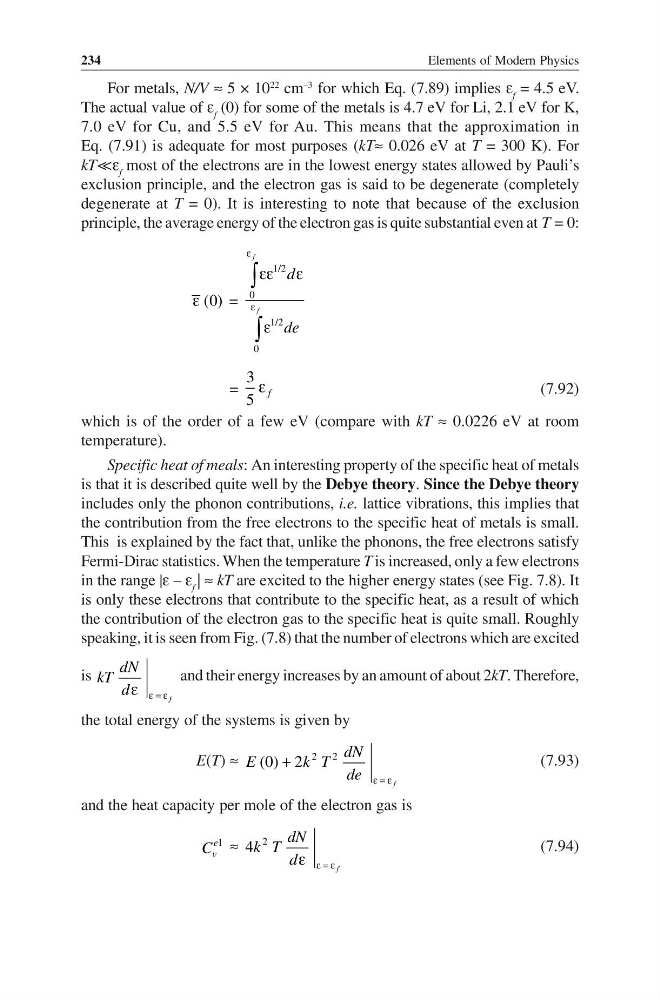
principle, the average energy of the electron gas is quite substantial even at T = 0:
(0)
ε
=
1/2
0
1/2
0
f
f
d
de
ε
ε
εε ε
ε
∫
∫
=
3
5
f
ε
(7.92)
which is of the order of a few eV (compare with kT ≈ 0.0226 eV at room
temperature).
Specific heat of meals: An interesting property of the specific heat of metals
is that it is described quite well by the Debye theory. Since the Debye theory
includes only the phonon contributions, i.e. lattice vibrations, this implies that
the contribution from the free electrons to the specific heat of metals is small.
This is explained by the fact that, unlike the phonons, the free electrons satisfy
Fermi-Dirac statistics. When the temperature T is increased, only a few electrons
in the range |ε – ε f | ≈ kT are excited to the higher energy states (see Fig. 7.8). It
is only these electrons that contribute to the specific heat, as a result of which
the contribution of the electron gas to the specific heat is quite small. Roughly
speaking, it is seen from Fig. (7.8) that the number of electrons which are excited
is
f
dN
kT d ε = ε
ε
and their energy increases by an amount of about 2kT. Therefore,
the total energy of the systems is given by
E(T) ≈
2
2
(0) 2
f
dN
E
k T de ε = ε
+
(7.93)
and the heat capacity per mole of the electron gas is
1
e
v
C ≈
2
4
f
dN
k T d ε = ε
ε
(7.94)
234
For metals, N/V ≈ 5 × 10
22
cm
–3
for which Eq. (7.89) implies ε f = 4.5 eV.
The actual value of ε f (0) for some of the metals is 4.7 eV for Li, 2.1 eV for K,
7.0 eV for Cu, and 5.5 eV for Au. This means that the approximation in
Eq. (7.91) is adequate for most purposes (kT≈ 0.026 eV at T = 300 K). For
kT< <ε f most of the electrons are in the lowest energy states allowed by Pauli’s
exclusion principle, and the electron gas is said to be degenerate (completely
degenerate at T = 0). It is interesting to note that because of the exclusion
principle, the average energy of the electron gas is quite substantial even at T = 0:
(0)
ε
=
1/2
0
1/2
0
f
f
d
de
ε
ε
εε ε
ε
∫
∫
=
3
5
f
ε
(7.92)
which is of the order of a few eV (compare with kT ≈ 0.0226 eV at room
temperature).
Specific heat of meals: An interesting property of the specific heat of metals
is that it is described quite well by the Debye theory. Since the Debye theory
includes only the phonon contributions, i.e. lattice vibrations, this implies that
the contribution from the free electrons to the specific heat of metals is small.
This is explained by the fact that, unlike the phonons, the free electrons satisfy
Fermi-Dirac statistics. When the temperature T is increased, only a few electrons
in the range |ε – ε f | ≈ kT are excited to the higher energy states (see Fig. 7.8). It
is only these electrons that contribute to the specific heat, as a result of which
the contribution of the electron gas to the specific heat is quite small. Roughly
speaking, it is seen from Fig. (7.8) that the number of electrons which are excited
is
f
dN
kT d ε = ε
ε
and their energy increases by an amount of about 2kT. Therefore,
the total energy of the systems is given by
E(T) ≈
2
2
(0) 2
f
dN
E
k T de ε = ε
+
(7.93)
and the heat capacity per mole of the electron gas is
1
e
v
C ≈
2
4
f
dN
k T d ε = ε
ε
(7.94)