

Elements of Modern Physics
212
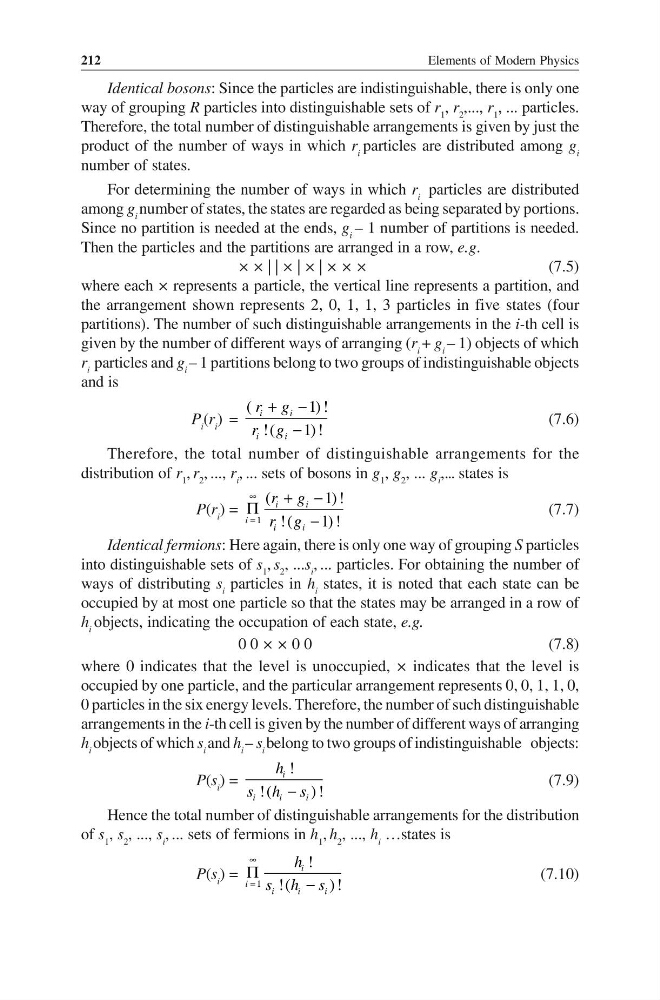
Identical bosons: Since the particles are indistinguishable, there is only one
way of grouping R particles into distinguishable sets of r 1 , r 2 ,..., r 1 , ... particles.
Therefore, the total number of distinguishable arrangements is given by just the
product of the number of ways in which r i particles are distributed among g i
number of states.
For determining the number of ways in which r i particles are distributed
among g i number of states, the states are regarded as being separated by portions.
Since no partition is needed at the ends, g i – 1 number of partitions is needed.
Then the particles and the partitions are arranged in a row, e.g.
× × | | × | × | × × ×
(7.5)
where each × represents a particle, the vertical line represents a partition, and
the arrangement shown represents 2, 0, 1, 1, 3 particles in five states (four
partitions). The number of such distinguishable arrangements in the i-th cell is
given by the number of different ways of arranging (r i + g i – 1) objects of which
r i particles and g i – 1 partitions belong to two groups of indistinguishable objects
and is
P i (r i ) =
(
1 )!
!(
1) !
i
i
i
i
r g
r g
+ −
−
(7.6)
Therefore, the total number of distinguishable arrangements for the
distribution of r 1 , r 2 , ..., r i , ... sets of bosons in g 1 , g 2 , ... g i ,... states is
P(r i ) =
1
(
1 )!
!(
1) !
i
i
i
i
i
r g
r g
∞
=
+ −
Π
−
(7.7)
Identical fermions: Here again, there is only one way of grouping S particles
into distinguishable sets of s 1 , s 2 , ...s i , ... particles. For obtaining the number of
ways of distributing s i particles in h i states, it is noted that each state can be
occupied by at most one particle so that the states may be arranged in a row of
h i objects, indicating the occupation of each state, e.g.
0 0 × × 0 0
(7.8)
where 0 indicates that the level is unoccupied, × indicates that the level is
occupied by one particle, and the particular arrangement represents 0, 0, 1, 1, 0,
0 particles in the six energy levels. Therefore, the number of such distinguishable
arrangements in the i-th cell is given by the number of different ways of arranging
h i objects of which s i and h i – s i belong to two groups of indistinguishable objects:
P(s i ) =
!
!(
) !
i
i
i
i
h
s h s
−
(7.9)
Hence the total number of distinguishable arrangements for the distribution
of s 1 , s 2 , ..., s i , ... sets of fermions in h 1 , h 2 , ..., h i …states is
P(s i ) = 1
!
!(
) !
i
i
i
i
i
h
s h s
∞
=
Π
−
(7.10)
212
Identical bosons: Since the particles are indistinguishable, there is only one
way of grouping R particles into distinguishable sets of r 1 , r 2 ,..., r 1 , ... particles.
Therefore, the total number of distinguishable arrangements is given by just the
product of the number of ways in which r i particles are distributed among g i
number of states.
For determining the number of ways in which r i particles are distributed
among g i number of states, the states are regarded as being separated by portions.
Since no partition is needed at the ends, g i – 1 number of partitions is needed.
Then the particles and the partitions are arranged in a row, e.g.
× × | | × | × | × × ×
(7.5)
where each × represents a particle, the vertical line represents a partition, and
the arrangement shown represents 2, 0, 1, 1, 3 particles in five states (four
partitions). The number of such distinguishable arrangements in the i-th cell is
given by the number of different ways of arranging (r i + g i – 1) objects of which
r i particles and g i – 1 partitions belong to two groups of indistinguishable objects
and is
P i (r i ) =
(
1 )!
!(
1) !
i
i
i
i
r g
r g
+ −
−
(7.6)
Therefore, the total number of distinguishable arrangements for the
distribution of r 1 , r 2 , ..., r i , ... sets of bosons in g 1 , g 2 , ... g i ,... states is
P(r i ) =
1
(
1 )!
!(
1) !
i
i
i
i
i
r g
r g
∞
=
+ −
Π
−
(7.7)
Identical fermions: Here again, there is only one way of grouping S particles
into distinguishable sets of s 1 , s 2 , ...s i , ... particles. For obtaining the number of
ways of distributing s i particles in h i states, it is noted that each state can be
occupied by at most one particle so that the states may be arranged in a row of
h i objects, indicating the occupation of each state, e.g.
0 0 × × 0 0
(7.8)
where 0 indicates that the level is unoccupied, × indicates that the level is
occupied by one particle, and the particular arrangement represents 0, 0, 1, 1, 0,
0 particles in the six energy levels. Therefore, the number of such distinguishable
arrangements in the i-th cell is given by the number of different ways of arranging
h i objects of which s i and h i – s i belong to two groups of indistinguishable objects:
P(s i ) =
!
!(
) !
i
i
i
i
h
s h s
−
(7.9)
Hence the total number of distinguishable arrangements for the distribution
of s 1 , s 2 , ..., s i , ... sets of fermions in h 1 , h 2 , ..., h i …states is
P(s i ) = 1
!
!(
) !
i
i
i
i
i
h
s h s
∞
=
Π
−
(7.10)