

Special Theory of Relativity
11
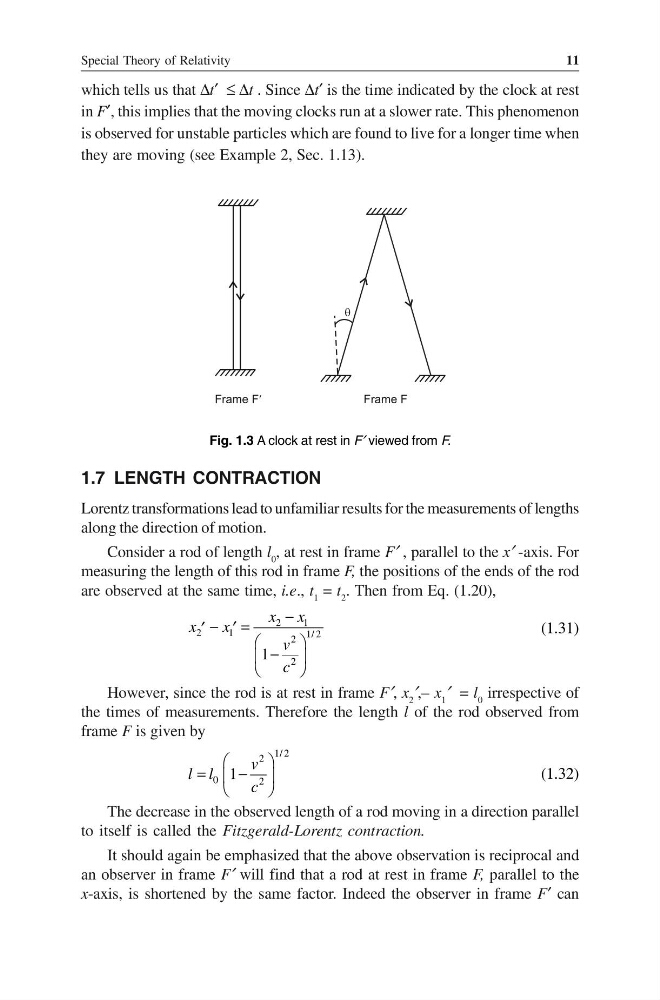
which tells us that ∆t′ ≤ ∆t . Since ∆t′ is the time indicated by the clock at rest
in F′, this implies that the moving clocks run at a slower rate. This phenomenon
is observed for unstable particles which are found to live for a longer time when
they are moving (see Example 2, Sec. 1.13).
q
Frame F¢
Frame F
Fig. 1.3 A clock at rest in F′ viewed from F.
1.7 LENGTH CONTRACTION
Lorentz transformations lead to unfamiliar results for the measurements of lengths
along the direction of motion.
Consider a rod of length l 0 , at rest in frame F′ , parallel to the x′ -axis. For
measuring the length of this rod in frame F, the positions of the ends of the rod
are observed at the same time, i.e., t 1 = t 2 . Then from Eq. (1.20),
2
1
2
1
1/ 2
2
2
1
x x
x
x
v
c
−
− =
′
′
−
(1.31)
However, since the rod is at rest in frame F′, x 2 ′,– x 1 ′ = l 0 irrespective of
the times of measurements. Therefore the length l of the rod observed from
frame F is given by
1/ 2
2
0
2
1
v
l l
c
=
−
(1.32)
The decrease in the observed length of a rod moving in a direction parallel
to itself is called the Fitzgerald-Lorentz contraction.
It should again be emphasized that the above observation is reciprocal and
an observer in frame F′ will find that a rod at rest in frame F, parallel to the
x-axis, is shortened by the same factor. Indeed the observer in frame F′ can
11
which tells us that ∆t′ ≤ ∆t . Since ∆t′ is the time indicated by the clock at rest
in F′, this implies that the moving clocks run at a slower rate. This phenomenon
is observed for unstable particles which are found to live for a longer time when
they are moving (see Example 2, Sec. 1.13).
q
Frame F¢
Frame F
Fig. 1.3 A clock at rest in F′ viewed from F.
1.7 LENGTH CONTRACTION
Lorentz transformations lead to unfamiliar results for the measurements of lengths
along the direction of motion.
Consider a rod of length l 0 , at rest in frame F′ , parallel to the x′ -axis. For
measuring the length of this rod in frame F, the positions of the ends of the rod
are observed at the same time, i.e., t 1 = t 2 . Then from Eq. (1.20),
2
1
2
1
1/ 2
2
2
1
x x
x
x
v
c
−
− =
′
′
−
(1.31)
However, since the rod is at rest in frame F′, x 2 ′,– x 1 ′ = l 0 irrespective of
the times of measurements. Therefore the length l of the rod observed from
frame F is given by
1/ 2
2
0
2
1
v
l l
c
=
−
(1.32)
The decrease in the observed length of a rod moving in a direction parallel
to itself is called the Fitzgerald-Lorentz contraction.
It should again be emphasized that the above observation is reciprocal and
an observer in frame F′ will find that a rod at rest in frame F, parallel to the
x-axis, is shortened by the same factor. Indeed the observer in frame F′ can