

Atoms and Molecules
171
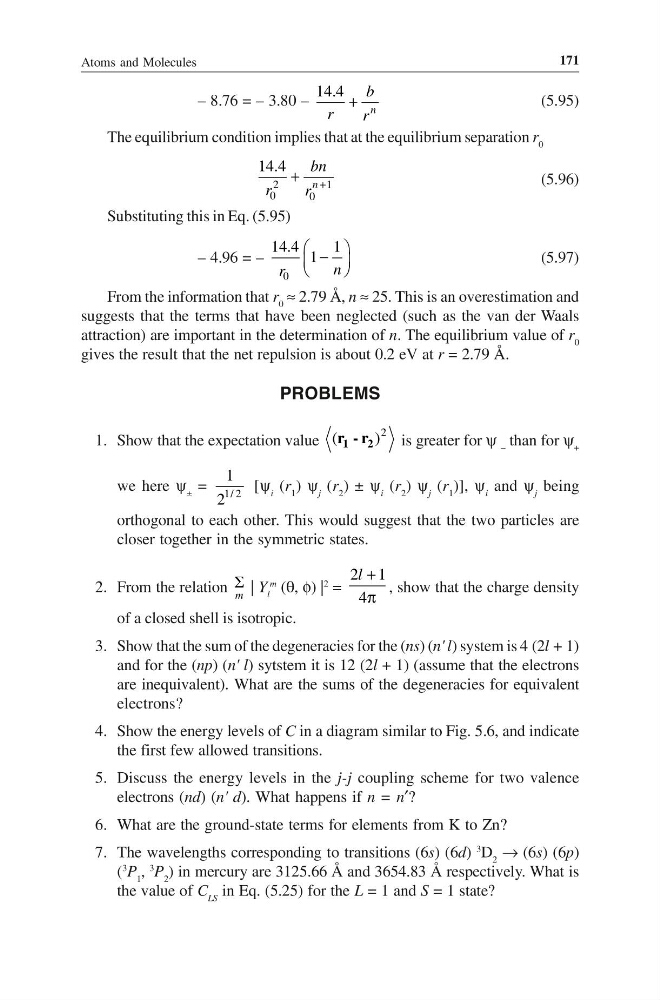
– 8.76 = – 3.80 –
14.4
n
b
r
r
+
(5.95)
The equilibrium condition implies that at the equilibrium separation r 0
2
1
0
0
14.4
+
+ n
bn
r
r
(5.96)
Substituting this in Eq. (5.95)
– 4.96 = –
0
14.4
1
1 n
r
−
(5.97)
From the information that r 0 ≈ 2.79 Å, n ≈ 25. This is an overestimation and
suggests that the terms that have been neglected (such as the van der Waals
attraction) are important in the determination of n. The equilibrium value of r 0
gives the result that the net repulsion is about 0.2 eV at r = 2.79 Å.
PROBLEMS
1. Show that the expectation value
2
(
)
1
2
r - r
is greater for ψ – than for ψ +
we here ψ ± = 1/ 2
1
2
[ψ i (r 1 ) ψ j (r 2 ) ± ψ i (r 2 ) ψ j (r 1 )], ψ i and ψ j being
orthogonal to each other. This would suggest that the two particles are
closer together in the symmetric states.
2. From the relation m
Σ | Y l
m
(θ, φ) |
2
=
2 1
4
l +
π
, show that the charge density
of a closed shell is isotropic.
3. Show that the sum of the degeneracies for the (ns) (n' l) system is 4 (2l + 1)
and for the (np) (n' l) sytstem it is 12 (2l + 1) (assume that the electrons
are inequivalent). What are the sums of the degeneracies for equivalent
electrons?
4. Show the energy levels of C in a diagram similar to Fig. 5.6, and indicate
the first few allowed transitions.
5. Discuss the energy levels in the j-j coupling scheme for two valence
electrons (nd) (n' d). What happens if n = n′?
6. What are the ground-state terms for elements from K to Zn?
7. The wavelengths corresponding to transitions (6s) (6d)
3
D 2 → (6s) (6p)
(
3
P 1 ,
3
P 2 ) in mercury are 3125.66 Å and 3654.83 Å respectively. What is
the value of C LS in Eq. (5.25) for the L = 1 and S = 1 state?
171
– 8.76 = – 3.80 –
14.4
n
b
r
r
+
(5.95)
The equilibrium condition implies that at the equilibrium separation r 0
2
1
0
0
14.4
+
+ n
bn
r
r
(5.96)
Substituting this in Eq. (5.95)
– 4.96 = –
0
14.4
1
1 n
r
−
(5.97)
From the information that r 0 ≈ 2.79 Å, n ≈ 25. This is an overestimation and
suggests that the terms that have been neglected (such as the van der Waals
attraction) are important in the determination of n. The equilibrium value of r 0
gives the result that the net repulsion is about 0.2 eV at r = 2.79 Å.
PROBLEMS
1. Show that the expectation value
2
(
)
1
2
r - r
is greater for ψ – than for ψ +
we here ψ ± = 1/ 2
1
2
[ψ i (r 1 ) ψ j (r 2 ) ± ψ i (r 2 ) ψ j (r 1 )], ψ i and ψ j being
orthogonal to each other. This would suggest that the two particles are
closer together in the symmetric states.
2. From the relation m
Σ | Y l
m
(θ, φ) |
2
=
2 1
4
l +
π
, show that the charge density
of a closed shell is isotropic.
3. Show that the sum of the degeneracies for the (ns) (n' l) system is 4 (2l + 1)
and for the (np) (n' l) sytstem it is 12 (2l + 1) (assume that the electrons
are inequivalent). What are the sums of the degeneracies for equivalent
electrons?
4. Show the energy levels of C in a diagram similar to Fig. 5.6, and indicate
the first few allowed transitions.
5. Discuss the energy levels in the j-j coupling scheme for two valence
electrons (nd) (n' d). What happens if n = n′?
6. What are the ground-state terms for elements from K to Zn?
7. The wavelengths corresponding to transitions (6s) (6d)
3
D 2 → (6s) (6p)
(
3
P 1 ,
3
P 2 ) in mercury are 3125.66 Å and 3654.83 Å respectively. What is
the value of C LS in Eq. (5.25) for the L = 1 and S = 1 state?