

Atoms and Molecules
169
(2
1)
Σ
+
⋅
J
J
L S = 0
(5.80)
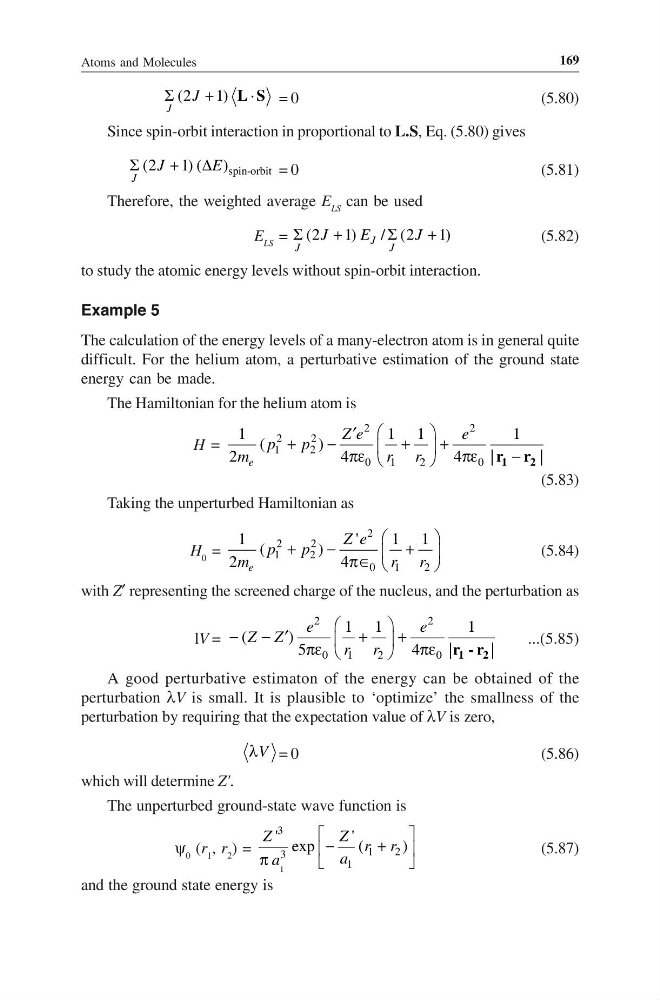
Since spin-orbit interaction in proportional to L.S, Eq. (5.80) gives
spin-orbit
(2
1) ( )
J
J
E
Σ
+ ∆
= 0
(5.81)
Therefore, the weighted average E LS can be used
E LS = (2
1)
/ (2
1)
J
J
J
J
E
J
Σ
+
Σ
+
(5.82)
to study the atomic energy levels without spin-orbit interaction.
Example 5
The calculation of the energy levels of a many-electron atom is in general quite
difficult. For the helium atom, a perturbative estimation of the ground state
energy can be made.
The Hamiltonian for the helium atom is
H =
2
2
2
2
1
2
0
1
2
0
1
1 1
1
(
)
2
4
4
|
|
′
+
−
+
+
πε
πε
−
e
Z e
e
p
p
m
r r
1
2
r r
(5.83)
Taking the unperturbed Hamiltonian as
H 0 =
2
2
2
1
2
0
1
2
1
'
1 1
(
)
2
4
+
−
+
π∈
e
Z e
p
p
m
r r
(5.84)
with Z′ representing the screened charge of the nucleus, and the perturbation as
lV =
2
2
0
1
2
0
1 1
1
(
) 5
4
|
|
− − ′
+
+
πε
πε
e
e
Z Z
r r
1
2
r - r
...(5.85)
A good perturbative estimaton of the energy can be obtained of the
perturbation λV is small. It is plausible to ‘optimize’ the smallness of the
perturbation by requiring that the expectation value of λV is zero,
V
λ = 0
(5.86)
which will determine Z'.
The unperturbed ground-state wave function is
ψ 0 (r 1 , r 2 ) =
1
3
1
2
3
1
'
'
exp
(
)
Z
Z r r
a
a
−
+
π
(5.87)
and the ground state energy is
169
(2
1)
Σ
+
⋅
J
J
L S = 0
(5.80)
Since spin-orbit interaction in proportional to L.S, Eq. (5.80) gives
spin-orbit
(2
1) ( )
J
J
E
Σ
+ ∆
= 0
(5.81)
Therefore, the weighted average E LS can be used
E LS = (2
1)
/ (2
1)
J
J
J
J
E
J
Σ
+
Σ
+
(5.82)
to study the atomic energy levels without spin-orbit interaction.
Example 5
The calculation of the energy levels of a many-electron atom is in general quite
difficult. For the helium atom, a perturbative estimation of the ground state
energy can be made.
The Hamiltonian for the helium atom is
H =
2
2
2
2
1
2
0
1
2
0
1
1 1
1
(
)
2
4
4
|
|
′
+
−
+
+
πε
πε
−
e
Z e
e
p
p
m
r r
1
2
r r
(5.83)
Taking the unperturbed Hamiltonian as
H 0 =
2
2
2
1
2
0
1
2
1
'
1 1
(
)
2
4
+
−
+
π∈
e
Z e
p
p
m
r r
(5.84)
with Z′ representing the screened charge of the nucleus, and the perturbation as
lV =
2
2
0
1
2
0
1 1
1
(
) 5
4
|
|
− − ′
+
+
πε
πε
e
e
Z Z
r r
1
2
r - r
...(5.85)
A good perturbative estimaton of the energy can be obtained of the
perturbation λV is small. It is plausible to ‘optimize’ the smallness of the
perturbation by requiring that the expectation value of λV is zero,
V
λ = 0
(5.86)
which will determine Z'.
The unperturbed ground-state wave function is
ψ 0 (r 1 , r 2 ) =
1
3
1
2
3
1
'
'
exp
(
)
Z
Z r r
a
a
−
+
π
(5.87)
and the ground state energy is