

Atoms and Molecules
165
For nuclei with an integral I, the ortho states are associated with even l values
and the para states with odd l values, while for nuclei with an half-integral I, the
ortho states are associated with odd/values and the para states with even
l values. Since nuclear spin has only a weak interaction, it does not change in a
normal transition.
J = 3
2
1
0
n = 1
J = 3
2
1
0
n = 0
Line
Spectrum
2n 1
3n 1
n 1
n 0
n n
1
1
= J
n n n
= ± J
0
1
(a)
(b)
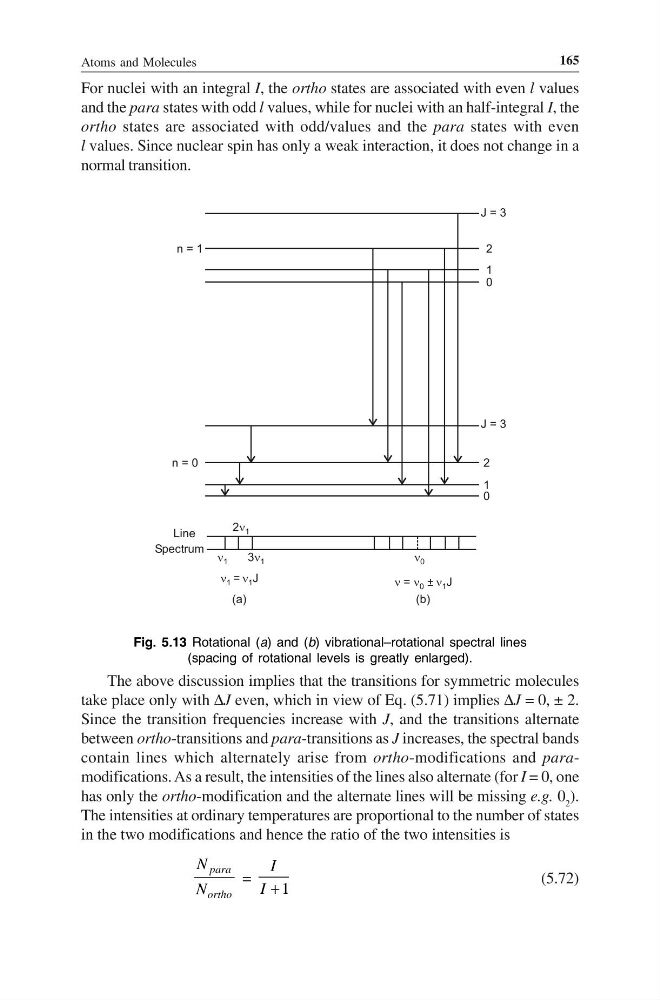
Fig. 5.13 Rotational (a) and (b) vibrational–rotational spectral lines
(spacing of rotational levels is greatly enlarged).
The above discussion implies that the transitions for symmetric molecules
take place only with ∆J even, which in view of Eq. (5.71) implies ∆J = 0, ± 2.
Since the transition frequencies increase with J, and the transitions alternate
between ortho-transitions and para-transitions as J increases, the spectral bands
contain lines which alternately arise from ortho-modifications and paramodifications. As a result, the intensities of the lines also alternate (for I = 0, one
has only the ortho-modification and the alternate lines will be missing e.g. 0 2 ).
The intensities at ordinary temperatures are proportional to the number of states
in the two modifications and hence the ratio of the two intensities is
para
ortho
N
N
=
1
I
I +
(5.72)
165
For nuclei with an integral I, the ortho states are associated with even l values
and the para states with odd l values, while for nuclei with an half-integral I, the
ortho states are associated with odd/values and the para states with even
l values. Since nuclear spin has only a weak interaction, it does not change in a
normal transition.
J = 3
2
1
0
n = 1
J = 3
2
1
0
n = 0
Line
Spectrum
2n 1
3n 1
n 1
n 0
n n
1
1
= J
n n n
= ± J
0
1
(a)
(b)
Fig. 5.13 Rotational (a) and (b) vibrational–rotational spectral lines
(spacing of rotational levels is greatly enlarged).
The above discussion implies that the transitions for symmetric molecules
take place only with ∆J even, which in view of Eq. (5.71) implies ∆J = 0, ± 2.
Since the transition frequencies increase with J, and the transitions alternate
between ortho-transitions and para-transitions as J increases, the spectral bands
contain lines which alternately arise from ortho-modifications and paramodifications. As a result, the intensities of the lines also alternate (for I = 0, one
has only the ortho-modification and the alternate lines will be missing e.g. 0 2 ).
The intensities at ordinary temperatures are proportional to the number of states
in the two modifications and hence the ratio of the two intensities is
para
ortho
N
N
=
1
I
I +
(5.72)