

Elements of Modern Physics
160
atom which has five valence electrons in the 3p shell, can attract another electron
(because of its incomplete shell) and bind it with a binding energy of 3.80 eV.
However, if an electron is transferred from a K atom to the Cl atom, resulting in
K
+
and Cl
–
ions, there will be an additional electrostatic attraction between the
ions. Including the van der Waals repulsion (the – 1/r
6
attraction may be neglected
as compared to the electrostatic attraction), the energy of the system is
E = – 3.80 –
14.4
n
b
r
r
+
(5.59)
where E is expressed in eV and r is in Å (the small kinetic energy of the atoms
has not been included). If this energy is less than –4.34 eV (the binding energy
of the electron in the K atom), then it is favourable for the electron from the
K atom to be transferred to the Cl atom, with the resulting ions held together by
the electrostatic attraction between them. This gives rise to ionic bondng. The
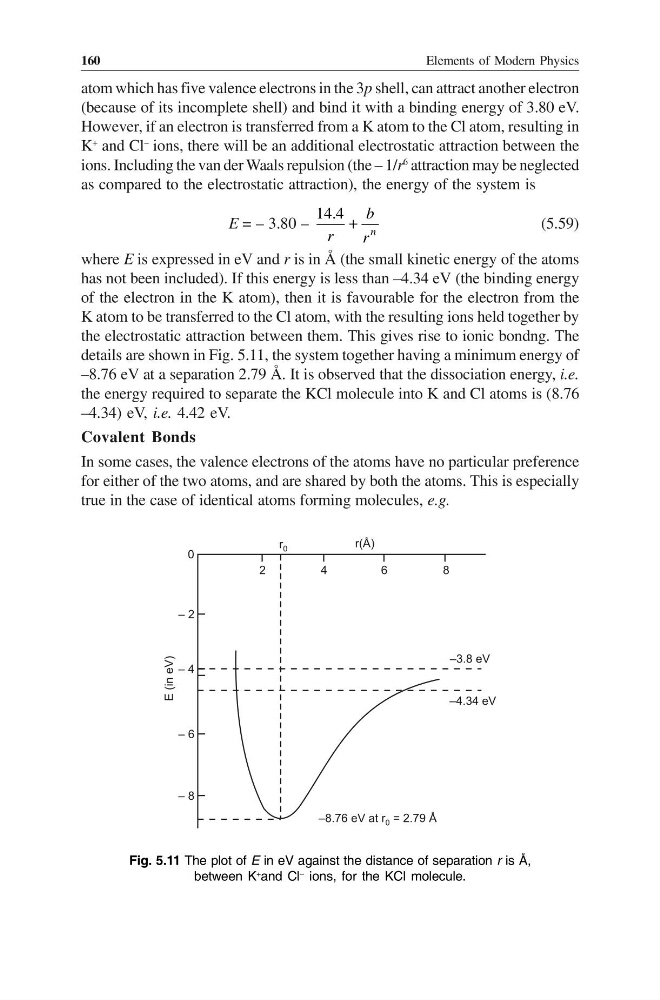
details are shown in Fig. 5.11, the system together having a minimum energy of
–8.76 eV at a separation 2.79 Å. It is observed that the dissociation energy, i.e.
the energy required to separate the KCl molecule into K and Cl atoms is (8.76
–4.34) eV, i.e. 4.42 eV.
Covalent Bonds
In some cases, the valence electrons of the atoms have no particular preference
for either of the two atoms, and are shared by both the atoms. This is especially
true in the case of identical atoms forming molecules, e.g.
2
4
6
8
r 0
r(Å)
0
– 2
– 4
– 6
– 8
E (in eV)
–3.8 eV
–4.34 eV
–8.76 eV at r = 2.79 Å
0
Fig. 5.11 The plot of E in eV against the distance of separation r is Å,
between K
+
and Cl
–
ions, for the KCl molecule.
160
atom which has five valence electrons in the 3p shell, can attract another electron
(because of its incomplete shell) and bind it with a binding energy of 3.80 eV.
However, if an electron is transferred from a K atom to the Cl atom, resulting in
K
+
and Cl
–
ions, there will be an additional electrostatic attraction between the
ions. Including the van der Waals repulsion (the – 1/r
6
attraction may be neglected
as compared to the electrostatic attraction), the energy of the system is
E = – 3.80 –
14.4
n
b
r
r
+
(5.59)
where E is expressed in eV and r is in Å (the small kinetic energy of the atoms
has not been included). If this energy is less than –4.34 eV (the binding energy
of the electron in the K atom), then it is favourable for the electron from the
K atom to be transferred to the Cl atom, with the resulting ions held together by
the electrostatic attraction between them. This gives rise to ionic bondng. The
details are shown in Fig. 5.11, the system together having a minimum energy of
–8.76 eV at a separation 2.79 Å. It is observed that the dissociation energy, i.e.
the energy required to separate the KCl molecule into K and Cl atoms is (8.76
–4.34) eV, i.e. 4.42 eV.
Covalent Bonds
In some cases, the valence electrons of the atoms have no particular preference
for either of the two atoms, and are shared by both the atoms. This is especially
true in the case of identical atoms forming molecules, e.g.
2
4
6
8
r 0
r(Å)
0
– 2
– 4
– 6
– 8
E (in eV)
–3.8 eV
–4.34 eV
–8.76 eV at r = 2.79 Å
0
Fig. 5.11 The plot of E in eV against the distance of separation r is Å,
between K
+
and Cl
–
ions, for the KCl molecule.