

Atoms and Molecules
157
where dI is the reduction in intensity while passing through a thickness dx of a
material of density ρ, I is the intensity of x-rays of frequecy v, and µ is the
frequency-dependent mass absorption coefficient. The relation can be
integrated to give
I(x) = I 0 e
–µρx
(5.54)
where I 0 is the intensity of the incident radiation. The absorption characteristics
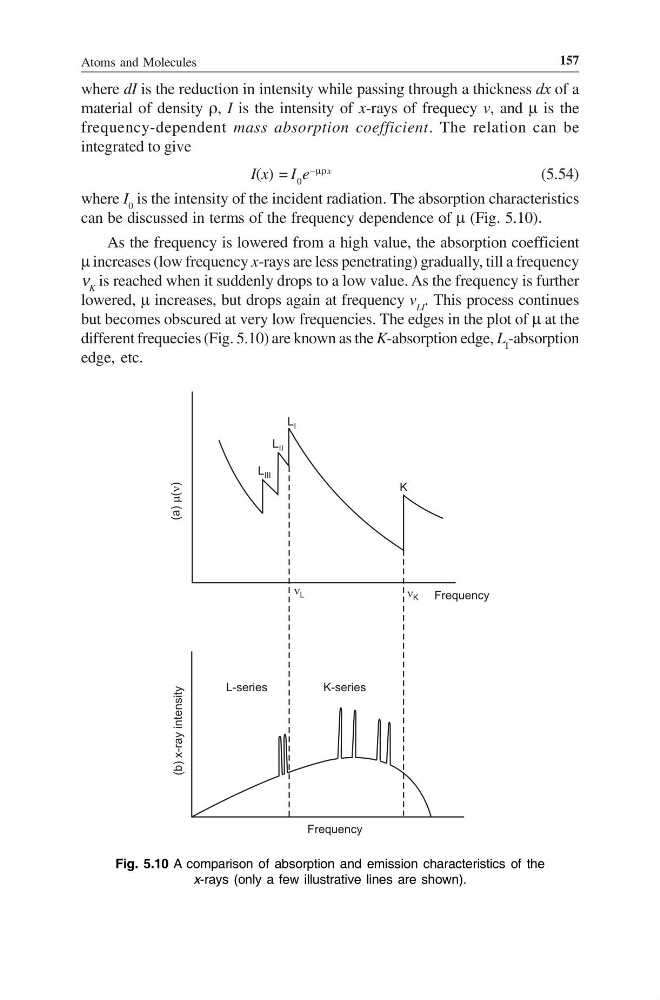
can be discussed in terms of the frequency dependence of µ (Fig. 5.10).
As the frequency is lowered from a high value, the absorption coefficient
µ increases (low frequency x-rays are less penetrating) gradually, till a frequency
ν K is reached when it suddenly drops to a low value. As the frequency is further
lowered, µ increases, but drops again at frequency v LI . This process continues
but becomes obscured at very low frequencies. The edges in the plot of µ at the
different frequecies (Fig. 5.10) are known as the K-absorption edge, L I -absorption
edge, etc.
L I
L II
L III
K
(a) ( )
m n
n L
n K Frequency
Frequency
L-series
K-series
(b) x-ray intensity
Fig. 5.10 A comparison of absorption and emission characteristics of the
x-rays (only a few illustrative lines are shown).
157
where dI is the reduction in intensity while passing through a thickness dx of a
material of density ρ, I is the intensity of x-rays of frequecy v, and µ is the
frequency-dependent mass absorption coefficient. The relation can be
integrated to give
I(x) = I 0 e
–µρx
(5.54)
where I 0 is the intensity of the incident radiation. The absorption characteristics
can be discussed in terms of the frequency dependence of µ (Fig. 5.10).
As the frequency is lowered from a high value, the absorption coefficient
µ increases (low frequency x-rays are less penetrating) gradually, till a frequency
ν K is reached when it suddenly drops to a low value. As the frequency is further
lowered, µ increases, but drops again at frequency v LI . This process continues
but becomes obscured at very low frequencies. The edges in the plot of µ at the
different frequecies (Fig. 5.10) are known as the K-absorption edge, L I -absorption
edge, etc.
L I
L II
L III
K
(a) ( )
m n
n L
n K Frequency
Frequency
L-series
K-series
(b) x-ray intensity
Fig. 5.10 A comparison of absorption and emission characteristics of the
x-rays (only a few illustrative lines are shown).