

Atoms and Molecules
143
given shell then reduces to the problem of determining the different possible
total angular momentum states for a given shel configuration. In this context, it
is noted that the total angular momentum of an assembly of electrons forming a
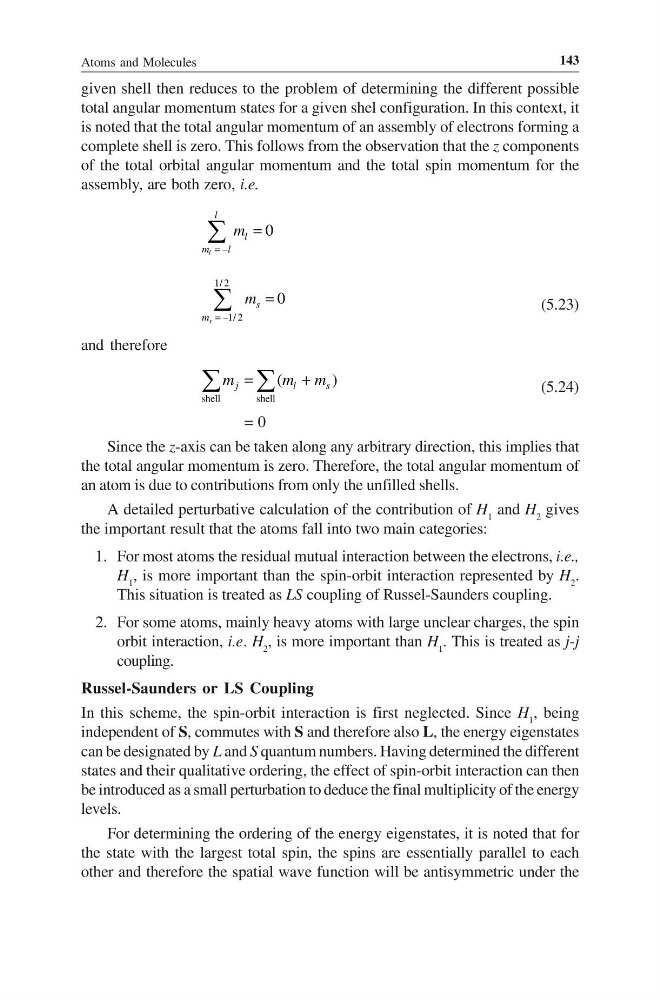
complete shell is zero. This follows from the observation that the z components
of the total orbital angular momentum and the total spin momentum for the
assembly, are both zero, i.e.
–
0
l
l
l
m
l
m
=
=
∑
1/ 2
–1/ 2
0
s
s
m
m
=
=
∑
(5.23)
and therefore
shell
shell
(
)
=
+
∑ ∑
j
l
s
m
m m
(5.24)
= 0
Since the z-axis can be taken along any arbitrary direction, this implies that
the total angular momentum is zero. Therefore, the total angular momentum of
an atom is due to contributions from only the unfilled shells.
A detailed perturbative calculation of the contribution of H 1 and H 2 gives
the important result that the atoms fall into two main categories:
1. For most atoms the residual mutual interaction between the electrons, i.e.,
H 1 , is more important than the spin-orbit interaction represented by H 2 .
This situation is treated as LS coupling of Russel-Saunders coupling.
2. For some atoms, mainly heavy atoms with large unclear charges, the spin
orbit interaction, i.e. H 2 , is more important than H 1 . This is treated as j-j
coupling.
Russel-Saunders or LS Coupling
In this scheme, the spin-orbit interaction is first neglected. Since H 1 , being
independent of S, commutes with S and therefore also L, the energy eigenstates
can be designated by L and S quantum numbers. Having determined the different
states and their qualitative ordering, the effect of spin-orbit interaction can then
be introduced as a small perturbation to deduce the final multiplicity of the energy
levels.
For determining the ordering of the energy eigenstates, it is noted that for
the state with the largest total spin, the spins are essentially parallel to each
other and therefore the spatial wave function will be antisymmetric under the
143
given shell then reduces to the problem of determining the different possible
total angular momentum states for a given shel configuration. In this context, it
is noted that the total angular momentum of an assembly of electrons forming a
complete shell is zero. This follows from the observation that the z components
of the total orbital angular momentum and the total spin momentum for the
assembly, are both zero, i.e.
–
0
l
l
l
m
l
m
=
=
∑
1/ 2
–1/ 2
0
s
s
m
m
=
=
∑
(5.23)
and therefore
shell
shell
(
)
=
+
∑ ∑
j
l
s
m
m m
(5.24)
= 0
Since the z-axis can be taken along any arbitrary direction, this implies that
the total angular momentum is zero. Therefore, the total angular momentum of
an atom is due to contributions from only the unfilled shells.
A detailed perturbative calculation of the contribution of H 1 and H 2 gives
the important result that the atoms fall into two main categories:
1. For most atoms the residual mutual interaction between the electrons, i.e.,
H 1 , is more important than the spin-orbit interaction represented by H 2 .
This situation is treated as LS coupling of Russel-Saunders coupling.
2. For some atoms, mainly heavy atoms with large unclear charges, the spin
orbit interaction, i.e. H 2 , is more important than H 1 . This is treated as j-j
coupling.
Russel-Saunders or LS Coupling
In this scheme, the spin-orbit interaction is first neglected. Since H 1 , being
independent of S, commutes with S and therefore also L, the energy eigenstates
can be designated by L and S quantum numbers. Having determined the different
states and their qualitative ordering, the effect of spin-orbit interaction can then
be introduced as a small perturbation to deduce the final multiplicity of the energy
levels.
For determining the ordering of the energy eigenstates, it is noted that for
the state with the largest total spin, the spins are essentially parallel to each
other and therefore the spatial wave function will be antisymmetric under the