

Atoms and Molecules
133
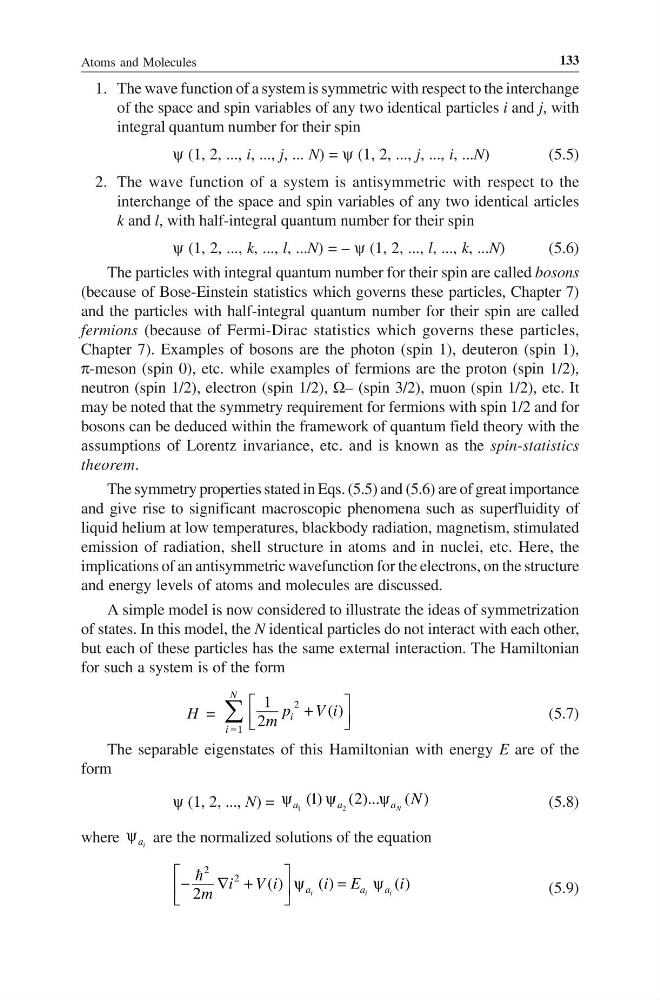
1. The wave function of a system is symmetric with respect to the interchange
of the space and spin variables of any two identical particles i and j, with
integral quantum number for their spin
ψ (1, 2, ..., i, ..., j, ... N) = ψ (1, 2, ..., j, ..., i, ...N)
(5.5)
2. The wave function of a system is antisymmetric with respect to the
interchange of the space and spin variables of any two identical articles
k and l, with half-integral quantum number for their spin
ψ (1, 2, ..., k, ..., l, ...N) = – ψ (1, 2, ..., l, ..., k, ...N)
(5.6)
The particles with integral quantum number for their spin are called bosons
(because of Bose-Einstein statistics which governs these particles, Chapter 7)
and the particles with half-integral quantum number for their spin are called
fermions (because of Fermi-Dirac statistics which governs these particles,
Chapter 7). Examples of bosons are the photon (spin 1), deuteron (spin 1),
π-meson (spin 0), etc. while examples of fermions are the proton (spin 1/2),
neutron (spin 1/2), electron (spin 1/2), Ω– (spin 3/2), muon (spin 1/2), etc. It
may be noted that the symmetry requirement for fermions with spin 1/2 and for
bosons can be deduced within the framework of quantum field theory with the
assumptions of Lorentz invariance, etc. and is known as the spin-statistics
theorem.
The symmetry properties stated in Eqs. (5.5) and (5.6) are of great importance
and give rise to significant macroscopic phenomena such as superfluidity of
liquid helium at low temperatures, blackbody radiation, magnetism, stimulated
emission of radiation, shell structure in atoms and in nuclei, etc. Here, the
implications of an antisymmetric wavefunction for the electrons, on the structure
and energy levels of atoms and molecules are discussed.
A simple model is now considered to illustrate the ideas of symmetrization
of states. In this model, the N identical particles do not interact with each other,
but each of these particles has the same external interaction. The Hamiltonian
for such a system is of the form
H =
2
1
1
( )
2
=
+
∑
N
i
i
p
V i
m
(5.7)
The separable eigenstates of this Hamiltonian with energy E are of the
form
ψ (1, 2, ..., N) = 1
2
(1)
(2)...
( )
N
a
a
a N
ψ
ψ
ψ
(5.8)
where i
a
ψ are the normalized solutions of the equation
2
2
( )
( )
( )
2
i
i
i
a
a
a
i V i
i E
i
m
−
∇ +
ψ
=
ψ
(5.9)
133
1. The wave function of a system is symmetric with respect to the interchange
of the space and spin variables of any two identical particles i and j, with
integral quantum number for their spin
ψ (1, 2, ..., i, ..., j, ... N) = ψ (1, 2, ..., j, ..., i, ...N)
(5.5)
2. The wave function of a system is antisymmetric with respect to the
interchange of the space and spin variables of any two identical articles
k and l, with half-integral quantum number for their spin
ψ (1, 2, ..., k, ..., l, ...N) = – ψ (1, 2, ..., l, ..., k, ...N)
(5.6)
The particles with integral quantum number for their spin are called bosons
(because of Bose-Einstein statistics which governs these particles, Chapter 7)
and the particles with half-integral quantum number for their spin are called
fermions (because of Fermi-Dirac statistics which governs these particles,
Chapter 7). Examples of bosons are the photon (spin 1), deuteron (spin 1),
π-meson (spin 0), etc. while examples of fermions are the proton (spin 1/2),
neutron (spin 1/2), electron (spin 1/2), Ω– (spin 3/2), muon (spin 1/2), etc. It
may be noted that the symmetry requirement for fermions with spin 1/2 and for
bosons can be deduced within the framework of quantum field theory with the
assumptions of Lorentz invariance, etc. and is known as the spin-statistics
theorem.
The symmetry properties stated in Eqs. (5.5) and (5.6) are of great importance
and give rise to significant macroscopic phenomena such as superfluidity of
liquid helium at low temperatures, blackbody radiation, magnetism, stimulated
emission of radiation, shell structure in atoms and in nuclei, etc. Here, the
implications of an antisymmetric wavefunction for the electrons, on the structure
and energy levels of atoms and molecules are discussed.
A simple model is now considered to illustrate the ideas of symmetrization
of states. In this model, the N identical particles do not interact with each other,
but each of these particles has the same external interaction. The Hamiltonian
for such a system is of the form
H =
2
1
1
( )
2
=
+
∑
N
i
i
p
V i
m
(5.7)
The separable eigenstates of this Hamiltonian with energy E are of the
form
ψ (1, 2, ..., N) = 1
2
(1)
(2)...
( )
N
a
a
a N
ψ
ψ
ψ
(5.8)
where i
a
ψ are the normalized solutions of the equation
2
2
( )
( )
( )
2
i
i
i
a
a
a
i V i
i E
i
m
−
∇ +
ψ
=
ψ
(5.9)