

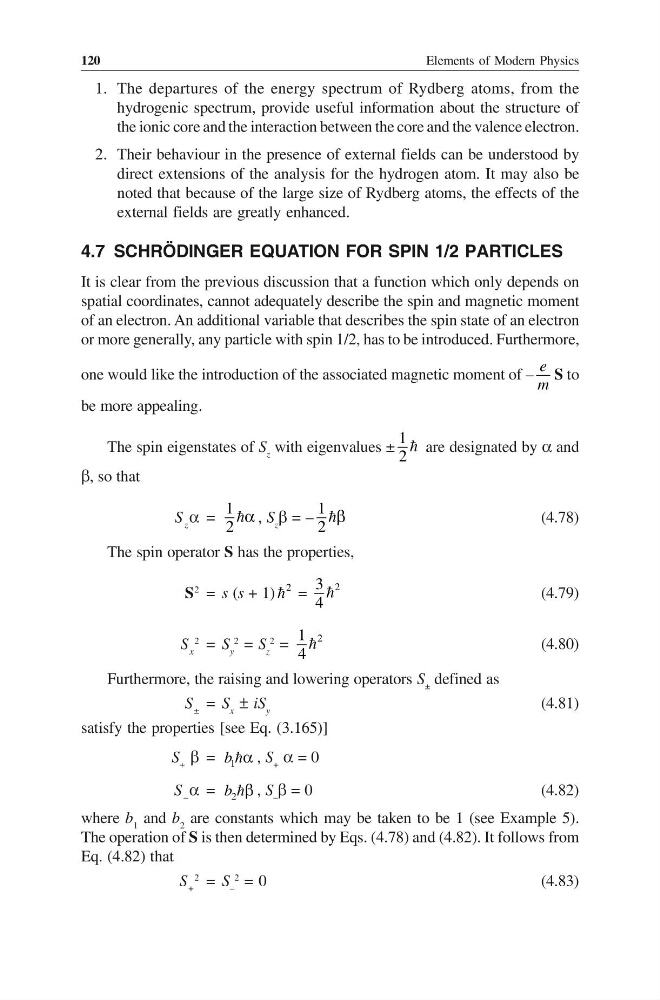
Elements of Modern Physics
120
1. The departures of the energy spectrum of Rydberg atoms, from the
hydrogenic spectrum, provide useful information about the structure of
the ionic core and the interaction between the core and the valence electron.
2. Their behaviour in the presence of external fields can be understood by
direct extensions of the analysis for the hydrogen atom. It may also be
noted that because of the large size of Rydberg atoms, the effects of the
external fields are greatly enhanced.
4.7 SCHRÖDINGER EQUATION FOR SPIN 1/2 PARTICLES
It is clear from the previous discussion that a function which only depends on
spatial coordinates, cannot adequately describe the spin and magnetic moment
of an electron. An additional variable that describes the spin state of an electron
or more generally, any particle with spin 1/2, has to be introduced. Furthermore,
one would like the introduction of the associated magnetic moment of –
e
m
S to
be more appealing.
The spin eigenstates of S z with eigenvalues ±
1
2
are designated by α and
β, so that
S z α =
1
2
α
, S z β = –
1
2
β
(4.78)
The spin operator S has the properties,
S
2
= s (s + 1)
2
=
2
3
4
(4.79)
S x
2
= S y
2
= S z
2
=
2
1
4
(4.80)
Furthermore, the raising and lowering operators S ± defined as
S ± = S x ± iS y
(4.81)
satisfy the properties [see Eq. (3.165)]
S + β = 1
b α
, S + α = 0
S – α = 2
b β
, S – β = 0
(4.82)
where b 1 and b 2 are constants which may be taken to be 1 (see Example 5).
The operation of S is then determined by Eqs. (4.78) and (4.82). It follows from
Eq. (4.82) that
S +
2
= S –
2
= 0
(4.83)
120
1. The departures of the energy spectrum of Rydberg atoms, from the
hydrogenic spectrum, provide useful information about the structure of
the ionic core and the interaction between the core and the valence electron.
2. Their behaviour in the presence of external fields can be understood by
direct extensions of the analysis for the hydrogen atom. It may also be
noted that because of the large size of Rydberg atoms, the effects of the
external fields are greatly enhanced.
4.7 SCHRÖDINGER EQUATION FOR SPIN 1/2 PARTICLES
It is clear from the previous discussion that a function which only depends on
spatial coordinates, cannot adequately describe the spin and magnetic moment
of an electron. An additional variable that describes the spin state of an electron
or more generally, any particle with spin 1/2, has to be introduced. Furthermore,
one would like the introduction of the associated magnetic moment of –
e
m
S to
be more appealing.
The spin eigenstates of S z with eigenvalues ±
1
2
are designated by α and
β, so that
S z α =
1
2
α
, S z β = –
1
2
β
(4.78)
The spin operator S has the properties,
S
2
= s (s + 1)
2
=
2
3
4
(4.79)
S x
2
= S y
2
= S z
2
=
2
1
4
(4.80)
Furthermore, the raising and lowering operators S ± defined as
S ± = S x ± iS y
(4.81)
satisfy the properties [see Eq. (3.165)]
S + β = 1
b α
, S + α = 0
S – α = 2
b β
, S – β = 0
(4.82)
where b 1 and b 2 are constants which may be taken to be 1 (see Example 5).
The operation of S is then determined by Eqs. (4.78) and (4.82). It follows from
Eq. (4.82) that
S +
2
= S –
2
= 0
(4.83)