

The One-Electron Atom
117
=
2
2
2
0
2
( )| (0) |
3
ψ
ε e p
ge
m m c
I.S
(4.75)
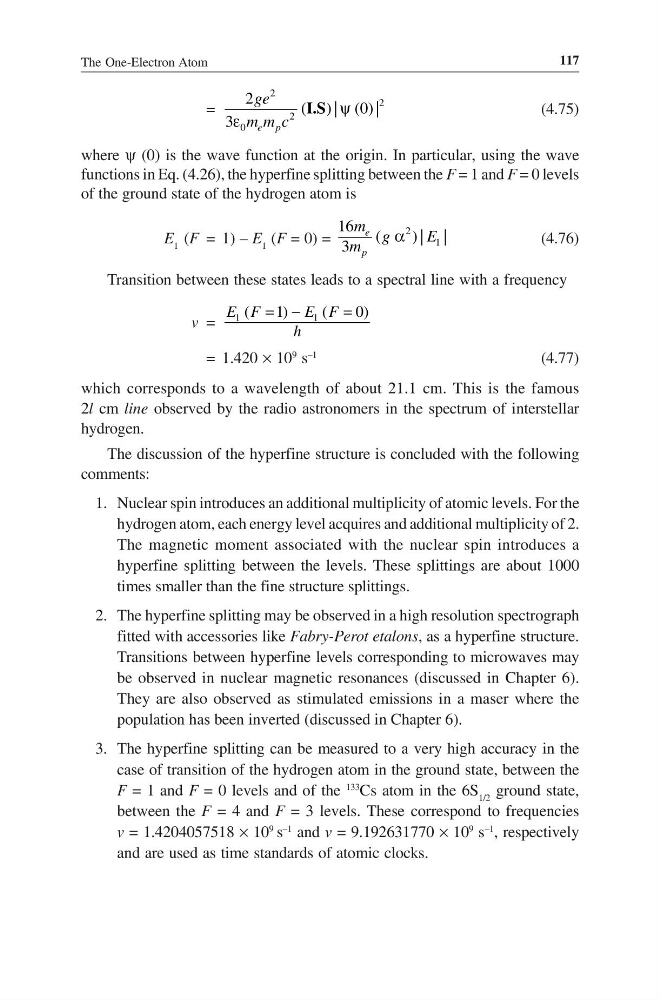
where ψ (0) is the wave function at the origin. In particular, using the wave
functions in Eq. (4.26), the hyperfine splitting between the F = 1 and F = 0 levels
of the ground state of the hydrogen atom is
E 1 (F = 1) – E 1 (F = 0) =
2
1
16 (
)| |
3
e
p
m g
E
m
α
(4.76)
Transition between these states leads to a spectral line with a frequency
v =
1
1
(
1)
(
0)
E F
E F
h
= −
=
= 1.420 × 10
9
s
–1
(4.77)
which corresponds to a wavelength of about 21.1 cm. This is the famous
2l cm line observed by the radio astronomers in the spectrum of interstellar
hydrogen.
The discussion of the hyperfine structure is concluded with the following
comments:
1. Nuclear spin introduces an additional multiplicity of atomic levels. For the
hydrogen atom, each energy level acquires and additional multiplicity of 2.
The magnetic moment associated with the nuclear spin introduces a
hyperfine splitting between the levels. These splittings are about 1000
times smaller than the fine structure splittings.
2. The hyperfine splitting may be observed in a high resolution spectrograph
fitted with accessories like Fabry-Perot etalons, as a hyperfine structure.
Transitions between hyperfine levels corresponding to microwaves may
be observed in nuclear magnetic resonances (discussed in Chapter 6).
They are also observed as stimulated emissions in a maser where the
population has been inverted (discussed in Chapter 6).
3. The hyperfine splitting can be measured to a very high accuracy in the
case of transition of the hydrogen atom in the ground state, between the
F = 1 and F = 0 levels and of the
133
Cs atom in the 6S 1/2 ground state,
between the F = 4 and F = 3 levels. These correspond to frequencies
v = 1.4204057518 × 10
9
s
–1
and v = 9.192631770 × 10
9
s
–1
, respectively
and are used as time standards of atomic clocks.
117
=
2
2
2
0
2
( )| (0) |
3
ψ
ε e p
ge
m m c
I.S
(4.75)
where ψ (0) is the wave function at the origin. In particular, using the wave
functions in Eq. (4.26), the hyperfine splitting between the F = 1 and F = 0 levels
of the ground state of the hydrogen atom is
E 1 (F = 1) – E 1 (F = 0) =
2
1
16 (
)| |
3
e
p
m g
E
m
α
(4.76)
Transition between these states leads to a spectral line with a frequency
v =
1
1
(
1)
(
0)
E F
E F
h
= −
=
= 1.420 × 10
9
s
–1
(4.77)
which corresponds to a wavelength of about 21.1 cm. This is the famous
2l cm line observed by the radio astronomers in the spectrum of interstellar
hydrogen.
The discussion of the hyperfine structure is concluded with the following
comments:
1. Nuclear spin introduces an additional multiplicity of atomic levels. For the
hydrogen atom, each energy level acquires and additional multiplicity of 2.
The magnetic moment associated with the nuclear spin introduces a
hyperfine splitting between the levels. These splittings are about 1000
times smaller than the fine structure splittings.
2. The hyperfine splitting may be observed in a high resolution spectrograph
fitted with accessories like Fabry-Perot etalons, as a hyperfine structure.
Transitions between hyperfine levels corresponding to microwaves may
be observed in nuclear magnetic resonances (discussed in Chapter 6).
They are also observed as stimulated emissions in a maser where the
population has been inverted (discussed in Chapter 6).
3. The hyperfine splitting can be measured to a very high accuracy in the
case of transition of the hydrogen atom in the ground state, between the
F = 1 and F = 0 levels and of the
133
Cs atom in the 6S 1/2 ground state,
between the F = 4 and F = 3 levels. These correspond to frequencies
v = 1.4204057518 × 10
9
s
–1
and v = 9.192631770 × 10
9
s
–1
, respectively
and are used as time standards of atomic clocks.