

The One-Electron Atom
115
4.5 HYPERFINE STRUCTURE
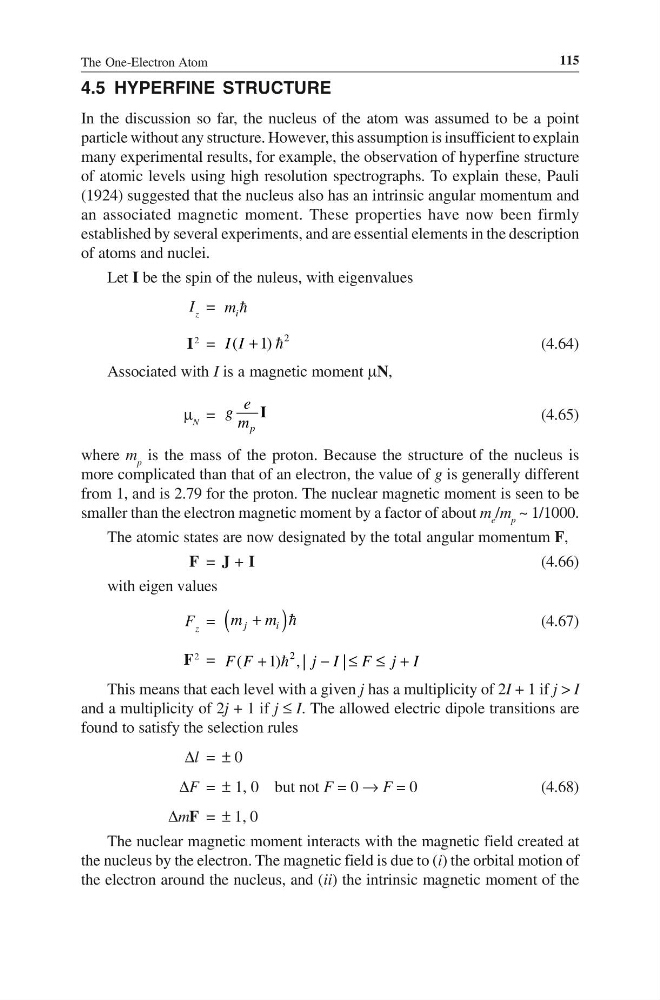
In the discussion so far, the nucleus of the atom was assumed to be a point
particle without any structure. However, this assumption is insufficient to explain
many experimental results, for example, the observation of hyperfine structure
of atomic levels using high resolution spectrographs. To explain these, Pauli
(1924) suggested that the nucleus also has an intrinsic angular momentum and
an associated magnetic moment. These properties have now been firmly
established by several experiments, and are essential elements in the description
of atoms and nuclei.
Let I be the spin of the nuleus, with eigenvalues
I z = i
m
I
2
=
2
( 1)
I I +
(4.64)
Associated with I is a magnetic moment µN,
µ N =
p
e
g m
I
(4.65)
where m p is the mass of the proton. Because the structure of the nucleus is
more complicated than that of an electron, the value of g is generally different
from 1, and is 2.79 for the proton. The nuclear magnetic moment is seen to be
smaller than the electron magnetic moment by a factor of about m e /m p ~ 1/1000.
The atomic states are now designated by the total angular momentum F,
F = J + I
(4.66)
with eigen values
F z = (
)
j
i
m m
+
(4.67)
F
2
=
2
(
1) ,|
|
F F
j I F j I
+
− ≤ ≤ +
This means that each level with a given j has a multiplicity of 2I + 1 if j > I
and a multiplicity of 2j + 1 if j ≤ I. The allowed electric dipole transitions are
found to satisfy the selection rules
∆l = ± 0
∆F = ± 1, 0 but not F = 0 → F = 0
(4.68)
∆mF = ± 1, 0
The nuclear magnetic moment interacts with the magnetic field created at
the nucleus by the electron. The magnetic field is due to (i) the orbital motion of
the electron around the nucleus, and (ii) the intrinsic magnetic moment of the
115
4.5 HYPERFINE STRUCTURE
In the discussion so far, the nucleus of the atom was assumed to be a point
particle without any structure. However, this assumption is insufficient to explain
many experimental results, for example, the observation of hyperfine structure
of atomic levels using high resolution spectrographs. To explain these, Pauli
(1924) suggested that the nucleus also has an intrinsic angular momentum and
an associated magnetic moment. These properties have now been firmly
established by several experiments, and are essential elements in the description
of atoms and nuclei.
Let I be the spin of the nuleus, with eigenvalues
I z = i
m
I
2
=
2
( 1)
I I +
(4.64)
Associated with I is a magnetic moment µN,
µ N =
p
e
g m
I
(4.65)
where m p is the mass of the proton. Because the structure of the nucleus is
more complicated than that of an electron, the value of g is generally different
from 1, and is 2.79 for the proton. The nuclear magnetic moment is seen to be
smaller than the electron magnetic moment by a factor of about m e /m p ~ 1/1000.
The atomic states are now designated by the total angular momentum F,
F = J + I
(4.66)
with eigen values
F z = (
)
j
i
m m
+
(4.67)
F
2
=
2
(
1) ,|
|
F F
j I F j I
+
− ≤ ≤ +
This means that each level with a given j has a multiplicity of 2I + 1 if j > I
and a multiplicity of 2j + 1 if j ≤ I. The allowed electric dipole transitions are
found to satisfy the selection rules
∆l = ± 0
∆F = ± 1, 0 but not F = 0 → F = 0
(4.68)
∆mF = ± 1, 0
The nuclear magnetic moment interacts with the magnetic field created at
the nucleus by the electron. The magnetic field is due to (i) the orbital motion of
the electron around the nucleus, and (ii) the intrinsic magnetic moment of the