

Elements of Modern Physics
106
quantum number m which determines the z-component of the angular momentum.
However, the energy E n depends on only the principal quantum number n. This
is a special property of the attractive 1/r potential. Thus, there is the accidental
degeneracy that there are several states with different l values but the same
value of n, which have the same energy. It then follows that since for a given l,
there are 2l + 1 states with m = 0, ± 1, ..., ± l, and for a given n there are n states
with l = 0, 1, ..., n – 1 all of which have the same energy, the degeneracy of the
states with energy E n is
1
0
(2 1)
n
l
l
−
=
+
∑
= n
2
(4.27)
Actually, the l-degeneracy gets multiplied by another factor of 2 due to the
fact that the electron has an intrinsic angular momentum called spin (this is
discussed later) which allows it to be in two independent spin states with the
same energy.
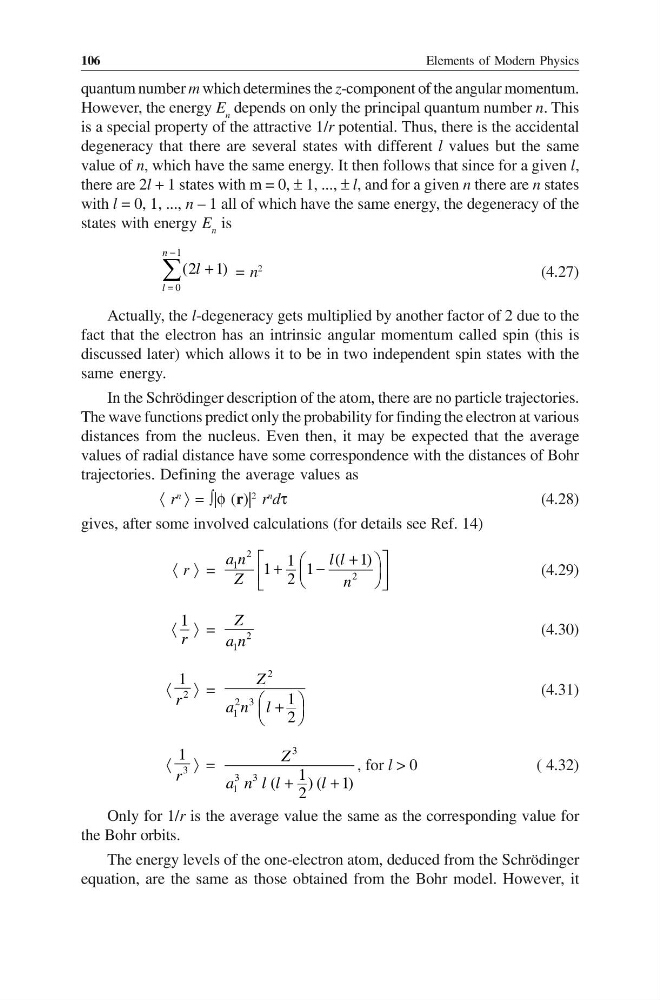
In the Schrödinger description of the atom, there are no particle trajectories.
The wave functions predict only the probability for finding the electron at various
distances from the nucleus. Even then, it may be expected that the average
values of radial distance have some correspondence with the distances of Bohr
trajectories. Defining the average values as
〈 r
n
〉 = ∫|φ (r)|
2
r
n
dτ
(4.28)
gives, after some involved calculations (for details see Ref. 14)
〈 r 〉 =
2
1
2
( 1)
1
1
1
2
a n
l l
Z
n
+
+
−
(4.29)
〈
1
r
〉 =
2
1
Z
a n
(4.30)
〈 2
1
r
〉 =
2
2 3
1
1
2
Z
a n l
+
(4.31)
〈 3
1
r
〉 =
3
3 3
1
1
(
)( 1)
2
Z
a n l l
l
+
+
, for l > 0
( 4.32)
Only for 1/r is the average value the same as the corresponding value for
the Bohr orbits.
The energy levels of the one-electron atom, deduced from the Schrödinger
equation, are the same as those obtained from the Bohr model. However, it
106
quantum number m which determines the z-component of the angular momentum.
However, the energy E n depends on only the principal quantum number n. This
is a special property of the attractive 1/r potential. Thus, there is the accidental
degeneracy that there are several states with different l values but the same
value of n, which have the same energy. It then follows that since for a given l,
there are 2l + 1 states with m = 0, ± 1, ..., ± l, and for a given n there are n states
with l = 0, 1, ..., n – 1 all of which have the same energy, the degeneracy of the
states with energy E n is
1
0
(2 1)
n
l
l
−
=
+
∑
= n
2
(4.27)
Actually, the l-degeneracy gets multiplied by another factor of 2 due to the
fact that the electron has an intrinsic angular momentum called spin (this is
discussed later) which allows it to be in two independent spin states with the
same energy.
In the Schrödinger description of the atom, there are no particle trajectories.
The wave functions predict only the probability for finding the electron at various
distances from the nucleus. Even then, it may be expected that the average
values of radial distance have some correspondence with the distances of Bohr
trajectories. Defining the average values as
〈 r
n
〉 = ∫|φ (r)|
2
r
n
dτ
(4.28)
gives, after some involved calculations (for details see Ref. 14)
〈 r 〉 =
2
1
2
( 1)
1
1
1
2
a n
l l
Z
n
+
+
−
(4.29)
〈
1
r
〉 =
2
1
Z
a n
(4.30)
〈 2
1
r
〉 =
2
2 3
1
1
2
Z
a n l
+
(4.31)
〈 3
1
r
〉 =
3
3 3
1
1
(
)( 1)
2
Z
a n l l
l
+
+
, for l > 0
( 4.32)
Only for 1/r is the average value the same as the corresponding value for
the Bohr orbits.
The energy levels of the one-electron atom, deduced from the Schrödinger
equation, are the same as those obtained from the Bohr model. However, it