

Elements of Quantum Theory
97
Example 4
Bohr’s correspondence principle states that a quantum system tends (in a
particular sense) to its classical analogue, for large quantum numbers. This
is demonstrated for a particle in a box.
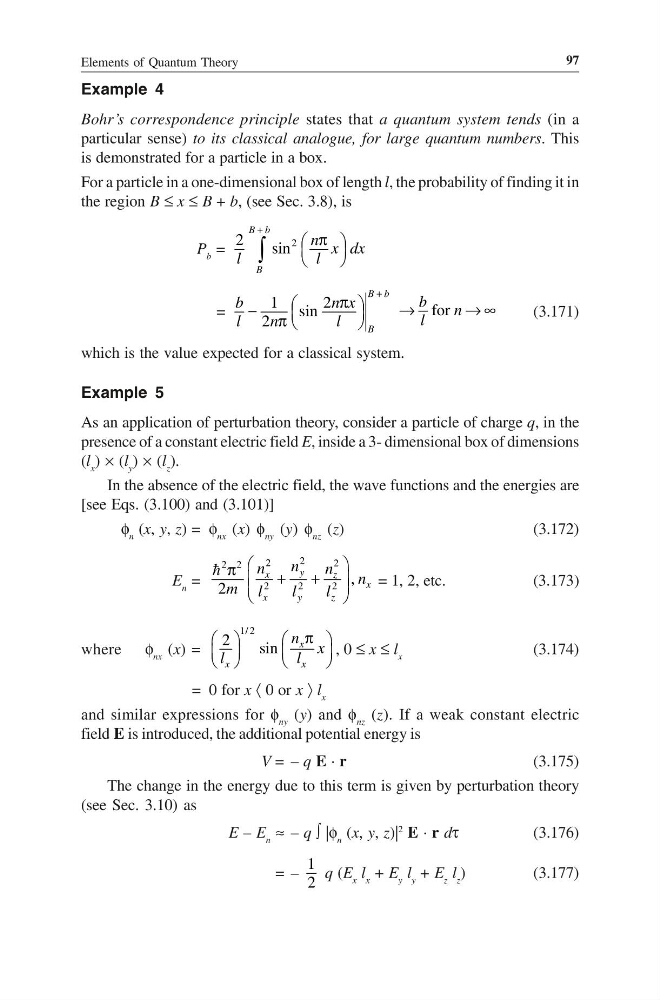
For a particle in a one-dimensional box of length l, the probability of finding it in
the region B ≤ x ≤ B + b, (see Sec. 3.8), is
P b =
2
2
sin
B b
B
n x dx
l
l
+
π
∫
=
1
2
sin
2
B b
B
b
nx
l
n
l
+
π
−
π
for
b
n
l
→
→∞
(3.171)
which is the value expected for a classical system.
Example 5
As an application of perturbation theory, consider a particle of charge q, in the
presence of a constant electric field E, inside a 3- dimensional box of dimensions
(l x ) × (l y ) × (l z ).
In the absence of the electric field, the wave functions and the energies are
[see Eqs. (3.100) and (3.101)]
φ n (x, y, z) = φ nx (x) φ ny (y) φ nz (z)
(3.172)
E n =
2
2
2
2 2
2
2
2
,
2
y
x
z
x
x
y
z
n
n
n
n
m l
l
l
π
+
+
= 1, 2, etc.
(3.173)
where φ nx (x) =
1/ 2
2
sin
x
x
x
n x
l
l
π
, 0 ≤ x ≤ l x
(3.174)
= 0 for x 〈 0 or x 〉 l x
and similar expressions for φ ny (y) and φ nz (z). If a weak constant electric
field E is introduced, the additional potential energy is
V = – q E ⋅ r
(3.175)
The change in the energy due to this term is given by perturbation theory
(see Sec. 3.10) as
E – E n ≈ – q ∫ |φ n (x, y, z)|
2
E ⋅ r dτ
(3.176)
= –
1
2
q (E x l x + E y l y + E z l z )
(3.177)
97
Example 4
Bohr’s correspondence principle states that a quantum system tends (in a
particular sense) to its classical analogue, for large quantum numbers. This
is demonstrated for a particle in a box.
For a particle in a one-dimensional box of length l, the probability of finding it in
the region B ≤ x ≤ B + b, (see Sec. 3.8), is
P b =
2
2
sin
B b
B
n x dx
l
l
+
π
∫
=
1
2
sin
2
B b
B
b
nx
l
n
l
+
π
−
π
for
b
n
l
→
→∞
(3.171)
which is the value expected for a classical system.
Example 5
As an application of perturbation theory, consider a particle of charge q, in the
presence of a constant electric field E, inside a 3- dimensional box of dimensions
(l x ) × (l y ) × (l z ).
In the absence of the electric field, the wave functions and the energies are
[see Eqs. (3.100) and (3.101)]
φ n (x, y, z) = φ nx (x) φ ny (y) φ nz (z)
(3.172)
E n =
2
2
2
2 2
2
2
2
,
2
y
x
z
x
x
y
z
n
n
n
n
m l
l
l
π
+
+
= 1, 2, etc.
(3.173)
where φ nx (x) =
1/ 2
2
sin
x
x
x
n x
l
l
π
, 0 ≤ x ≤ l x
(3.174)
= 0 for x 〈 0 or x 〉 l x
and similar expressions for φ ny (y) and φ nz (z). If a weak constant electric
field E is introduced, the additional potential energy is
V = – q E ⋅ r
(3.175)
The change in the energy due to this term is given by perturbation theory
(see Sec. 3.10) as
E – E n ≈ – q ∫ |φ n (x, y, z)|
2
E ⋅ r dτ
(3.176)
= –
1
2
q (E x l x + E y l y + E z l z )
(3.177)